Rotary Hoe Questions

nh8260

Member
I have several fields that have pipe clay in them or just plain ol red clay so after a good rain or maybe two the top of the ground has a crust over it which makes it hard for seeds to come up through it, so a fellow farmer said i needed a rotary hoe to help break up the crust. I've never used one just saw pictures of them, my question is...won't the spikes go down where my seeds are and flip them out of the ground?

Also what is a good brand to look at? Any to stay away from?
 
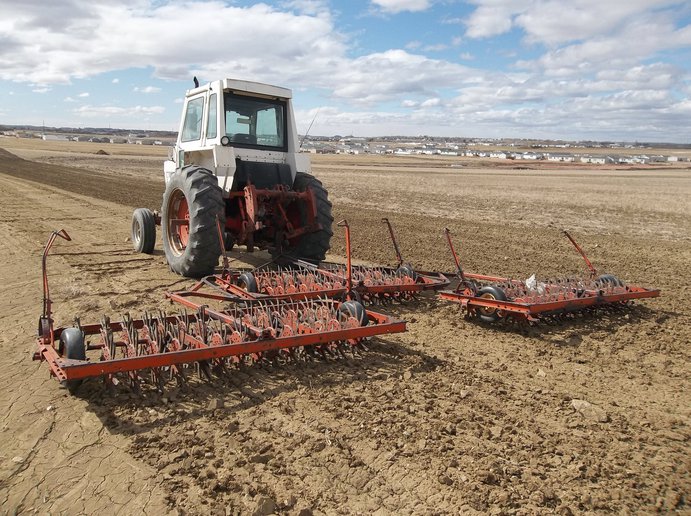
I wouldn't think so. Rotary hoes were used before the advent of herbicides to cultivate small grains in the early stages of growth. As for good/bad brands, not sure. I use an old McCormick #8 with the cast iron tines. Really like it. Used it to crumble up clods between using the springtooth & packer, pulled it behind the packer before broadcast seeding, weeding my oats & aerating my hay field & lawn. Works good.

Mike
 
It totally defies common sense how those things work. You'd think they had some kind of computerized infrared system to know the difference between weeds and crops. LOL

I was just laying in bed thinking about it this morning. It's so darned cold here, I hate to put any corn in the ground for fear that it'll just lay there and the ground will crust over, and the corn will gooseneck underground and won't come up. My uncle and cousin used to raise about 1000 acres of edible beans every year. I remember one spring when we had a big rain and the ground crusted over so the beans wouldn't come up. They ran over all of that with a rotary hoe to break the crust. I bought one and used it in the corn one spring when it did the same thing.

The guy who told you to use one had it right. As far as brand, I don't know that it matters much.
 

Soybeans will sometimes curl over at the top as they try to push their way through the soil, and if the soybeans are in that stage of growth, then yes, the rotary hoe will just pluck them right out of the ground. Once the beans are all through the soil, then the rotary hoe can safely be used. Corn does not develop that curl, or hook, so the hoe can be used just about anytime without damaging the crop. Corn and beans are all that I am familiar with. Don't know about using the rotary hoe on any other crops.
 
I always felt the same about a spiketooth drag. My father in law would pull one over the corn after the seedlings were up two or three inches as I recall. Never understood how it got the weeds without ripping out the corn.
 
Those old weeders were the same way. I don't know how you could pull those tines through a crop without taking it all out of the ground. I remember Dad used to pull a spring tooth drag through the potatoes before they were very far out of the ground. Amazing that they'd keep right on growing.
 
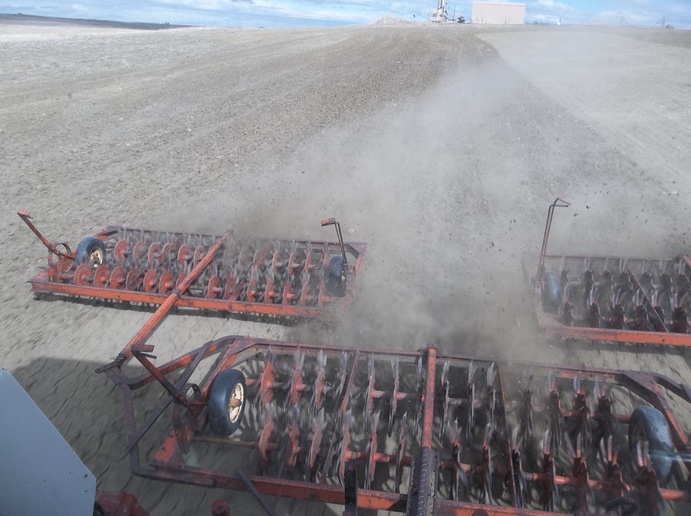
I have to use one every 8 to 10 years if i get the conditions to crust,, at least my style of them will not pull out deep rooted/planted crops,, here I was running overa winter wheat field, as long as it is breakingt he curst yu can drive as fast as you want or can stay in the seat I was running 10-12 mph here, as you can see in some places I had to hit it a couple times it was crusted so bad that year
cvphoto4230.jpg


cvphoto4232.jpg
 
Spike tooth harrows were used before people were getting the rotary hoes. And you need a tooth on the how with a good curl in it to break up crusth. If that curl is gone then the hoe is wore out and will not do the job. I liked the angle iron type of tooth better than the JD or IHC type of tooth because it would penetrate the crust better on my ground. Most of the older hoes the spoon with the curl at end of tooth is wore away and hoe is junk. There used to be a company that made new spoons to weld on JD hoes to repair that wore out tooth. Never saw one of them, thought about redoing ours with them but cost was prohibitive and then did not have ability to weld them to the wore out tooth. Different hoe was cheaper. And I never saw a tooth pull out a soybean like that. The old Roderick-Lean how was already wore out by time I first remenber seeing it in about 57 but I did not realize it and we kept trying to use it for years and when got rid of it the teeth were wore out to an inch from orignal 5" long. This is from the hub that held them in place, total length would have been a lot longer on the tooth.
 
Yetter or Deere are the brands that do the most good--the rest of them have gangs of wheels that just ride on the ridges where Deere and Yetter have walking wheels that follow the contour of the ground better. If you are just breaking the crust it does not matter how much the spoons are wore but if you are after weeds it is said the spoons should be no narrower than a dime--you will loose you hooking effect if they are.---Tee
cvphoto4245.jpg

Yetter
cvphoto4246.jpg

Deere
 
We never had a rotary hoe, used the spike tooth harrow.

Find one with good spoons, won?t matter for crusting, but might as well get one with good weed action as well, full spoons.

Paul
 
Good spons do mater with crusting. Without them it is just an areator and will not break the crust. Got rid of JD because was no good on crust and went to Ford.
 
I have run both Deere and IH and both worked well. Depending on where the crop is in the growing cycle, speed and down pressure are the keys to making it effective. I always ran a mounted, so you could apply pressure with your top linkage and that would get it to penetrate. You have to get out and look at what you are doing or you can break little bean necks or throw out the corn. THe primary focus was using it to break crust to get it through and throw out little weeds. I was always amazed that we did not destroy everything.
 

Rotary hoes work in the top inch or less of soil. You plant the seed deeper and the hoe cannot get them. It surely can break off the tops if you run it in taller growing corn, but corn will grow back as long as the growing point is still below the surface. You can do a lot of damage in beans at gooseneck stage. The hoe hooks the emerging bean and pulls it right out. You can use them just before emergence and after the beans are up, but NOT while they emerge.

As far as brands, the old gang models aren t real good at following the lay of the ground. The Deere 400s have two wheels on one arm on walking tandems. They plug up easier. Yetters have a wheel on each arm, but they are still close together, so they plug a little less than the Deere s. Case IH 181mts are much better because the front and back row of wheels are quite a bit further apart and allow trash to clear. M&W and Hiniker also made them.

DO NOT turn with the hoe in the ground. You will bend all the wheels and it is not fun trying to get them straightened
 
Yesterday's Tractor Forums

We sell tractor parts! We have the parts you need to repair your tractor - the right parts. Our low prices and years of research make us your best choice when you need parts. Shop Online Today.

Back
Top