


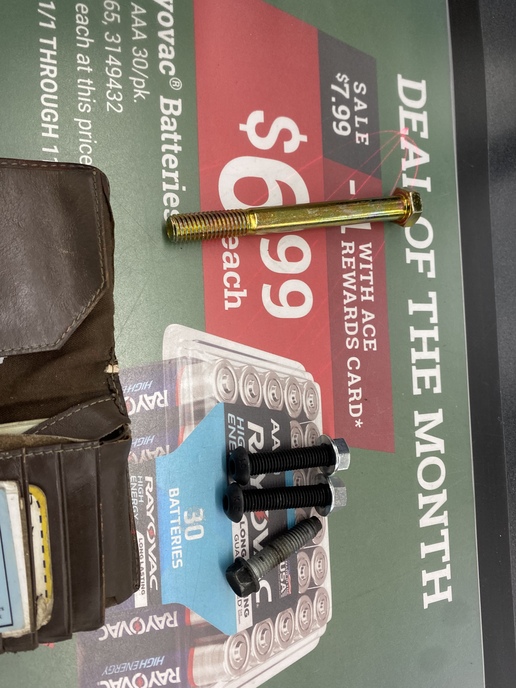
To make a metric bolt than it does a standard size bolt ? Noe Ive never worked at a bolt factory and I only worked 15 hours a day this week so I hope this isnt a slam to bolt makers everywhere. Back to original question why are metric bolts 4 times as much as a standard of English size bolt ?
You are using an out of date browser. It may not display this or other websites correctly.
You should upgrade or use an alternative browser.
You should upgrade or use an alternative browser.
When you make a million of something, the cost of design, set up and production costs are absorbed by all million pieces. When you make 100,000, the cost is higher per unit than the million piece run. Also it has to do with demand. The higher the demand the more inventory turnovers they have per year vs lower demand. Same thing with tires. An odd ball size will always have a higher price than a more common sized tire.
leroy in ne
Well-known Member
- Location
- Sterling, Nebraska
SV, Why is the same size bolt different prices if grade 2, grade 5, grade 8, socket head vs hex head or square head ect.


Bruce from Can.
Well-known Member
- Location
- Woodville, Ontario, Canada
At our Peavy Mart,( formerly TSC ) , the bolts are sold by the lb/kg. And are the same price for metric or Standard thread . Really only two countries in the entire world are not on the metric system, yours is one of them.


MarkB_MI
Well-known Member
- Location
- Motown USA
It depends on what you call a 'standard English size bolt'. AN aircraft bolts are standard and come in English dimensions, but they aren't cheap.
I can assure you that the price you pay for a fastener (or anything else) has little to do with what it costs to manufacture it. Almsot every fastener in a new automobile is metric, but OEMs, who buy thousands at a time, pay only a small fraction of what they charge you for a replacement at the dealership.
I can assure you that the price you pay for a fastener (or anything else) has little to do with what it costs to manufacture it. Almsot every fastener in a new automobile is metric, but OEMs, who buy thousands at a time, pay only a small fraction of what they charge you for a replacement at the dealership.
Traditional Farmer
Well-known Member
- Location
- Virginia
Probably turnover,no one buys metric unless they are forced to.
Russ from MN
Well-known Member
- Location
- Bemidji MN
Like Hendrik said, if you lived anywhere in the rest of the world it would be the other way around!
coonie minnie
Well-known Member
I bought a metric kit last winter, couple thousand peices. Same cost, metric or english.
lee little
Member
Wow !
BillinCentralMO
Well-known Member
Wow Mark. The economy in Michigan must be much different than here. Cost has a lot to do with prices where I come from. But you are saying not just bolts , but anything else , cost is not a factor. That is amazing .
Stephen Newell
Well-known Member
You go into a hardware store and you find bolts in a bin sold by the pound. Then you find the metric bolts in individual bags in drawers. It would have to cost more to do that. Then when I go to my local box store you find drawers of empty bags where people have stolen the bolts. That just adds to the cost.


timcasbolt
Well-known Member
- Location
- Cecil County, MD
t's no different in Michigan than anywhere else. He didn't say cost is not a factor, he said is has little to do with the price. We live in a supply and demand economy. All prices are based on what the market will bear. Surprised you didn't know that.(quoted from post at 08:00:56 11/06/21) Wow Mark. The economy in Michigan must be much different than here. Cost has a lot to do with prices where I come from. But you are saying not just bolts , but anything else , cost is not a factor. That is amazing .
MarkB_MI
Well-known Member
- Location
- Motown USA
> Wow Mark. The economy in Michigan must be much different than here. Cost has a lot to do with prices where I come from. But you are saying not just bolts , but anything else , cost is not a factor. That is amazing .
How much do you think it costs Levi Strauss to make a pair of jeans that retails for 50 bucks? How much does it cost General Mills to make a 4 dollar box of Wheaties? In both cases, it's a few cents on the dollar. Transportation, advertising and markup add much more to the cost.
How much do you think it costs Levi Strauss to make a pair of jeans that retails for 50 bucks? How much does it cost General Mills to make a 4 dollar box of Wheaties? In both cases, it's a few cents on the dollar. Transportation, advertising and markup add much more to the cost.
timcasbolt
Well-known Member
- Location
- Cecil County, MD
ore to the point: how much difference in cost between a pair of jeans that retails for $50 and a pair of jeans that retails for $10? Pennies.(quoted from post at 08:16:40 11/06/21) > Wow Mark. The economy in Michigan must be much different than here. Cost has a lot to do with prices where I come from. But you are saying not just bolts , but anything else , cost is not a factor. That is amazing .
How much do you think it costs Levi Strauss to make a pair of jeans that retails for 50 bucks? How much does it cost General Mills to make a 4 dollar box of Wheaties? In both cases, it's a few cents on the dollar. Transportation, advertising and markup add much more to the cost.
Traditional Farmer
Well-known Member
- Location
- Virginia
Each step from manufacturing a lone doesn't seem like much but it all adds up and all steps figure into the final cost.A tiny increase in initial cost of a product gets magnified at every step.

showcrop
Well-known Member
(quoted from post at 05:13:57 11/06/21)t's no different in Michigan than anywhere else. He didn't say cost is not a factor, he said is has little to do with the price. We live in a supply and demand economy. All prices are based on what the market will bear. Surprised you didn't know that.(quoted from post at 08:00:56 11/06/21) Wow Mark. The economy in Michigan must be much different than here. Cost has a lot to do with prices where I come from. But you are saying not just bolts , but anything else , cost is not a factor. That is amazing .
Tim, I am surprised that you think that you know that, LOL.
MARK ROBKE
Well-known Member
Anywhere that I have bought bolts- it's the same price- cost is by the pound. Where are you getting yours? Mark.
BillinCentralMO
Well-known Member
You are probably correct about blue jeans. It was when you threw in anything else that logic , economics and succinctness got thrown under the bus . You have good day. Buy some new jeans !
1948CaseVAI
Well-known Member
(quoted from post at 07:00:56 11/06/21) Wow Mark. The economy in Michigan must be much different than here. Cost has a lot to do with prices where I come from. But you are saying not just bolts , but anything else , cost is not a factor. That is amazing .
He didn't say cost didn't matter, he said the cost of MANUFACTURING the product doesn' t much matter. And he is right.
OregonAaron
Member
I have noticed that it really depends upon where you buy em. I REALLY needed some M12x125 bolts and the local hardware store wanted over $10 a piece for them. A few years later when I lived near a larger town the fastenel store had them for a couple bucks a piece. Same bolts however the fastenel store deals in alot larger volume and has a network of locations.
redforlife
Well-known Member
Stores probably have to charge more for them because they sell fewer of them. They probably sell way more standard than metric. So they basically have to stock, supply, handle, and carry them to sell em, and in order to make it worth while they have to charge more than standard. Think of it in a shelf space aspect. Stores are probably doubling thier shelf space to even carry metrics. When they sell fewer of them than standard, they have to charge more for tying up the same amount of shelf space as standard.
In an example of selling fewer, just think about someone building a home project from scratch. They are never going to walk into a store and ask for metric. So, in a nut shell, your customers are going to reflect that. Your box full customers are going to want standard. Your metric customers are usually only going to want a very few amount.
In an example of selling fewer, just think about someone building a home project from scratch. They are never going to walk into a store and ask for metric. So, in a nut shell, your customers are going to reflect that. Your box full customers are going to want standard. Your metric customers are usually only going to want a very few amount.
Material, transportation and sales costs should be similar. The tooling costs would be the same, but there might be a much smaller volume to amortize the tooling costs, thus higher tooling cost per piece. The same with warehouse costs, sales floor costs, and other overhead costs, there might be a much smaller volume to amortize the these costs, thus higher cost per piece.

Good question.
I think even in USA, the metric bolts are starting to get more common than Standard bolts. Worlwide, metric bolts are the norm, USA is only country in the world not using metric.
On equipment without engines like a plow or soemthing like that, having standard is OK because there is no metric bolts.
But as soon as you have a recent tractor or combine, some newer equipments are a nightmare, because they have both metric and standard bolts. For instance, 20 years old combines had metric engines, metric hydraulic components and some purchased component, but standard bolts for the frame: A nightmare
Personally, I like to have one or the other, but not both. The Deere 9R were last to switch to full metric, but I think they are now.
Standard system is complete disaster to do math and calculation and some of the people I talked to had no idea of what they were doing because of it:
Exercice:
In non metric world:
I run a combine with a 30F header at 6MPH, yield average 100Bu/ac, grain bin 400Bu, how many passes can I go before I dump on a quarter section? how many acres/hours.
Someone please post the impossible to do on top of your head math.
Same in metric:
I run a combine with a 9m header at 8km/h, yield average 7t/ha, grain bin 10T, how many passes can I go before I dump on a 800m long field? How many ha/hr?
Answers in metric:
ha / hours = 9mx 8km/hr x 1000m/km / 10000m2/ha
ha / hours = 9mx 8km/hr / 10 = 7.2Ha/hr
Distance to fill:
10t/grain bin /7t/ha= about 1.4ha in a grain bin
1.4hax10000m2/ha /9m = about 1550m to get a grain bin full, so almost able to do 1 full turn in a 800m long field.
Someone please post the impossible to do on top of your head math, required in the standard system.
This post was edited by fdt860 on 11/07/2021 at 03:22 am.
2rich4me63
Member
My answer to I run a combine with a 30F header at 6MPH, yield average 100Bu/ac, grain bin 400Bu, how many passes can I go before I dump on a quarter section? how many acres/hours.
Your quarter section is 160 rods long (a rod is 16.5 feet). An acre is 160 square rods so it is an area 1 rod wide by the length of your field. Your header is cutting a little less than 2 rods each way so you will get your
4 acres in one round to fill your hopper.
The round is 1 mile long (1/2 mile each way). If you are going 6 mph, it takes 10 minutes to travel that mile. If you take 5 minutes to dump into the truck and make the turns, you are using 15 minutes per round. 4
rounds per hour at 4 acres per round comes to 16 acres per hour. If you want to get a little closer, reduce by the 30 header/2 rod (33) which is a little less than 10% so the 16 acres would be 14.5 acres.

We sell tractor parts! We have the parts you need to repair your tractor - the right parts. Our low prices and years of research make us your best choice when you need parts. Shop Online Today.
Copyright © 1997-2025 Yesterday's Tractor Co.
All Rights Reserved. Reproduction of any part of this website, including design and content, without written permission is strictly prohibited. Trade Marks and Trade Names contained and used in this Website are those of others, and are used in this Website in a descriptive sense to refer to the products of others. Use of this Web site constitutes acceptance of our User Agreement and Privacy Policy TRADEMARK DISCLAIMER: Tradenames and Trademarks referred to within Yesterday's Tractor Co. products and within the Yesterday's Tractor Co. websites are the property of their respective trademark holders. None of these trademark holders are affiliated with Yesterday's Tractor Co., our products, or our website nor are we sponsored by them. John Deere and its logos are the registered trademarks of the John Deere Corporation. Agco, Agco Allis, White, Massey Ferguson and their logos are the registered trademarks of AGCO Corporation. Case, Case-IH, Farmall, International Harvester, New Holland and their logos are registered trademarks of CNH Global N.V.
Yesterday's Tractors - Antique Tractor Headquarters
Website Accessibility Policy