


Volt meter can't get a good read right now, I'll probably take some time to clean the contacts with some scotchbrite later, battery charger I hooked it up to is saying 6.3-6.4, but it's a Canadian Tire charger so I'm not super confident in those numbers.OK, let's be very specific here. A 6 volt battery showing only 6.0 volts is a seriously undercharged battery, possibly because it has gone bad.
View attachment 166471
What is the exact voltage your meter tells you with one lead on each of the battery posts? Notice that a fully charged 6 volt battery should show 6.37 volts.
You are using an out of date browser. It may not display this or other websites correctly.
You should upgrade or use an alternative browser.
You should upgrade or use an alternative browser.
I think there is some confusion. What exactly do you mean by touching the frame of the tractor? For positive ground systems, the positive terminal of the battery should be connected to the tractor frame and the negative cable should be connected to the starter solenoid on an 8N or to the starter switch on a 2N or 9N. To bypass the wiring for the ignition you would run a wire from the negative post of the battery to the terminal on top of the ignition coil terminal. Then crank the tractor and see if there's any spark at the plugs. If not , it is in the distributor or coil. If you have spark or the tractor starts, then the problem is in the circuit from the battery to the coil.coil does not spark when hooked directly to the battery. and touching the frame of the tractor.
A coil discharges a spark when the field is collapsed, that's the job of the points. To test a coil remotely you can apply power to one side and toggle the other side to the ground and it should give a spark to ground. Has to be a complete circuit, electricity always needs to go home.
used red MN
Well-known Member
- Location
- Coon Rapids, MN
Jag… welcome to YT! Sometimes guys that talk about these systems all the time don’t realize that even though they are attempting to explain something in a simple way they are actually still going over someone’s head. My apologies if you actually understood what was being said. The field which I think I can call it “magnetic” collapses or goes away when the power to the coil is turned off, that of course makes sense. The primary winding in the coil that is connected to the small terminal that are fed voltage powers up when energized. It is physically next to the secondary winding that connects to the spark output terminal. The powered primary winding excites the electrons flowing through it. When the power is removed from the primary winding by the points opening those excited electrons want to find a place to go. This causes them to jump as a group into the secondary windings to create the spark. That is a very simplistic explanation but adequate for a beginner.A coil discharges a spark when the field is collapsed, that's the job of the points.
So let's make sure I understand this correctly, I hook the battery up to the tractor, strip the ends of a piece of extension cord I had lying around, put one end on the negative, the other end on the post of the coil assembly, touch the coil to a piece of metal like the frame of the tractor, if the coil sparks, it's probably the resistor, if it doesn't it's probably the battery, given that it's a brand new coil out of the box.
One of our maintenance guys at work tried to explain the science behind it, man's an electrical wizard, but it went way over my head.
One of our maintenance guys at work tried to explain the science behind it, man's an electrical wizard, but it went way over my head.
I made a YouTube video on how to bench test a front mount distributor. Mine was converted to 12 volts Negative ground, but the test works the same. Remove the distributor and attached coil from the tractor and do this on the kitchen table when your wife is not around. (Thanks Dell!, RIP) Mine has a 3 Ohm external coil, but that is not a big deal. You just need to connect the battery to the coil and distributor base and then spin the tang on the distributor to make it fire. Again, 12 Volts Negative ground on mine. If you have the original square coil then just wire directly to the coil. Again, make sure of your polarity!
Hope this helps.
Jimps in GA.
Hope this helps.
Jimps in GA.
Last Thursday you answered Non-farmer's post by saying you couldn't get a reading with your voltmeter. WHY NOT? Then you tell me that you don't have a test light or a helper to crank the engine while you hold the voltmeter.
Go to your auto supply store and pick up a test light or some clip-on leads for you voltmeter. Not much cost for either one. By the way, an analog type voltmeter works better around these old tractors than digital.
Go to your auto supply store and pick up a test light or some clip-on leads for you voltmeter. Not much cost for either one. By the way, an analog type voltmeter works better around these old tractors than digital.
So turns out the volt meter thing was user error, I don't wanna talk about it, but the battery is sitting around 6.20V, so plenty of juice. I've replaced too many parts at this point for it to not be user error, so just to idiot check, when I gapped the points, the tutorial I followed looked like the .015" gap was at the closest and the points should never touch, but knowing that's a ground now, it feels incorrect.
Should the points be getting no closer than .015", or no further?
Should the points be getting no closer than .015", or no further?
soaked
Member
- Location
- Lake Stevens, Wa
No further.
To set .015" the points rubbing block should be on one of the cam "loabs" at its high point, then as the cam lobe slopes away to the "flat" the points must touch together, grounding the coil, so it can fill up. The rubbing block will be not touching the cam at all when on a "flat"
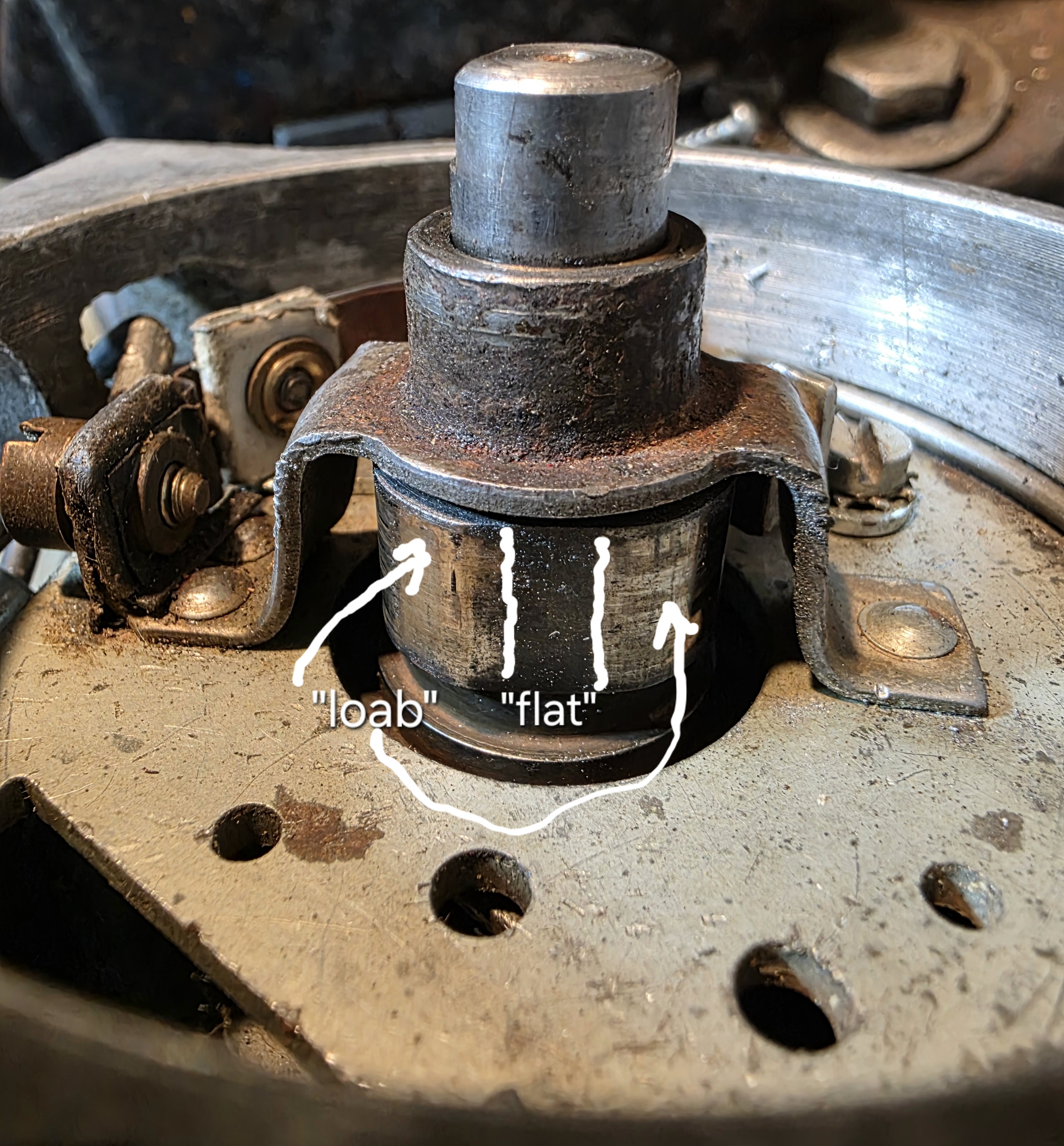
See how the "flat" isn't shiny from touching the point rubbing block.
To set .015" the points rubbing block should be on one of the cam "loabs" at its high point, then as the cam lobe slopes away to the "flat" the points must touch together, grounding the coil, so it can fill up. The rubbing block will be not touching the cam at all when on a "flat"
See how the "flat" isn't shiny from touching the point rubbing block.
Yep. Turns out I'm an idiot.No further.
To set .015" the points rubbing block should be on one of the cam "loabs" at its high point, then as the cam lobe slopes away to the "flat" the points must touch together, grounding the coil, so it can fill up. The rubbing block will be not touching the cam at all when on a "flat"
View attachment 167044
See how the "flat" isn't shiny from touching the point rubbing block.
Adjusted the points and got immediate spark. I'll put the tractor back together and fire it up tomorrow.
Non-farmer
Well-known Member
Good deal.
soaked
Member
- Location
- Lake Stevens, Wa
Its ok, we all come here to learn
HarryVanderpool
Member
- Location
- Salem, Oregon
You're not an idiot. Each and every episode like this makes you stronger and more self-reliant.
Soon you may find yourself answering questions here from your experiences. If you are a nerd like me, you will come to love the mysteries uncovered during troubleshooting. I genuinely love it.
Soon you may find yourself answering questions here from your experiences. If you are a nerd like me, you will come to love the mysteries uncovered during troubleshooting. I genuinely love it.
So we've now moved on to a vague fuel problem, I wasn't getting any fuel from the tank into the bowl with or without the fuel cap on, so I pulled the fuel line off, with the line off fuel will flow to the bowl, checked the line for blockages, liquid has no problem going through it. I've taken the carb off pre-emptively, but I haven't started ripping that apart yet. if anyone has advise on what to poke, it would be appreciated as my wife hates the smell of fuel. I guess it's a specific fuel problem with bad pressure in the system, but I don't know from whence it came.
Carb, fuel line, and sediment filter were all replaced in the spring.
Carb, fuel line, and sediment filter were all replaced in the spring.
Non-farmer
Well-known Member
With the carb off, will fuel flow out of the elbow that attaches the fuel line to the carb when you open the valve at the sediment bowl? If yes, I'd suspect your float is not opening its valve in the carb.
PS: not sure what you are calling the sediment filter. The only filters in a stock N fuel setup are three screens - one on the top of the bowl assembly in the fuel tank, one at the top of the glass bowl, and one coming out of the elbow at the carb. Anything else is non-standard.
PS: not sure what you are calling the sediment filter. The only filters in a stock N fuel setup are three screens - one on the top of the bowl assembly in the fuel tank, one at the top of the glass bowl, and one coming out of the elbow at the carb. Anything else is non-standard.
Technically, the bowl is a filter of sorts for sediment, but that's semantics at this point.With the carb off, will fuel flow out of the elbow that attaches the fuel line to the carb when you open the valve at the sediment bowl? If yes, I'd suspect your float is not opening its valve in the carb.
PS: not sure what you are calling the sediment filter. The only filters in a stock N fuel setup are three screens - one on the top of the bowl assembly in the fuel tank, one at the top of the glass bowl, and one coming out of the elbow at the carb. Anything else is non-standard.
I'll double check that all the valves move freely on the carb in the morning, then check the line attached to the bowl.
Non-farmer
Well-known Member
Thank you, just wanted some clarification there. My N is not unique in that a previous owner added an inline fuel filter. Wanted to make sure that wasn't what you meant.Technically, the bowl is a filter of sorts for sediment, but that's semantics at this point.
Similar threads
- Replies
- 11
- Views
- 74K

We sell tractor parts! We have the parts you need to repair your tractor - the right parts. Our low prices and years of research make us your best choice when you need parts. Shop Online Today.
Copyright © 1997-2025 Yesterday's Tractor Co.
All Rights Reserved. Reproduction of any part of this website, including design and content, without written permission is strictly prohibited. Trade Marks and Trade Names contained and used in this Website are those of others, and are used in this Website in a descriptive sense to refer to the products of others. Use of this Web site constitutes acceptance of our User Agreement and Privacy Policy TRADEMARK DISCLAIMER: Tradenames and Trademarks referred to within Yesterday's Tractor Co. products and within the Yesterday's Tractor Co. websites are the property of their respective trademark holders. None of these trademark holders are affiliated with Yesterday's Tractor Co., our products, or our website nor are we sponsored by them. John Deere and its logos are the registered trademarks of the John Deere Corporation. Agco, Agco Allis, White, Massey Ferguson and their logos are the registered trademarks of AGCO Corporation. Case, Case-IH, Farmall, International Harvester, New Holland and their logos are registered trademarks of CNH Global N.V.
Yesterday's Tractors - Antique Tractor Headquarters
Website Accessibility Policy