


Bern
Well-known Member
- Location
- Mount Vernon, WA
I had been looking for a M&W turbo kit for my 6000 for some time now, not for increased power but rather to clean up the
smoke levels at full load. Thanks to my friend Harry from Nebraska (a member of this board), I was able to get my hands on
one due to his persistent scouring of numerous wrecking yards for me.
I disassembled the turbo to put some new seals and gaskets inside of it, but otherwise it was in good condition. I installed
it on the tractor and then put it on the dyno and gained 5 more HP over stock (from 65 to 70) without turning up the fuel
pump. The instructions for the kit advertised a max power of 85HP if you turn up the fuel pump, but there's no way I'm
pushing that engine that hard. The 6000 engine is nothing more than a 1950s-era gasoline motor converted over to diesel, and
the last thing I want to see is a connecting rod poking out the side of the block.
On the dyno it was running 6PSI of boost at full load at 70HP, which is just fine by me. All I want to do is get a little
more oxygen into the cylinders to burn more of the fuel that is going in. That engine was never designed to breathe well,
but it does much better now. Overall I'm very happy with the way it all turned out.
Here are some descriptions for the 5 pictures below (in order):
1) This is what the exhaust stream looked like at full load BEFORE the installation of the turbo. While I'm no tree hugger,
I don't need real ones getting in my face. Actually, I was more concerned about some of that soot working its way into the
crankcase and turning the oil black in a hurry. Now at full load you can't see a visible trail at all. Which makes me
environmentally conscious I guess. It has to be getting better fuel economy now as well. Talk about a win-win!
2) Here's a side-by-side of the before and after turbo install. I had to move the fuel tank back about 4 inches to make room
for the turbo.
3) This is a top-view of the turbo with the hood removed. The clearance under the hood is very tight, I had to position the
tubes just so to keep them from rubbing on the hood or each other.
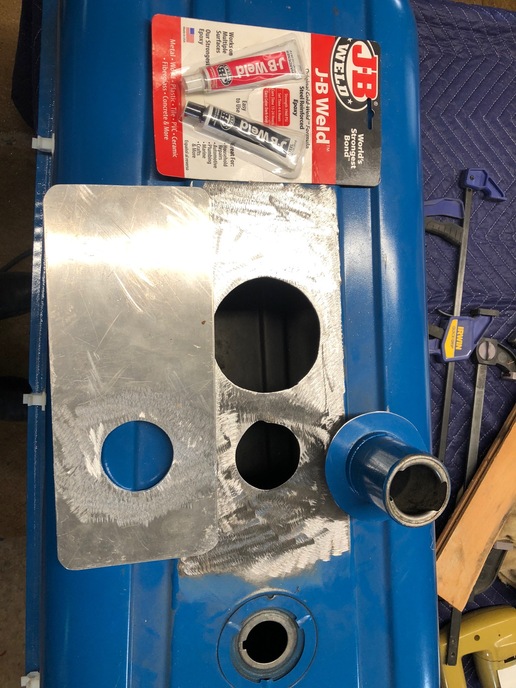
4) Because the fuel tank had to be moved back, the instructions said to cut a new hole in the hood to allow for fuel filler
neck access. Since I didn't want to butcher the hood, I decided to butcher the tank instead. 2 packages of JB Weld were
used, one under the adapter plate, and one surrounding the perimeter of the adapter plate.
5) I was able to get a copy of the original M&W kit instructions from a guy who is re-producing M&W kits for more popular
tractors such as 4020 JDs and 806 Internationals (link below). Currently there are no kits available for any Fords, however
if some of you start asking, maybe he'll make up a kit for the 5000.



M&W turbo kits
smoke levels at full load. Thanks to my friend Harry from Nebraska (a member of this board), I was able to get my hands on
one due to his persistent scouring of numerous wrecking yards for me.
I disassembled the turbo to put some new seals and gaskets inside of it, but otherwise it was in good condition. I installed
it on the tractor and then put it on the dyno and gained 5 more HP over stock (from 65 to 70) without turning up the fuel
pump. The instructions for the kit advertised a max power of 85HP if you turn up the fuel pump, but there's no way I'm
pushing that engine that hard. The 6000 engine is nothing more than a 1950s-era gasoline motor converted over to diesel, and
the last thing I want to see is a connecting rod poking out the side of the block.
On the dyno it was running 6PSI of boost at full load at 70HP, which is just fine by me. All I want to do is get a little
more oxygen into the cylinders to burn more of the fuel that is going in. That engine was never designed to breathe well,
but it does much better now. Overall I'm very happy with the way it all turned out.
Here are some descriptions for the 5 pictures below (in order):
1) This is what the exhaust stream looked like at full load BEFORE the installation of the turbo. While I'm no tree hugger,
I don't need real ones getting in my face. Actually, I was more concerned about some of that soot working its way into the
crankcase and turning the oil black in a hurry. Now at full load you can't see a visible trail at all. Which makes me
environmentally conscious I guess. It has to be getting better fuel economy now as well. Talk about a win-win!
2) Here's a side-by-side of the before and after turbo install. I had to move the fuel tank back about 4 inches to make room
for the turbo.
3) This is a top-view of the turbo with the hood removed. The clearance under the hood is very tight, I had to position the
tubes just so to keep them from rubbing on the hood or each other.
4) Because the fuel tank had to be moved back, the instructions said to cut a new hole in the hood to allow for fuel filler
neck access. Since I didn't want to butcher the hood, I decided to butcher the tank instead. 2 packages of JB Weld were
used, one under the adapter plate, and one surrounding the perimeter of the adapter plate.
5) I was able to get a copy of the original M&W kit instructions from a guy who is re-producing M&W kits for more popular
tractors such as 4020 JDs and 806 Internationals (link below). Currently there are no kits available for any Fords, however
if some of you start asking, maybe he'll make up a kit for the 5000.
M&W turbo kits


