

60LP Questions

We have a 60LP on our farm that I"m considering restoring. It"s been parked outside without runnning for at least 30 years. Dad said it was parked because the water pump quit.

I"ve restored a Farmall Cub and have some experience with larger Farmalls, but none with a 2 cylinder. The motor is stuck. The clutch won"t pull back to dis-engage, so it"s stuck in gear. The sheet metal is actually in pretty good shape (needs new screens). At least one rear rim needs replaced, along with needing all new rubber. By the way, it"s a single front wheel.

I guess these are my main questions:

1. I know it"s not really rare or collectable, but is it gonna be just a huge money pit? I"d restore it out of nostalgia. It"s been on the farm since I was a kid - though I wasn"t old enough to drive it before it was parked. If it"s too far gone, I"d rather put the money into some other projects. What are some key things that I should look at that could be big pitfalls?

2. What has to be done to restore an LP system and make sure it"s safe to use? What are some pros/cons of keeping it LP vs changing to gas?

I realize that it might not be worth the cost of restoration once completed, but I enjoy tinkering, and I"d just like to get some more info. Any input/suggestions/links would be greatly appreciated. Thanks.
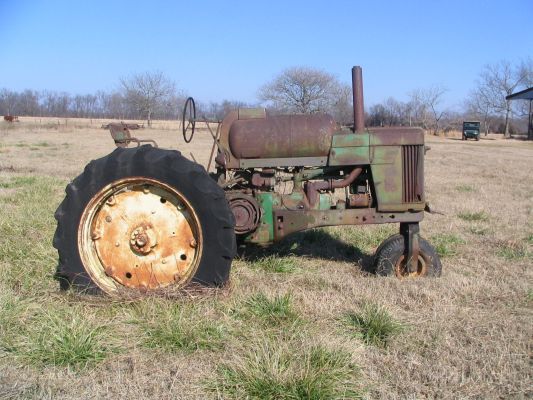
60_rt_side.jpg
 

Looks complete and not bad at all for the time it has set...

Might be well worth restoring..."the Price is right"..!!

Gatting the engine "un-stuck" may take a while, but parts are around for them..
I have a JD 630 LP I restored..was a "Basket Case" when I got it, too...!!
 
Don't even think about converting it to a gasoline-burner. Takes a lot of parts that are getting harder to find. Most of the LP-Gas parts are readily available. Parts Catalogs and a Service Manual, including the one for LP-Gas, are not cheap but will more than save their cost by preventing you from making expensive mistakes. There's not a lot of people restoring LP-Gas tractors because they are afraid of them, but once the fuel system is rebuilt to "as new" standards, there's less cause to worry than with a gasoline tractor. However, you cannot "poor boy" one of these---the "it'll get me by fixes that work on gasoline tractors won't work on an LP-Gas tractor. You'll spend some money, but if you do it right, you'll probably won't end up in an upside down position with it if you can do a lot of the work yourself. LP-Gas tractors are one of the next coming trends in JD restoring, many believe.
 
I f you have the time and money I would keep it and restore it. TH early numbered series tractors are fairly chaep to come by. I am restoring a medl 50 with a single front wheel. I have rebuilt the engine and clutch and am rebuilding the powersteering pump and pedestal now. Next will be the radiator and then cosmetics and all thelittle stuff. With new tires I will be looking at over $3,000 in parts and machine shop labor. And that was a tractor that was previoulsy running. Hopefully your block and pistons are salvageable and you wont have to go oversize.Take your time and go through everything. Better to do it right the first time. I'm not rebuilding mine to sell it. If I were I wouldnt get my money back on a model 50. I'm doing it to use and enjoy it and know that is is really restored all the way through. If you don't want it let me know!
 
Looks like a diamond in the rough. Go for it and fix it up. I never did any of my restorations with making money on them being part of the plan.
If you want to make money on it sell it right now as is. If you want to get it running for old times sake do it and don't look back.
 
Lots of good and encouraging info. Thanks - and keep it coming.

The first thing I buy will be all the manuals. I learned that from restoring my Cub.

I have some questions regarding the LP tank. I'm assuming that it's a very thick-walled tank. It currently shows that it's 60% full - of course the gauge could be broken from sitting. Hopefully that's helped keep it from corroding inside. It's got some pitting on the outside, but not too bad. Will it need to be pressure checked/cleaned out/etc? I would plan on replacing the hoses, valves, etc - but what needs to be done to the tank itself? I just have no experience at all with LP.

Thanks.
 
(quoted from post at 20:27:52 02/06/08) Lots of good and encouraging info. Thanks - and keep it coming.

The first thing I buy will be all the manuals. I learned that from restoring my Cub.

I have some questions regarding the LP tank. I'm assuming that it's a very thick-walled tank. It currently shows that it's 60% full - of course the gauge could be broken from sitting. Hopefully that's helped keep it from corroding inside. It's got some pitting on the outside, but not too bad. Will it need to be pressure checked/cleaned out/etc? I would plan on replacing the hoses, valves, etc - but what needs to be done to the tank itself? I just have no experience at all with LP.

Thanks.
Brian, you most likely will pull the tank off to work on the tractor anyway. You could take it and have it pressure checked at that time.
If you open the cover on top of the tank there will be a small bleed valve just to the rear of the two connections for hoses. Open that and if it has pressure in the tank it will let some pressure out. Sometimes if the temp. is right the tank may sweat on the outside up to the top of where the liquid is in the tank. (Just above 1/2 if gauge is correct) Also the tank will be colder at the bottom than top if fuel is in it. Full or empty that tank is very heavy so be careful when you remove it. If you still have either the fill line or return line for the tank you can connect it to the tank and it will release some fuel as you connect it if any is in the tank. The bleed valve is the best way if it works. You can also crack open the vapor or liquid line on the carb. side of the liquid or vapor control valve and open it a half turn to see if anything comes out.
Before you buy any parts you need, take everything you are going to rebuild apart, then decide if you think it is worth restoring before you spend a lot of money. Most running 60 LPG tractors sell in the $2000 range. You will just have to decide how far you want to go and how much you want to spend. I grew up on a 60 LP and loved the tractor. But they are just hard to sell today.
 
Don't convert to gas, keep it on propane!

There shouldn't be any corrosion problems on the inside. Since the propane is trying to get out, moisture can't get in. One good thing about propane is that it doesn't go bad over time. If it is indeed 60% full, that fuel is as good as the day it was put in there.

Replace the hoses, but hold off on the valves. Once the new lines are on, crack one of the valves just enough to pressurize the line, then close it again. Use your nose and a spray bottle of soapy water to check around the fittings and the packing for leaks. As old as they are, you are likely to find seapage around the packing. You can try tightening the packing nut a little bit. May seep around the guage too.

Depending on the brand of the valve and how good your propane supplier is, you may be able to get kits to replace just the packing, thus maintaining originality, but it may not be a whole lot cheaper than replacing the entire valve.

As long a the seapage is minor, you can run the tractor with valves as is until the tank is empty, then refurb that part.

You will also want to make up a nurse tank from a
bbq tank just in case you run out somewhere some day.
 
I just finished restoring a 60lp.It turned out great and is probably the sweetest running 2 cylinder I have.The head on that tractor is the same as a gas tractor.The pistons are higher compression.Mine was stuck and the cylinders were in bad shape;however,I could not find any oversize pistons.I was able to save the pistons and had to bore and resleeve the block back to standard.Deere had almost all the parts I needed to bring her back,the rest were not hard to come by.So please dont convert her to gasoline,You can have a nice running different type of tractor when you are done.Good luck and have fun
 
I don't have any experience with an LP, but I would love to have one. I agree with everyone keep it as LP. Think of it this way as someone else said previously in another post. Gas $3.00/Gal LP around $2.50/gal or so (just estimating) That right there would convince me.

Kris A NC
 
Brian I am in Oxford Mississippi and I have 5 Model 60s, 2-LP, 2 gas and 1 all fuel. Both LP models were bought as "parts tractors" but I am slowly, surely gathering all the missing parts to make one LP 60 to go. You can build it up to running condition if you are patient and take your time. First thing to do is pull all the drain plugs you can find and let all the water get out and that lets the rain pass on through. Pull the spark plugs and fill the cyinders with diesel fuel. That gets you a head start on the unstuck pistons. You can also fill the radiator and block with diesel to prevent further rusting. Paul in Oxford
 
your exactly right! propane doesnt go bad. it has sat in the earth all this time for billions of years. it is is a bi-product from the production of crude oil. no refining done to propane.
 
your exactly right! propane doesnt go bad. it has sat in the earth all this time for billions of years. it is is a bi-product from the production of crude oil. no refining done to propane.
 
Yesterday's Tractor Forums

We sell tractor parts! We have the parts you need to repair your tractor - the right parts. Our low prices and years of research make us your best choice when you need parts. Shop Online Today.

Back
Top
