


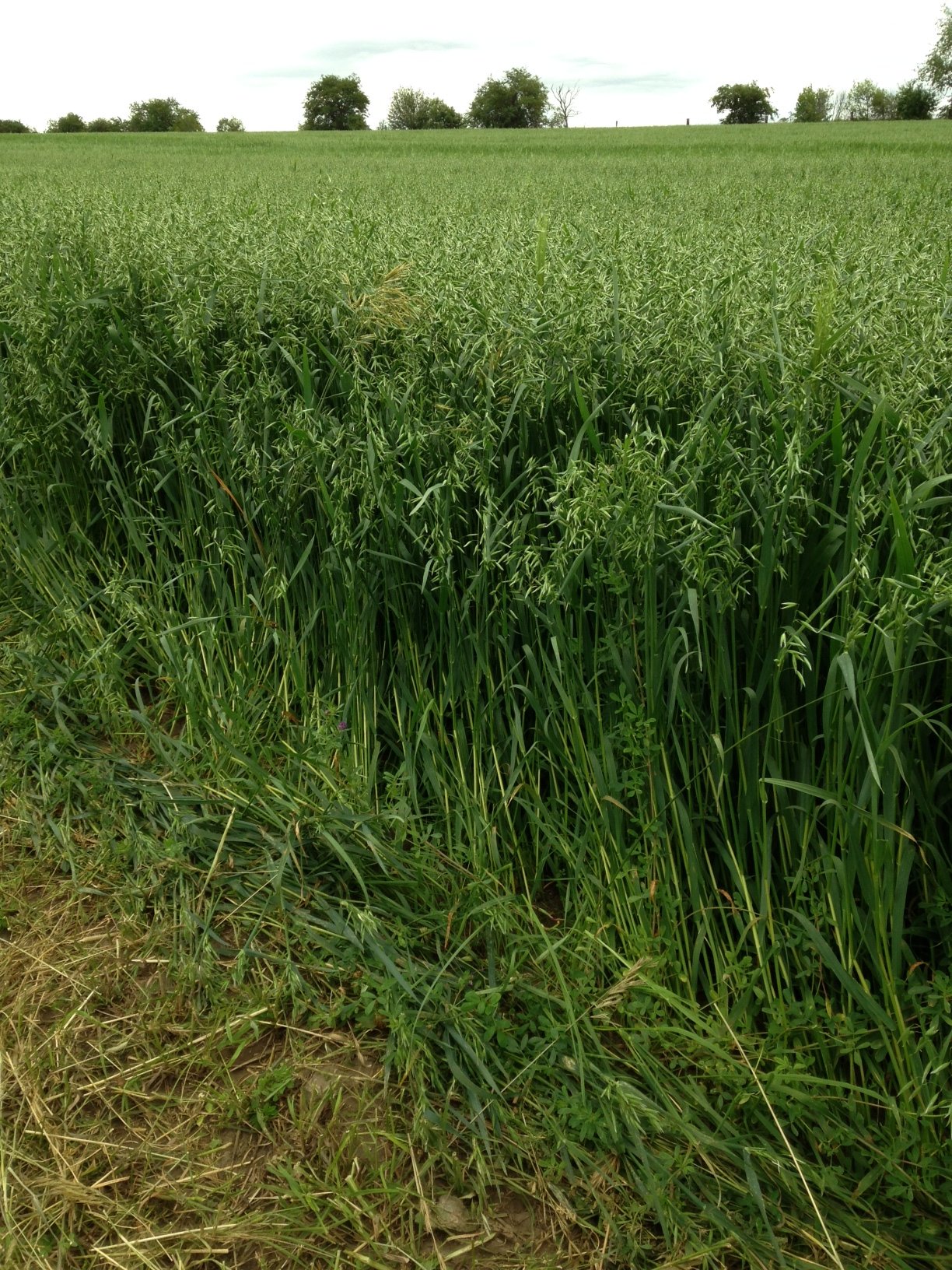
This coming spring I plan on seeding down around 30 acres to alfalfa/timothy/treefoil/brome. I have always used oats as a cover crop, but more often than not it seems like the oats smother out the hay. You can see by the attached pics of my last attempt what I mean. You can see some alfalfa in there but seems like the oats restrict the sunlight from getting to the hay crop resulting in a poor catch. I have no experience with direct seeding,and have always used a cover crop because that is how Dad did it kind of thing, but am wondering if I should try direct seeding? Maybe direct seed late summer after oats come off as never get a hay crop the same year around here anyway?? Hoping some on here have experience with this and will offer some advice. I am kinda leery of trying something different as it does work, just not getting the bumper hay crop the following year that I remember Dad getting, and he is not here to ask what I am doing wrong. We are south central Ontario north east of Toronto. Ground is on the heavy clay side, but all tile drained. Thanks for any advice.
You are using an out of date browser. It may not display this or other websites correctly.
You should upgrade or use an alternative browser.
You should upgrade or use an alternative browser.
rockcreek4630
Member
When I use oats as a cover crop I reduce my planting rate. By your pic you have a beautiful stand of oats but is to thick.
That is a beautiful stand of oats, wow! But not exactly what you wanted I understand.
Here in my part of Minnesota for oats we plant 3 bu to the acre and plant as soon as you can get in the field in spring. Might be a lot of frost still in the ground but plant early for grain.
As a cover crop for alfalfa we plant later, maybe 3 weeks later, and we plant 2 bu to the acre as a cover for the alfalfa. Some harvest the oats as normal, most cut off and wrap the oats as it’s heading. Some only plant a bu of oats per acre as cover crop, but it seems then it really doesn’t do much at such a low rate. Two bu an acre seems the sweet spot.
The past decade or two some went to direct seeding alfalfa in fall after the oats is off. In September some time. There is less heavy washing rains in fall, and less weed pressure, so direct seeding seems to work better in fall.
Your climate and planting dates might be very different, so I’m just saying what works locally, if any of that fits your climate.
Paul
Here in my part of Minnesota for oats we plant 3 bu to the acre and plant as soon as you can get in the field in spring. Might be a lot of frost still in the ground but plant early for grain.
As a cover crop for alfalfa we plant later, maybe 3 weeks later, and we plant 2 bu to the acre as a cover for the alfalfa. Some harvest the oats as normal, most cut off and wrap the oats as it’s heading. Some only plant a bu of oats per acre as cover crop, but it seems then it really doesn’t do much at such a low rate. Two bu an acre seems the sweet spot.
The past decade or two some went to direct seeding alfalfa in fall after the oats is off. In September some time. There is less heavy washing rains in fall, and less weed pressure, so direct seeding seems to work better in fall.
Your climate and planting dates might be very different, so I’m just saying what works locally, if any of that fits your climate.
Paul
Oats in picture were planted plus minus 2 bushels/acre, but were planted early April. I feel like I should really try direct seeding after first crop comes off, as I really dont want to wrap the oats. I would have to hire someone to wrap as only have string on my round baler, and dont really have a market for the wrapped oats. I do have a market for oats, as I clean and bag thru the winter which works out fairly well. I have a customer base for the bagged grain so really dont want to lose that. Hoping someone would convince me that I should direct seed next fall as I am very leery of spending all that money on hayseed and potentially being a flop? I guess its one of those situations were I need to make a decision , but want it to at least be an educated one. Thanks for your input.That is a beautiful stand of oats, wow! But not exactly what you wanted I understand.
Here in my part of Minnesota for oats we plant 3 bu to the acre and plant as soon as you can get in the field in spring. Might be a lot of frost still in the ground but plant early for grain.
As a cover crop for alfalfa we plant later, maybe 3 weeks later, and we plant 2 bu to the acre as a cover for the alfalfa. Some harvest the oats as normal, most cut off and wrap the oats as it’s heading. Some only plant a bu of oats per acre as cover crop, but it seems then it really doesn’t do much at such a low rate. Two bu an acre seems the sweet spot.
The past decade or two some went to direct seeding alfalfa in fall after the oats is off. In September some time. There is less heavy washing rains in fall, and less weed pressure, so direct seeding seems to work better in fall.
Your climate and planting dates might be very different, so I’m just saying what works locally, if any of that fits your climate.
Paul
DanielW
Well-known Member
- Location
- Haliburton, Ontario
We're in the same boat as you, and (as you know) not too far from you. We always had an oat cover on our hay, and it always did fine. We typically take the oats off for grain for the cattle. We used a binder and thresher up until 2004 (don't laugh), and it was always a struggle to bind as the green hay would be coming up through the oats. In more recent years we do the same, but combine the oats direct. But several years ago we started to notice the same thing as you: The oats seem to be doing better and better, and smother out the hay in some years. Usually not a concern as the hay will come back strong the next year. And we'll frost-seed into the hay stand the next year if really a concern, but of course frost-seeding alfalfa doesn't work too well due to autotoxicity. (We always do a heavy frost-seeding regardless, because our land is so rocky we'll do anything we can if it helps us avoid breaking it up for a few more years).
I think part of it may be due to our soil (finally) seeing decent nutrient levels, but also due to modern oat strains being more hardy and competitive.
Last year was the first year we varied from our norm. We cut and wrapped the oats as baleage before they started to head out to give the hay a little better chance of coming though. I don't think we'd make a regular practice of it, but with it being so dry last summer we wanted to give the hay all the help it could get, and also have the wrapped oats to supplement our hay in such a bad year. And the hay stand seemed to turn out very well.
The first thing I'd wonder about, however (and what we've been doing for the past few years - and find makes a big difference) is making sure you're not putting an N-heavy fertilizer on when you're doing the initial seeding. Depending on where/how we get our fertilizer (often we buy in bags because Agrico doesn't like delivering bulk loads as far as us) I'll mix about equal parts K-mag and 6-24-24 fertilizer. So the end result is moderate P, high K (which the alfalfa and trefoil really like), but quite low N. The oats really tone it back when they have that low N to start. So the oats are less aggressive and thick, and don't choke out the hay as much. Of course, you can't go too low on N, as you need it to get your grasses established as well. But that hasn't been much of a concern with us because our grasses are limited to timothy and brome. Timothy will frost-seed fairly well, so we often spread some on the next spring to help thicken if we're concerned. And brome seems to take over quite aggressively, and getting it established has never really been a concern.
Interestingly, since we've started doing the lower-N fertilizer at seeding, the oats are less stemmy and aggressive, but I haven't noticed any appreciable difference in yield when combining them. I will confess that we don't pay much attention to exact yield numbers however: We just take what we can and it all goes to the cattle. But I have a friend down South who grows a lot of cereal rye and he told me something similar: You don't want too much N, because it'll just grow thick, stemmy, and lodge, without any appreciable difference in yield. You want the grain just a little stressed. The way he put it, you want the grain to think it's coming on hard times, so it puts its energies into seed production and procreating, rather than just lots of top growth.
I think part of it may be due to our soil (finally) seeing decent nutrient levels, but also due to modern oat strains being more hardy and competitive.
Last year was the first year we varied from our norm. We cut and wrapped the oats as baleage before they started to head out to give the hay a little better chance of coming though. I don't think we'd make a regular practice of it, but with it being so dry last summer we wanted to give the hay all the help it could get, and also have the wrapped oats to supplement our hay in such a bad year. And the hay stand seemed to turn out very well.
The first thing I'd wonder about, however (and what we've been doing for the past few years - and find makes a big difference) is making sure you're not putting an N-heavy fertilizer on when you're doing the initial seeding. Depending on where/how we get our fertilizer (often we buy in bags because Agrico doesn't like delivering bulk loads as far as us) I'll mix about equal parts K-mag and 6-24-24 fertilizer. So the end result is moderate P, high K (which the alfalfa and trefoil really like), but quite low N. The oats really tone it back when they have that low N to start. So the oats are less aggressive and thick, and don't choke out the hay as much. Of course, you can't go too low on N, as you need it to get your grasses established as well. But that hasn't been much of a concern with us because our grasses are limited to timothy and brome. Timothy will frost-seed fairly well, so we often spread some on the next spring to help thicken if we're concerned. And brome seems to take over quite aggressively, and getting it established has never really been a concern.
Interestingly, since we've started doing the lower-N fertilizer at seeding, the oats are less stemmy and aggressive, but I haven't noticed any appreciable difference in yield when combining them. I will confess that we don't pay much attention to exact yield numbers however: We just take what we can and it all goes to the cattle. But I have a friend down South who grows a lot of cereal rye and he told me something similar: You don't want too much N, because it'll just grow thick, stemmy, and lodge, without any appreciable difference in yield. You want the grain just a little stressed. The way he put it, you want the grain to think it's coming on hard times, so it puts its energies into seed production and procreating, rather than just lots of top growth.
Last edited:
Thanks for the insight. What you are saying does make a lot of sense. I have just been putting on what the soil tests recomend or more like what Matt from alliance interprets I should put on. I will talk to him about your suggestion this spring. Your comment about frost seeding reminded me that I laid down some timothy with a brillion seeder last spring on a chunk that I am trying to stretch a couple more years out of. Really didnt notice much last summer, but hoping for results this year. When people complain about paying $5 or $6 for a bale of hay I really dont think they know the effort and $ that go into that bale of hay. Sitting here with not a lot to do I think I might do some kind of spread sheet on input costs. Then again knowing how much I am losing might take the fun out of it, so maybe better find something more constructive to do!We're in the same boat as you, and (as you know) not too far from you. We always had an oat cover on our hay, and it always did fine. We typically take the oats off for grain for the cattle. We used a binder and thresher up until 2004 (don't laugh), and it was always a struggle to bind as the green hay would be coming up through the oats. In more recent years we do the same, but combine the oats direct. But several years ago we started to notice the same thing as you: The oats seem to be doing better and better, and smother out the hay in some years. Usually not a concern as the hay will come back strong the next year. And we'll frost-seed into the hay stand the next year if really a concern, but of course frost-seeding alfalfa doesn't work too well due to autotoxicity. (We always do a heavy frost-seeding regardless, because our land is so rocky we'll do anything we can if it helps us avoid breaking it up for a few more years).
I think part of it may be due to our soil (finally) seeing decent nutrient levels, but also due to modern oat strains being more hardy and competitive.
Last year was the first year we varied from our norm. We cut and wrapped the oats as baleage before they started to head out to give the hay a little better chance of coming though. I don't think we'd make a regular practice of it, but with it being so dry last summer we wanted to give the hay all the help it could get, and also have the wrapped oats to supplement our hay in such a bad year. And the hay stand seemed to turn out very well.
The first thing I'd wonder about, however (and what we've been doing for the past few years - and find makes a big difference) is making sure you're not putting an N-heavy fertilizer on when you're doing the initial seeding. Depending on where/how we get our fertilizer (often we buy in bags because Agrico doesn't like delivering bulk loads as far as us) I'll mix about equal parts K-mag and 6-24-24 fertilizer. So the end result is moderate P, high K (which the alfalfa and trefoil really like), but quite low N. The oats really tone it back when they have that low N to start. So the oats are less aggressive and thick, and don't choke out the hay as much. Of course, you can't go too low on N, as you need it to get your grasses established as well. But that hasn't been much of a concern with us because our grasses are limited to timothy and brome. Timothy will frost-seed fairly well, so we often spread some on the next spring to help thicken if we're concerned. And brome seems to take over quite aggressively, and getting it established has never really been a concern.
Interestingly, since we've started doing the lower-N fertilizer at seeding, the oats are less stemmy and aggressive, but I haven't noticed any appreciable difference in yield when combining them. I will confess that we don't pay much attention to exact yield numbers however: We just take what we can and it all goes to the cattle. But I have a friend down South who grows a lot of cereal rye and he told me something similar: You don't want too much N, because it'll just grow thick, stemmy, and lodge, without any appreciable difference in yield. You want the grain just a little stressed. The way he put it, you want the grain to think it's coming on hard times, so it puts its energies into seed production and procreating, rather than just lots of top growth.

We sell tractor parts! We have the parts you need to repair your tractor - the right parts. Our low prices and years of research make us your best choice when you need parts. Shop Online Today.
Copyright © 1997-2025 Yesterday's Tractor Co.
All Rights Reserved. Reproduction of any part of this website, including design and content, without written permission is strictly prohibited. Trade Marks and Trade Names contained and used in this Website are those of others, and are used in this Website in a descriptive sense to refer to the products of others. Use of this Web site constitutes acceptance of our User Agreement and Privacy Policy TRADEMARK DISCLAIMER: Tradenames and Trademarks referred to within Yesterday's Tractor Co. products and within the Yesterday's Tractor Co. websites are the property of their respective trademark holders. None of these trademark holders are affiliated with Yesterday's Tractor Co., our products, or our website nor are we sponsored by them. John Deere and its logos are the registered trademarks of the John Deere Corporation. Agco, Agco Allis, White, Massey Ferguson and their logos are the registered trademarks of AGCO Corporation. Case, Case-IH, Farmall, International Harvester, New Holland and their logos are registered trademarks of CNH Global N.V.
Yesterday's Tractors - Antique Tractor Headquarters
Website Accessibility Policy