

You should upgrade or use an alternative browser.

Bruce (VA)
Well-known Member

Kirk-NJ
Well-known Member
bark ok but kept spinning the wheels. I probably won't have been able to move a load of dirt with the full blade. I agree with others that said a 6' blade is about the most you want to go on these little N
tractors. With a 6' blade you will still be able to spin it around on the tractor to use it as a dozer blade without taking it off to reverse it.
Kirk

Tim PloughNman Daley
Well-known Member
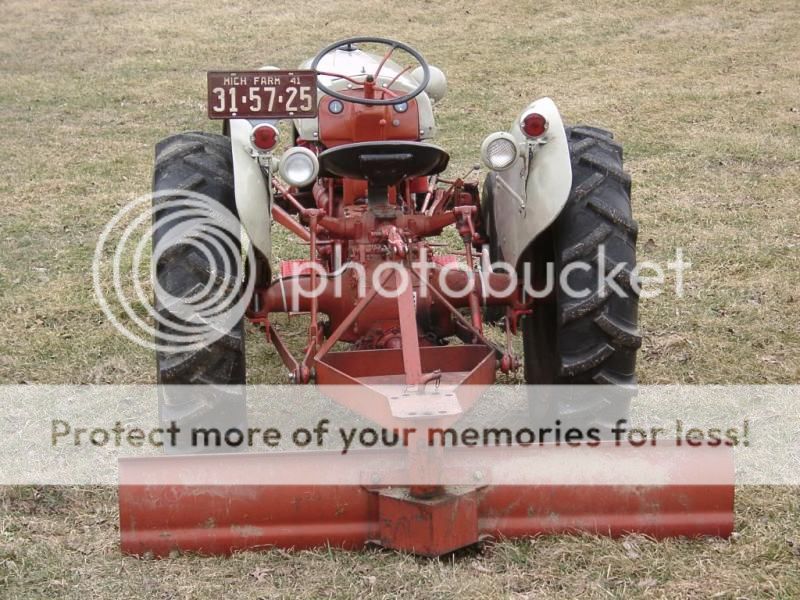
1948 Ford 8N with 6' Back Blade & Stabilizer Bars -
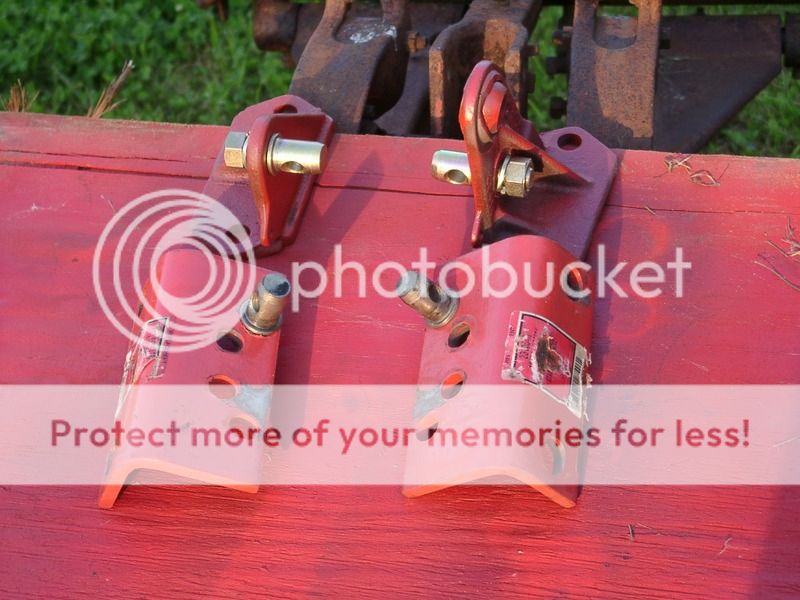
Original Dearborn Stabilizer Bar Brackets and aftermarket angle iron style -
Stabilizer Bars proper set up with rear mower -

Stabilizer Bars -proper set up -

Stabilizer Bars -proper set up of fender brackets -


Tim *PloughNman* Daley(MI)

Ultradog MN
Well-known Member
- Location
- Twin Cities
If you use it mostly for snow then you
will like a 7' as it kicks the snow well
past the tires when angled.
I have a heavy 8' that I use behind my
3000. I use it clean - without all the
appurtenances, appendages, peripherals,
impediamenta, accoutrements, accessories,
apparatus and supplemental gizmos.
Kenockee 8N
Member
(quoted from post at 03:10:56 10/31/16) As others said, a 6' back blade is typical and ideal for an N-Series Tractor. I highly recommend using stabilizer bars with a back blade too.
Tim *PloughNman* Daley(MI)
Question on the stabilizer bars.
Do you have to disconnect them to put an implement on? If not, how do you move the lift arm outward to go around the pins on the implement?
I currently just have a 6' back blade (also would agree with others that it is about perfect for these tractors) and a draw bar with stays that I use to pull a set of drag discs, but can already see the need for the stabilizer bars.
Greg (2N) TX
Member
tractor is running good under load.
Greg
Tim PloughNman Daley
Well-known Member
Taking your left hand, make a 'gun' with you thumb and index finger. Now turn it upside down so your thumb is pointing down and your index finger is pointing to the right. This is how the bracket that bolts to your right fender is set. The thumbnail area has the link pin and the index finger has the fender bolt mounting holes. The bracket link pin and lift pins now should align with each other. Now take both of your index fingers, point them at each other almost touching. This is how the pins locate correctly. Now, once you have positioning correct, snug down fender bolts, but do not tighten completely. Repeat procedure for the left side using opposite symmetry.
Next step is to get a back blade, bush hog, or rear finish mower that you will use the bars with and hitch to the tractor lift arms. Attach a top link too. Attach one stabilizer bar to the left side implement pin and latch with a linch pin. Attach a bar to the right side implement pin and latch as well. Take the left bar end nearest the point where it will attach to the bracket pin and fit it onto the link pin on the bracket. This may take some 'to and fro' motion to get it to fit on and one reason we left the brackets loose. Do not tighten down fender bolts yet. Repeat procedure now for the right side. Latch fender bracket link pins with linch pins. Once implement is attached with bars in place, still loosely bolted down, proceed to final adjustment.
Final Adjustment: At this phase you will proceed with extreme caution working slowly so you do not bend or break anything. Be sure your Finger Control lift is set at the bottom of the stoke -all the way DOWN. Start tractor. SLOWLY begin to raise the lift observing that the bars are not binding or that anything sounds or looks like it is under stress. There may be some 'positioning' of the fenders as they self adjust themselves to the bars. If something doesn't look or sound right, drop the lift arm right away and determine what it is that is out of sync. You will do a series of up and down lifts to ensure that the positioning is set correctly. Correct positioning is when the lift is all the way UP and the bars don't pinch, bend, bind, crack, break or otherwise fail. When you have a warm & fuzzy about the lifting, now you can secure the fender bolts down tightly. Always repeat the lift sequence a few times once the fender bolts are tight. That's it -the bars are set to your lift. There is no way they need to be changed.
Once this procedure is successful, you won't need to muck with the setting again. You should be able to go from a mower to a back blade to a disc harrow without any worry about touching the bar settings. You might want to do an occasional routine PM check to verify they didn't move. Jamming a snowbank full throttle can cause one side to move.
This method is a proven system to set stabilizer bars. I have seen bent lift arms, blown hydraulic pumps, and bent and twisted bars because the stabilizer bars, mostly the brackets, were installed wrong. One reason is the new, aftermarket style brackets have multiple pin location holes to use with different tractors, and if you don't have the pins in the right hole for your tractor, you will end up with a disaster. Most all issues with bars is they are not set up correctly. Either the pins are in wrong position or the brackets are facing the wrong direction.
I hope this helps you and anyone having the same problem...
Tim *PloughNman* Daley(MI)
(quoted from post at 05:45:13 10/31/16) "Question on the stabilizer bars.
Do you have to disconnect them to put an implement on?"
Yes. Like UD, I don't see any reason to use them with a back blade. I also use a 6 footer - no stabilizer bars.
Or you can use a set of Pat's Quick Hitches. The sway bars always stay connected. Just back up the quick hitches under your implements pins and lift up the arms to catch the pins.
Of course you can always remove or reinstall the sway bars depending on your implement.
Sorry, I forgot the picture.


We sell tractor parts! We have the parts you need to repair your tractor - the right parts. Our low prices and years of research make us your best choice when you need parts. Shop Online Today.
Copyright © 1997-2025 Yesterday's Tractor Co.
All Rights Reserved. Reproduction of any part of this website, including design and content, without written permission is strictly prohibited. Trade Marks and Trade Names contained and used in this Website are those of others, and are used in this Website in a descriptive sense to refer to the products of others. Use of this Web site constitutes acceptance of our User Agreement and Privacy Policy TRADEMARK DISCLAIMER: Tradenames and Trademarks referred to within Yesterday's Tractor Co. products and within the Yesterday's Tractor Co. websites are the property of their respective trademark holders. None of these trademark holders are affiliated with Yesterday's Tractor Co., our products, or our website nor are we sponsored by them. John Deere and its logos are the registered trademarks of the John Deere Corporation. Agco, Agco Allis, White, Massey Ferguson and their logos are the registered trademarks of AGCO Corporation. Case, Case-IH, Farmall, International Harvester, New Holland and their logos are registered trademarks of CNH Global N.V.
Yesterday's Tractors - Antique Tractor Headquarters
Website Accessibility Policy