Backhoe no dipper function

I have a Long 5n1 backhoe and loader. The dipper cylinder rod does not function when applying the control. In fact, it will actually cause the boom to go up or down.

If I pull back on both sticks then the boom lifts up violently.

I have been working on this machine for almost 6 months now. I rebuilt the backhoe control valve, replaced spool springs, spool seals, seals in between each working section. I removed the pressure reliefs and inspected for broken springs. I also rebuilt the dipper cylinder. When I was attaching the dipper cylinder I applied hydraulic power to extend the rod so I could connect the upper pin. The cylinder actually worked then. It had air in it but it still moved. But as soon as it was fully attached to the dipper arm it doesn't do anything. The engine is getting loaded when moving the control but nothing actuates. Fluid is topped off and all other functions work. This machine doesn't have a strainer or filter (I know completely stupid), so nothing is clogged in that regard.

I am at my wits end with this machine. Anybody have any suggestions what else I can do?
1845.png
1846.png
1847.png
1848.png
1849.png
1850.png
 

Attachments

  • PXL_20260427_232000878.jpg
    PXL_20260427_232000878.jpg
    2.1 MB · Views: 53
  • Screenshot_20260428-083108_OneDrive.png
    Screenshot_20260428-083108_OneDrive.png
    752.5 KB · Views: 33
  • Screenshot_20260428-083117_OneDrive.png
    Screenshot_20260428-083117_OneDrive.png
    773 KB · Views: 27
  • Screenshot_20260428-083134_OneDrive.png
    Screenshot_20260428-083134_OneDrive.png
    717.6 KB · Views: 27
Last edited:
Hello ddr, welcome to YT! I wonder if it has anti-drop safety valves in the base of the cylinder where the hoses connect. These valves lock the cylinder in position if a hose breaks. The passage of fluid one direction opens the opposite port allowing it to flow fluid and work normally. What I am saying is that it may have them and it may not be functioning properly. There would need to be a plug in the base of the cylinder for this valve. I think I see one in the right side picture.
 
Hello ddr, welcome to YT! I wonder if it has anti-drop safety valves in the base of the cylinder where the hoses connect. These valves lock the cylinder in position if a hose breaks. The passage of fluid one direction opens the opposite port allowing it to flow fluid and work normally. What I am saying is that it may have them and it may not be functioning properly. There would need to be a plug in the base of the cylinder for this valve. I think I see one in the right side picture.
Thank you for your reply! Interesting. I never heard of this but sounds promising. You are correct there is a plug at the base of the cylinder. How can I confirm this has the valve? How can it be fixed?
 
I really can't see how the velocity fuses would cause the boom to function when you operated the dipper. If the problem were only no dipper function, then the velocity fuses might be suspect. But the fact that the boom operates when you try to operate the dipper doesn't make sense for a velocity fuse problem. But still worth checking: Does it have velocity fuses (the 'anti-drop safety valves' mentioned above)? If so, did you have them off at any point? If so, are they re-installed in the correct orientation? I've never seen velocity fuses on any older hoe like that, but admittedly I've never worked on a Long.

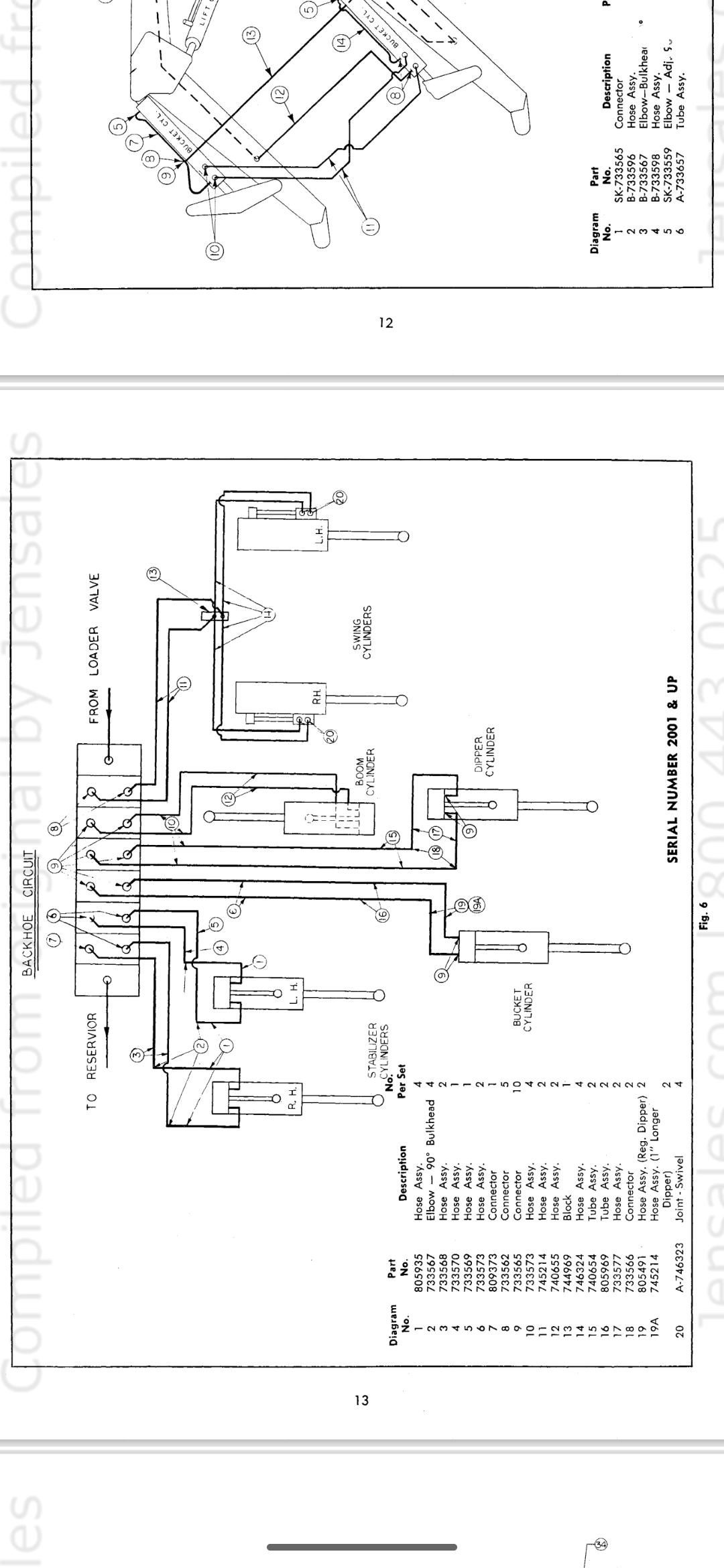
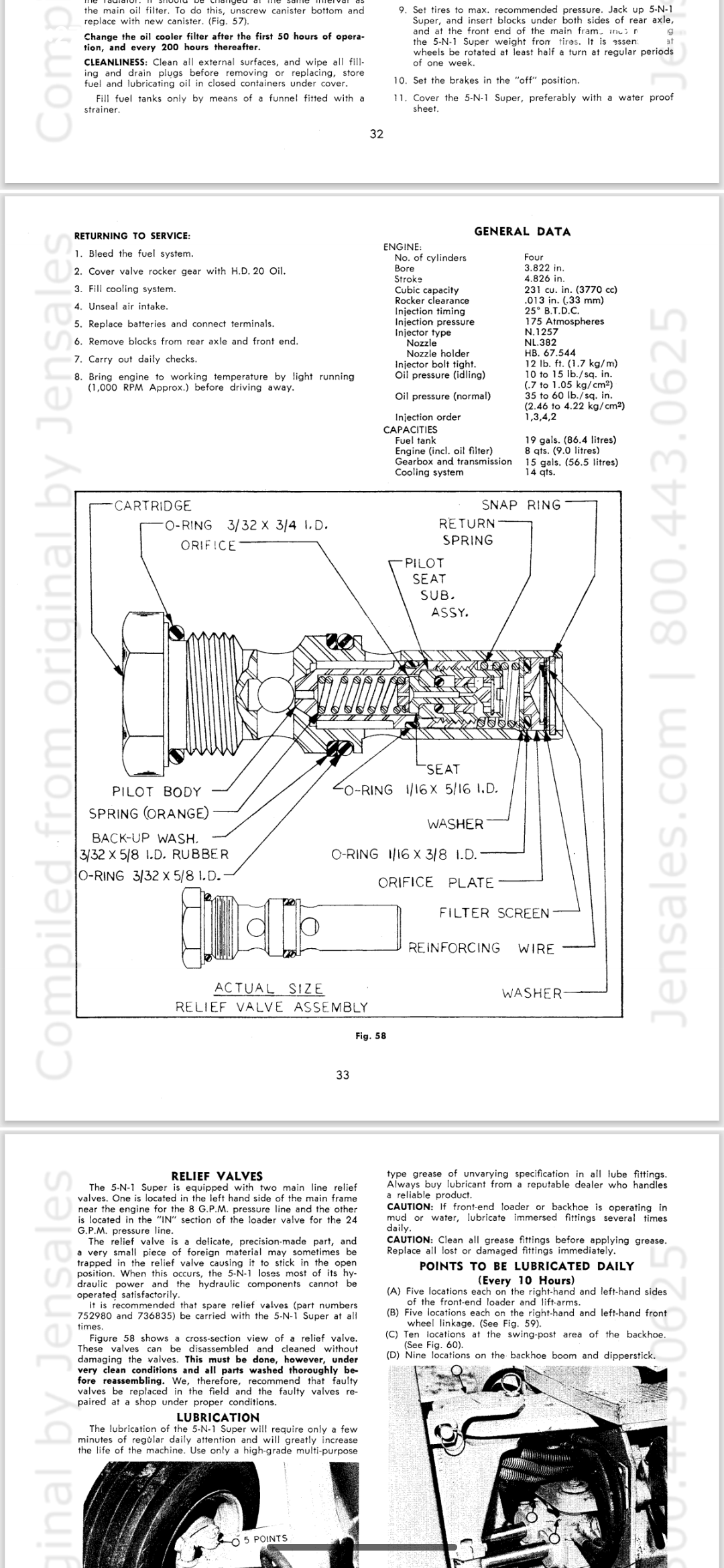
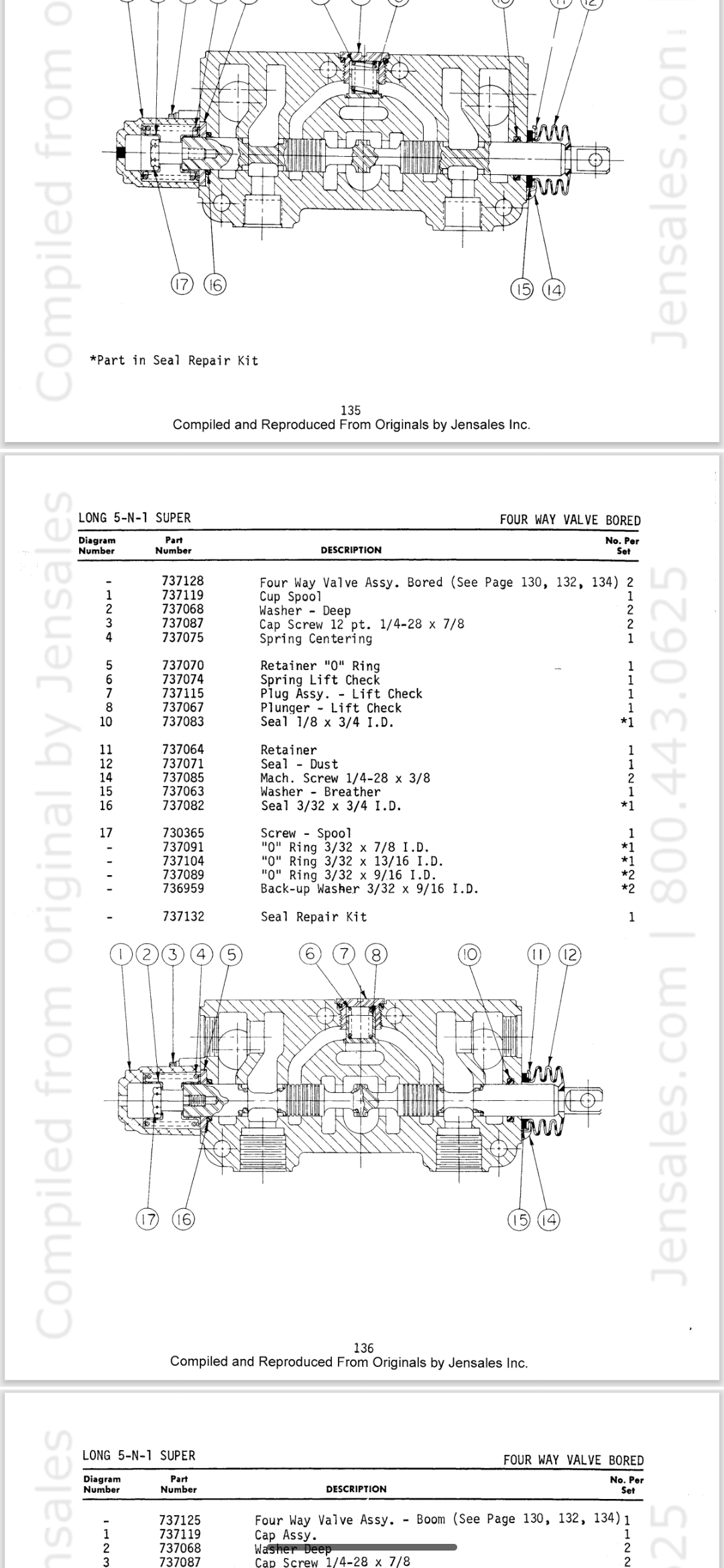
You said you had all the relief cartridges out of that sandwich stack. Do you have a hydraulic schematic to reference (and, if so, any chance you could post a pic of the schematic)? Are you 100% sure that they're all reliefs, and one cartridge isn't a reverse-flow/PO check or similar? Did you replace all o-rings on those cartridges? Easy for one to get torn when you remove one of those cartridges after they've been sitting/stuck in-place for the past 60 years.

This is just a guess, but I'd be looking at the o-rings between sandwich sections to confirm they're all in-place and new, confirming that all cartridges are indeed the same reliefs (that one non-operating section three in from the far side is the one that would really cause me to wonder), and making sure the o-rings on all those cartridges were good/new. Sounds like somehow pressure that's supposed to go to the A or B port on the dipper sandwich section is making its way to the boom section. Either from crossed lines (doubtful, as it's such a simple system), a bypassing o-ring that's allowing flow to go to a port it shouldn't, or cartridges not being in the correct configuration/location.

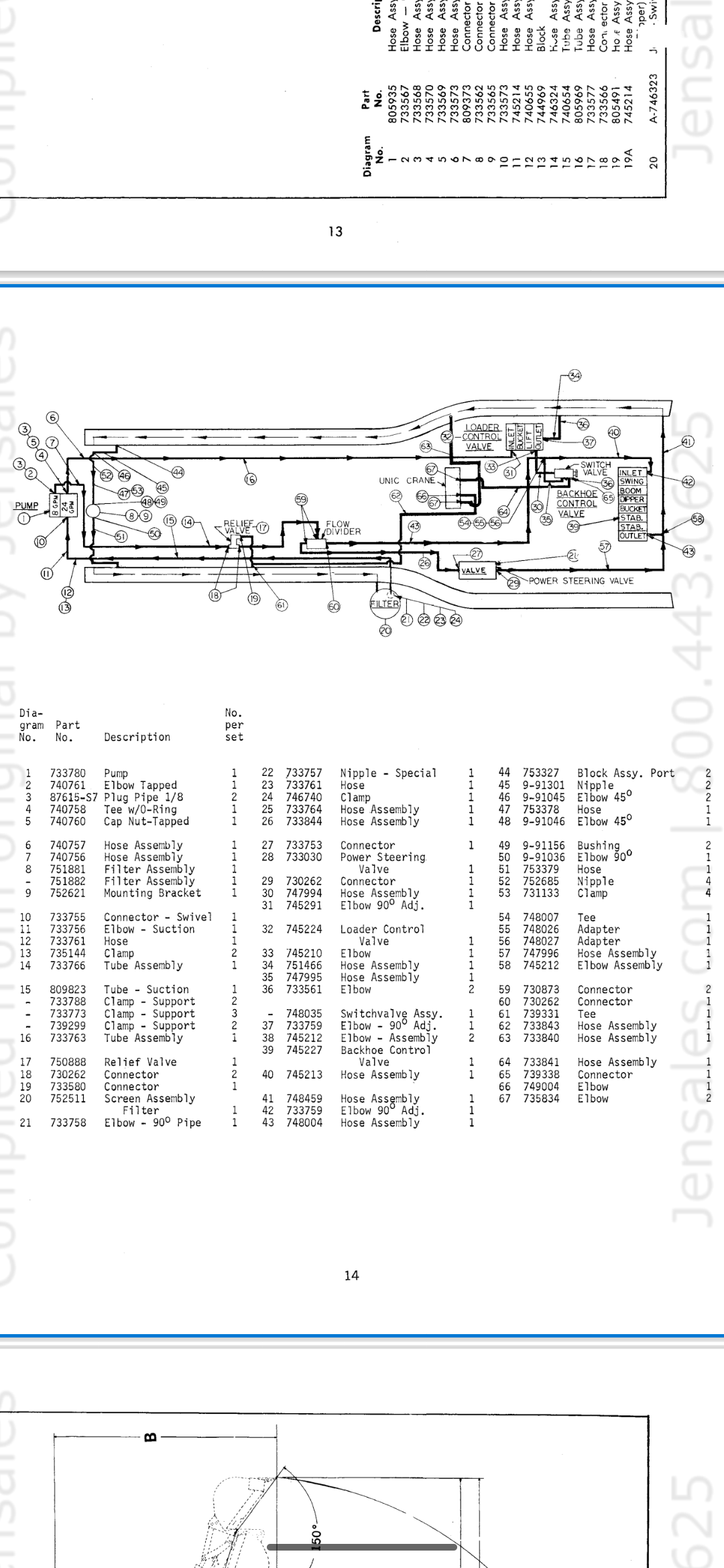
If you have a manual with a hydraulic schematic and can post a pic of the schematic, that would uber-helpful. As a first check, pull off the hoses at the dipper cylinder and see if fluid comes out when you operate the dipper valve. Then do the same for the hoses at the boom cylinder, and see what comes out when you operate the dipper and boom valves.
 
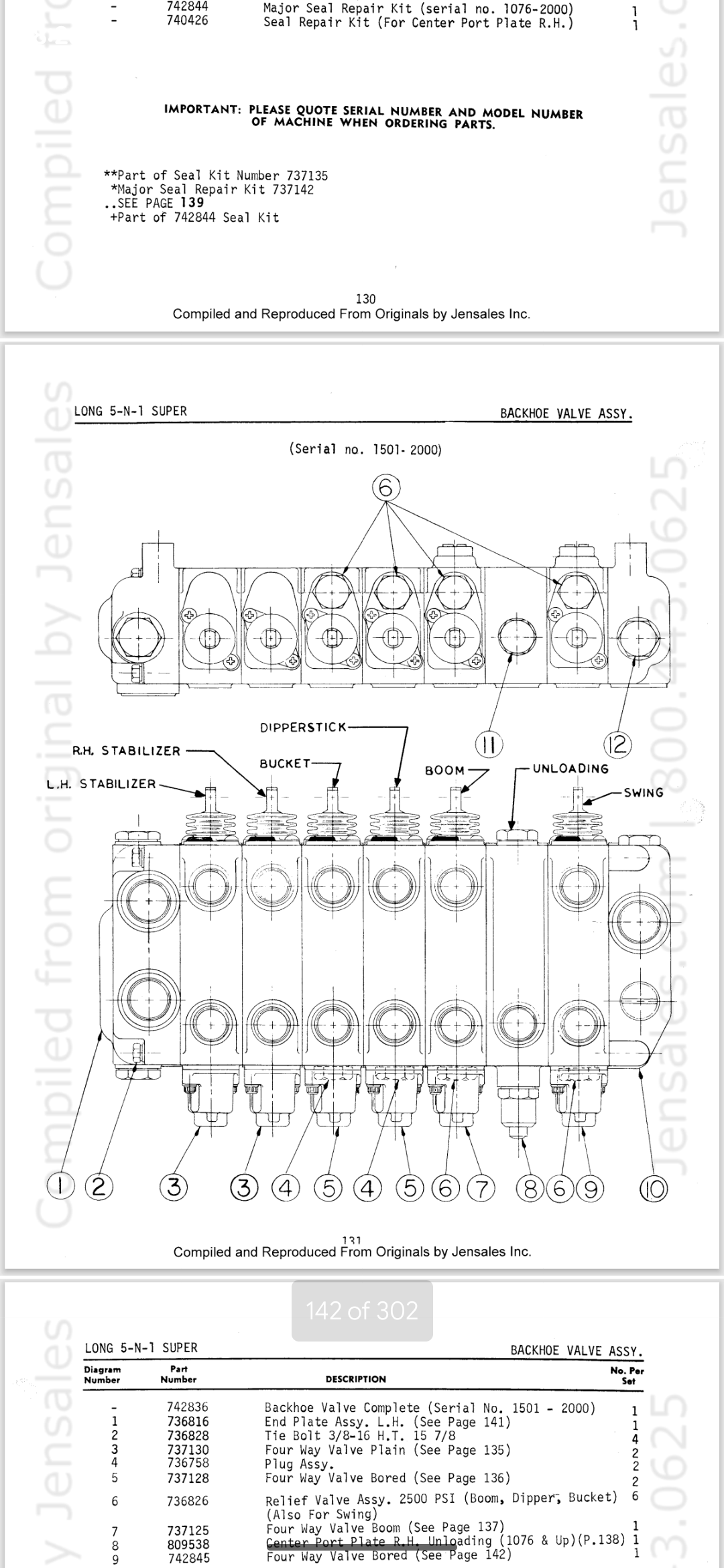
Just to clarify, because my last post wasn't very well worded: The two cartridges 'A' and 'B' would be the most suspect to me if you had them all out and they may have got mixed/matched. Cartridge 'A' is the one I would wonder about the most. I can possibly see how 'B' at the start of the stack might be a relief cartridge, but really not sure about 'A'. Seems to me like it might be a check, perhaps to prevent side-to-side wander once your swing position is set (because I think that furthest operating section 'F' is swing). Or perhaps more likely: Some sort of cushion function (most backhoe swing valves have some sort of dual crossover cushion relief). I'm quite sure all cartridges 'C' are (or rather: should be) reliefs.

Another guess, but I'm thinking a twin-stick hoe of that age would have Cat controls (not Deere)? If so, left/right on that left stick is to swing, while up/down on that left stick is to run the dipper? If correct, it looks like valve section 'D' is your dipper and 'F' is your swing. Section 'D' has something a little funkier than the rest of the sections, with protrusion in its casting at 'E'. Any idea what that is?

That's a lot of (probably incorrect) guess-work on my part. Really need to see a proper schematic to diagnose further. But I'd be wondering most about everything that goes on from B through D. With both Cat and Deere controls, section 'F' is going to be your swing. And knowing that pretty much all backhoes have some sort of dual-crossover cushion function for the swing makes me think something will be a little different in that region than it'll be for the rest of the sections.

1777378766282.png
 
Last edited:
I really can't see how the velocity fuses would cause the boom to function when you operated the dipper. If the problem were only no dipper function, then the velocity fuses might be suspect. But the fact that the boom operates when you try to operate the dipper doesn't make sense for a velocity fuse problem. But still worth checking: Does it have velocity fuses (the 'anti-drop safety valves' mentioned above)? If so, did you have them off at any point? If so, are they re-installed in the correct orientation? I've never seen velocity fuses on any older hoe like that, but admittedly I've never worked on a Long.

You said you had all the relief cartridges out of that sandwich stack. Do you have a hydraulic schematic to reference (and, if so, any chance you could post a pic of the schematic)? Are you 100% sure that they're all reliefs, and one cartridge isn't a reverse-flow/PO check or similar? Did you replace all o-rings on those cartridges? Easy for one to get torn when you remove one of those cartridges after they've been sitting/stuck in-place for the past 60 years.

This is just a guess, but I'd be looking at the o-rings between sandwich sections to confirm they're all in-place and new, confirming that all cartridges are indeed the same reliefs (that one non-operating section three in from the far side is the one that would really cause me to wonder), and making sure the o-rings on all those cartridges were good/new. Sounds like somehow pressure that's supposed to go to the A or B port on the dipper sandwich section is making its way to the boom section. Either from crossed lines (doubtful, as it's such a simple system), a bypassing o-ring that's allowing flow to go to a port it shouldn't, or cartridges not being in the correct configuration/location.

If you have a manual with a hydraulic schematic and can post a pic of the schematic, that would uber-helpful. As a first check, pull off the hoses at the dipper cylinder and see if fluid comes out when you operate the dipper valve. Then do the same for the hoses at the boom cylinder, and see what comes out when you operate the dipper and boom valves.
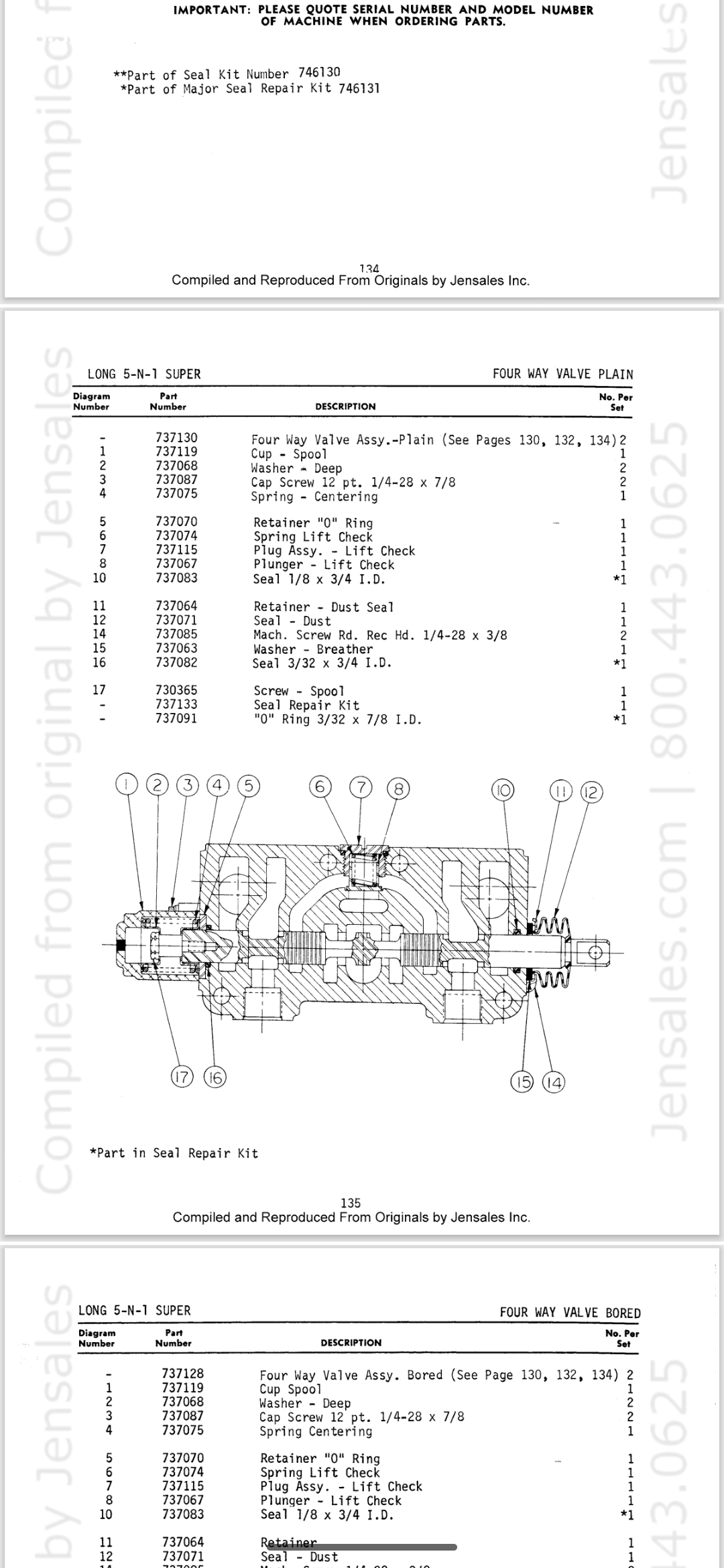
Thanks for the detailed reply. It is a mix of reliefs and plugs. There were also some sort of plugs you have to open with a flathead. I could not get those open. The manual calls them plug -lift checks. When I pulled the reliefs and plugs manual specifically states do no to disassemble the internals if springs are intact, which they were. Not sure which section you are referring to that is non operating, but there is what is an unloading valve. That is the only section that doesn't have a spool or linkage attached. I attached more photos but only allows 10. I have the entire manuals that ever existed for this thing if you need more. My serial is 1550 for reference.
 
Just to clarify, because my last post wasn't very well worded: The two cartridges 'A' and 'B' would be the most suspect to me if you had them all out and they may have got mixed/matched. Cartridge 'A' is the one I would wonder about the most. I can possibly see how 'B' at the start of the stack might be a relief cartridge, but really not sure about 'A'. Seems to me like it might be a check, perhaps to prevent side-to-side wander once your swing position is set (because I think that furthest operating section 'F' is swing). Or perhaps more likely: Some sort of cushion function (most backhoe swing valves have some sort of dual crossover cushion relief). I'm quite sure all cartridges 'C' are (or rather: should be) reliefs.

Another guess, but I'm thinking a twin-stick hoe of that age would have Cat controls (not Deere)? If so, left/right on that left stick is to swing, while up/down on that left stick is to run the dipper? If correct, it looks like valve section 'D' is your dipper and 'F' is your swing. Section 'D' has something a little funkier than the rest of the sections, with protrusion in its casting at 'E'. Any idea what that is?

That's a lot of (probably incorrect) guess-work on my part. Really need to see a proper schematic to diagnose further. But I'd be wondering most about everything that goes on from B through D. With both Cat and Deere controls, section 'F' is going to be your swing. And knowing that pretty much all backhoes have some sort of dual-crossover cushion function for the swing makes me think something will be a little different in that region than it'll be for the rest of the sections.

View attachment 149940
 

Attachments

  • Screenshot_20260428-082839_OneDrive.png
    Screenshot_20260428-082839_OneDrive.png
    770 KB · Views: 20
Ah.. an unloading valve. That makes sense. Right where it should be too. Why didn't I think of that? Hmm... Shows what I know...

Looks like I was right about the furthest section being swing, but I was wrong about the Cat controls - looks like yours are Deere (SAE) controls. Will have to do some more pondering.

I'm sure you've checked this, but are you 110% sure you don't have a hose between the boom and dipper sections crossed? If, for instance, the hose from the dipper valve port that is supposed to be leading to the dipper extend actually goes to the boom extend (and vice-versa), you'll get boom movement when you try and extend the dipper - even without operating the boom valve, because you'll have the pressure multiplication factor of the rod vs. lack-of-rod area on the boom cylinder, so return from the cap end of the boom piston would be able to go over the relief even though the pressure to the barrel-end isn't. It also wouldn't move the dipper when you operated the other way, because you're feeding to the cap end of the dipper cylinder and the rod area works to your disadvantage, so it would just deadhead over the relief. And it would also cause a regen scenario when you try top operate both levers and thus the violent action you descibe... I think... Trying to picture the schematic/routing it in my head and not doing a great job. Need a sketch pad in front of me to think about it properly.
 
No worries. I am new to tractor hydraulics. I am a former helicopter mechanic and worked on hydraulics and airframe, but it is a very different world when things are flying vs on the ground. So I am just learning myself.
If you were to troubleshoot this is swap hoses around what would be a good way to do it? Swap one hose at a time and test it? Very specifically how would you go about this? I wish I could trace the hoses from each cylinder but both are inside the boom so it is very difficult.
 
I think the first/easiest thing I'd do is undo the four lines from the dipper and boom cylinders (label first, if they're the type of cylinder with both hose connections right beside each other), stick them all in a bucket, and see which ones spit out oil when you operate the dipper control in/out, and then the boom control up/down. Might need a second person watching/holding them. Be careful: Hydraulic fluid under pressure can do some nasty damage to the skin. It'll likely be a bit of a mess, but you shouldn't need to dump much fluid just figuring out what goes where.
 
Last edited:
I think the first/easiest thing I'd do is undo the four lines from both cylinders (label first, if they're the type of cylinder with both hose connections right beside each other), stick them all in a bucket, and see which ones spit out oil when you operate the dipper control in/out, and then the boom control up/down. Might need a second person watching/holding them. Be careful: Hydraulic fluid under pressure can do some nasty damage to the skin. It'll likely be a bit of a mess, but you shouldn't need to dump much fluid just figuring out what goes where.
Okay makes sense. Only problem is, the boom lines can't be reached. Detaching from cylinders would be pretty difficult.
I wanted to also say, from what I could see just by tracing the lines and looking up inside the boom, it looks like boom and dipper lines are mix-matched. It's really hard to see inside the boom, but I'm almost certain they are mixed up.
 
Okay makes sense. Only problem is, the boom lines can't be reached. Detaching from cylinders would be pretty difficult.
I wanted to also say, from what I could see just by tracing the lines and looking up inside the boom, it looks like boom and dipper lines are mix-matched. It's really hard to see inside the boom, but I'm almost certain they are mixed up.
Sounds like you might be getting to the root of your problem. It might be only one line from each cylinder mismatched. Even if you can't get at the boom cylinder, you can do the bucket trick with the dipper cylinder and see what valves (and in what directions) send fluid there, which will probably still tell you all you need to know.
 
Sounds like you might be getting to the root of your problem. It might be only one line from each cylinder mismatched. Even if you can't get at the boom cylinder, you can do the bucket trick with the dipper cylinder and see what valves (and in what directions) send fluid there, which will probably still tell you all you need to know.
I have to say thank you for your help, even if it was a simple fix. I confirmed two lines were mix matched. I switch them back and dipper work, boom works, it's perfect! I been at this for months my friend. So I can't thank you enough. Thank you so much!
 
Glad you got it. Keep her greased and good oil in the hydraulics and engine, maybe a smidge of lube in the diesel fuel to keep the injection pump ticking away nicely, and she'll probably outlive you. Once you have a working backhoe on the place you'll find way more uses for it than you would have previously thought. I'm guessing from your handle you're a Lord of the Rings fan. Maybe use it to build yourself a Hobbit-hole guest house (I'm only half joking - I know a guy that did just that with a hoe, some armour-stone, and a do-it-yourself shotcrete sprayer).
 
Glad you got it. Keep her greased and good oil in the hydraulics and engine, maybe a smidge of lube in the diesel fuel to keep the injection pump ticking away nicely, and she'll probably outlive you. Once you have a working backhoe on the place you'll find way more uses for it than you would have previously thought. I'm guessing from your handle you're a Lord of the Rings fan. Maybe use it to build yourself a Hobbit-hole guest house (I'm only half joking - I know a guy that did just that with a hoe, some armour-stone, and a do-it-yourself shotcrete sprayer).
Absolutely! Problem is it doesn't have any hydraulic filter or screen. Someone must have removed it and replumbed a pipe in its place. This tractor uses the frames as a reservoir and they connect at the front. There used to be a filter housing there. What sucks is it is tight against a cross member so it would be a massive pain to retrofit a filter. It also used to have a screen in the full port but that's also gone. Not sure what to do with that. I know how important filtration is for hydraulics.
I did burn a little bit of ATF mixed with my diesel. But yes I am very excited. My pins are really bad on the hoe so those will need line bored unless there is another option out there. Line boring is expensive!
I am a LoTR fan, that is where my name came from. Sounds like a great idea!
 
I've never had or even driven a back hoe. Would some one please explain to this dummy what a dipper function is?
 
Yesterday's Tractor Forums

We sell tractor parts! We have the parts you need to repair your tractor - the right parts. Our low prices and years of research make us your best choice when you need parts. Shop Online Today.

Back
Top