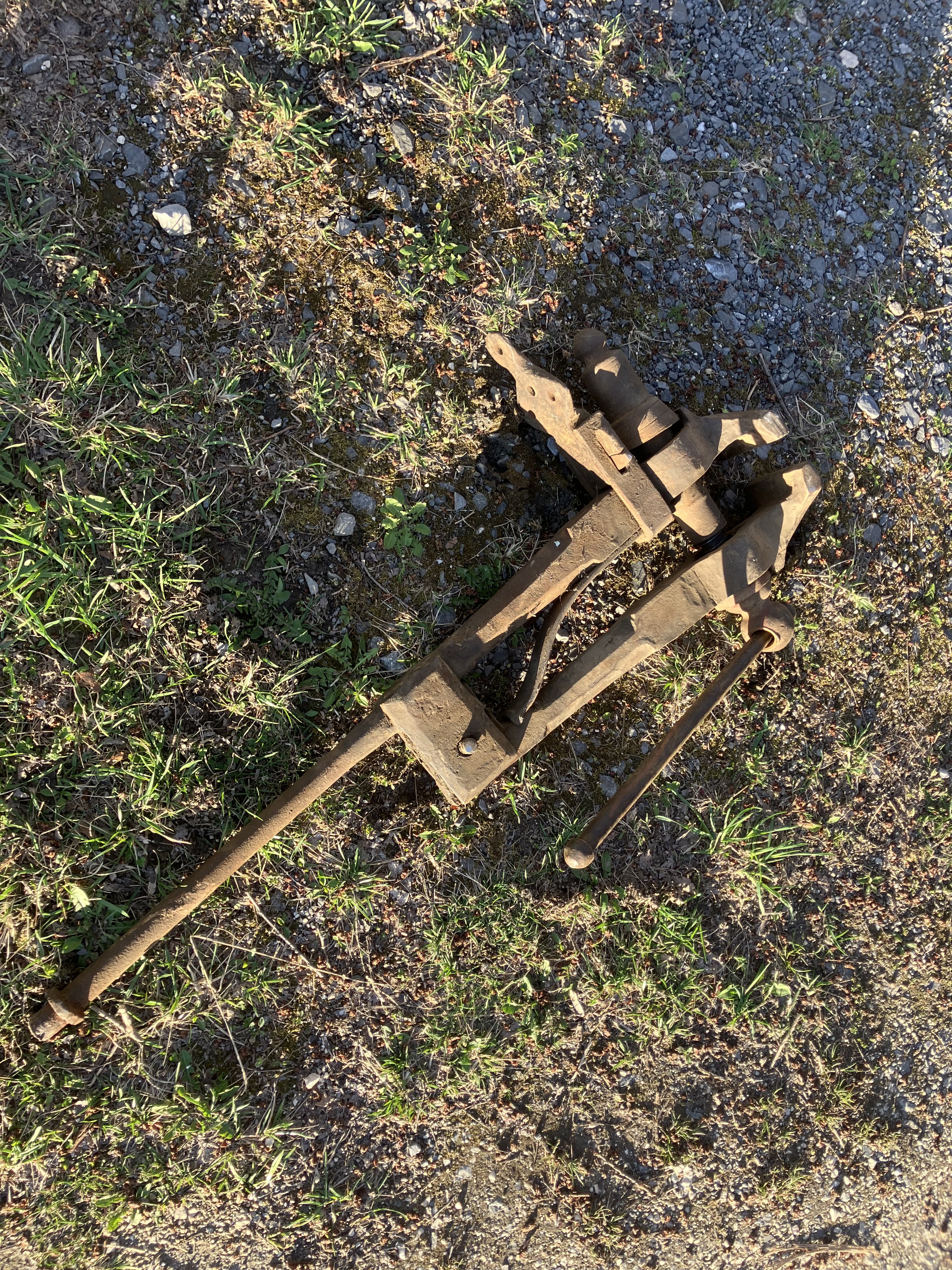
Blacksmith’s post vise

RedMF40

Not from Iceland!
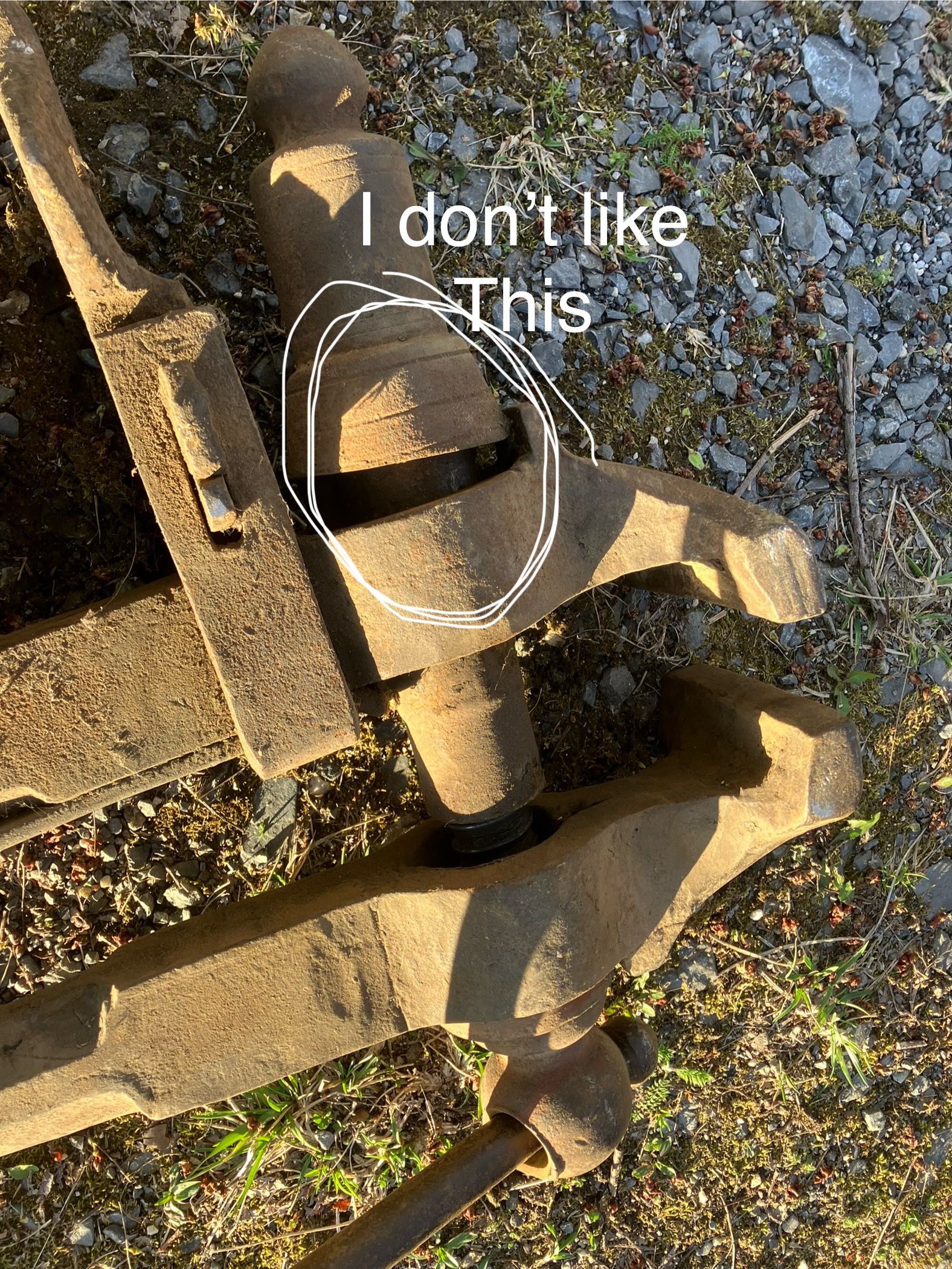
I bought this along with some other tools. It actually tightens and clamps down so far as I can tell but I don’t like the alignment in the photo. It looks out of whack. Just extreme wear? Bent shaft? Both? Not sure I’ll put it to use, had planned to mount it to something solid outside my workshop. Nice, heavy tool with some age on it. Thanks for any thoughts.
IMG_1849.jpeg
IMG_1850.jpeg
IMG_1850.jpeg
 
Normal. The pulling force touches gust at the top of the "keyhole" through which the "nut" passes. This is because the force is directed to close to the non moving jaw. The pivoting of the jaws together causes the actual jaw surfaces to be non parallel until they are at or near closed. at which point the "nut" will have nearly become flat to the non moving hole. But not quite. All good. Jim
 
Thanks for that. Just need to find a massive tree trunk or similar if I want to set it up.
 
You spreader spring looks like it might be a tad weak. Maybe have a crack in it or just weak.
I have one exactly the same as yours. They all look nearly the same except the mounting plates vary a lot.
You might want to place the peg leg into a hunk of iron. Like a lifting barbell weight or similar.
 
You spreader spring looks like it might be a tad weak. Maybe have a crack in it or just weak.
I have one exactly the same as yours. They all look nearly the same except the mounting plates vary a lot.
You might want to place the peg leg into a hunk of iron. Like a lifting barbell weight or similar.
Spring could be weak. A tap from a hammer made the jaws open quickly.
 
Spring looks fine. They don't open up as wide and a bench vise because the front jaw pivots and would not be parallel to each other. Working with much more than an inch thick material the jaws will tend to let it slip upward. They normally are fastened to a bench with a hole in the floor or other anchor method for holding the bottom end. Like bolting to the top of a bench then having a pocket st the bottom or a ring that fits tight around the bottom end so it doesn't twist sideways or flop around when pulling or pushing on it. I doubt a tree or stump would work very well for it. We have one in the shed . It has a hole in the floor for the bottom end to set in with a pipe in the floor up around the leg.
 
Last edited:
I bought this along with some other tools. It actually tightens and clamps down so far as I can tell but I don’t like the alignment in the photo. It looks out of whack. Just extreme wear? Bent shaft? Both? Not sure I’ll put it to use, had planned to mount it to something solid outside my workshop. Nice, heavy tool with some age on it. Thanks for any thoughts.View attachment 109300View attachment 109301View attachment 109301
I have one that is part of a package deal from Sears eary 1900s. I have the anvil,forge blower and damper assembly, and A hand cranked drill press that can be used with electric motor. The work plarform is missing on the drill press. My Dad's uncle had the identiacal setup in his shop. When I was a kid I spent a lot of time cranking the forge blower.
 
This is what I've been using for the last several years.
The post is an electric pole cutoff set 3 feet in the ground
& 33" above ground. Bottom is secured with a strap & 2
lag screws. Top is secured with 4 lag screws.
I oil the moving "hinge parts" every couple months & grease
the worm occasionally.
Jim
 

Attachments

  • IMG_4536.jpg
    IMG_4536.jpg
    4.1 MB · Views: 57
I bought this along with some other tools. It actually tightens and clamps down so far as I can tell but I don’t like the alignment in the photo. It looks out of whack. Just extreme wear? Bent shaft? Both? Not sure I’ll put it to use, had planned to mount it to something solid outside my workshop. Nice, heavy tool with some age on it. Thanks for any thoughts.View attachment 109300View attachment 109301View attachment 109301
How that one is is pretty much how they are. I have my grand fathers pole vise I use in the shop
 
Ours is mounted like Pitalplace has his only the pipe goes through the cement floor with a wood shim drove in beside the leg to hold it tight .Been that way since I was a kid. Probably 65-75 years. Dad could tell me since he remembers when they moved that building from a 1/4 or so mile down the road from where it is now. Had to be since grandpa got the blade for the Cat since he was back filling the old foundation in the field. When he buried it.
 
Missed out_. A friend has been a blacksmith for over 50 years, he passed away 4 years ago and I never knew. His wife sold the entire shop to one person somewhere out East. I'm guessing it took 3 semi's W/lift gates to haul everything.
 
My understanding is that this kind of vise is built to withstand some serious pounding. Hence the post which transfers the pounding to whatever it's resting on. I don't know that I'm going to give it that kind of abuse, so I'm reluctant to disturb my nice concrete shop floor to create a base for the post. I do have some robust chunks of wood that I can try out. Screw the vise in at the workbench and let the post rest in a hole in a thick block of wood. Maybe to keep things in place I could use some good quality builder's adhesive between the wood and the floor. Not permanent, since I could always pry the wood off if I decide to go in another direction. I do have a good bench vise already, so I'm trying to see how this new one fits into the whole scheme of things. I'm sure I can find a place for it.
 
Missed out_. A friend has been a blacksmith for over 50 years, he passed away 4 years ago and I never knew. His wife sold the entire shop to one person somewhere out East. I'm guessing it took 3 semi's W/lift gates to haul everything.
That must’ve been some Shop.
 
I bought this along with some other tools. It actually tightens and clamps down so far as I can tell but I don’t like the alignment in the photo. It looks out of whack. Just extreme wear? Bent shaft? Both? Not sure I’ll put it to use, had planned to mount it to something solid outside my workshop.

Here is what I did to mount one.
The stand is a rear axle housing from a Ford 4000. I left all the brakes and planetary gears in the bottom for extra ballast. It sits outside in the dirt for grinding on stuff but I can move it with the loader if needed.
Grinding outside keeps my shop a lot cleaner.
 

Attachments

  • cvphoto122892.jpg
    cvphoto122892.jpg
    456.8 KB · Views: 69
Here is what I did to mount one.
The stand is a rear axle housing from a Ford 4000. I left all the brakes and planetary gears in the bottom for extra ballast. It sits outside in the dirt for grinding on stuff but I can move it with the loader if needed.
Grinding outside keeps my shop a lot cleaner.
That’s a good idea. The grinding is an issue for me, too. Would rather keep the dust and grit outside.
 
We had one like that bolted to a 30-gallon barrel filed with concrete, inside our Quonset machine shed, I used it a lot when I was young. It stayed on the farm when it was sold, but I have a big vise outside my garage at our tree farm, bolted to a heavy steel table, that's where I do my welding now.
 
That must’ve been some Shop.
Every time he got wind of smithy tools for sale he went. Instead of having 1 or2 like tools he had racks of them. Last time I was there he had a bunch of forges. I doubt my Chevy dually would've been able to haul his anvil collection.
 
Yesterday's Tractor Forums

We sell tractor parts! We have the parts you need to repair your tractor - the right parts. Our low prices and years of research make us your best choice when you need parts. Shop Online Today.

Back
Top