Calcium or No?

I would like to hear people's opinions on whether or not putting calcium in an old tractor's rear tires is a sacrilege. When I say old, I'm talking about a 1947 JD D. The tire company I called
today recommended it over beat juice, because that gets too thick in the winter to pump.

I imagine this topic has been covered here before, but I haven't read it.

Thanks folks.
 
I guess it comes down to weather or not you need the extra weight? If your only doing work that is considered lite for your tractor maybe you don?t need it ,if your planning on doing work that?s considered heavy pulling for your model of tractor I?d put it in.
 
IF you never have any kind of leak in the tube calcium is fine. However any leak at all and your rims will rust. How bad they rust is based on how long and how big the leak is.

Tire dealers do not like Rim guard (unless they are selling it LOL) as it is a little harder to handle as far as flow. They also then have to have separate tanks on their trucks. So many of them do not recommend it as it makes their life easier to just use calcium. The tire dealer could care less about your rims rusting out in ten years or some thing.

I only have one tractor with calcium in the tires. The rest either have rim guard or cast/steel weights. Truthfully weights are better as the tire is more flexible with a larger air pocket inside.

Your tractor, your call.
 
As has been said before, if you?re not pulling then I would not. If you are planning to pull I?d go with weighs first. CaCL last. I don?t pull hard with my old tractors so I d rather have good rims and pretty tractors. I have newer tractors to pull heavy loads.
 
(quoted from post at 21:06:51 08/12/19) I would like to hear people's opinions on whether or not putting calcium in an old tractor's rear tires is a sacrilege. When I say old, I'm talking about a 1947 JD D. The tire company I called
today recommended it over beat juice, because that gets too thick in the winter to pump.

I imagine this topic has been covered here before, but I haven't read it.

Thanks folks.

"that gets too thick in the winter to pump"

WHAT the heck are you doing that would require the tire ballast fluid to be "pumped" in the cold wintertime???
 
Rims seem to rust out 20 to 40 some years after there is a fluid leak inside the rim, especially if the rim was not cleaned up properly after a leak. Most older tractors were designed with the idea that they would be obsolete in ten years and that half or more would be worn out after twenty years. So long as rims lasted longer than the expected life of the tractor, that was adequate to the first owner that was paying good money for the brand new tractor. So, what are your plans for the tractor 20 to 40 years from now?

Cast iron weights currently sell used for around $1 or less per pound, several times that much new. CaCl2 fluid costs considerably less then cast iron. For a tillage tractor that pulls hard for 500 to 1000 hours per year, cast iron is probably better for the improved performance. For a loader tractor or daily feeding tractor, fluid is adequate and much less expensive than cast iron.
 
I own several "D" John Deer's??.One 2-N Ford....a Ferguson TEA-20...a MF FE 35 X..and others..etc,etc,
These Tractors were purchased with liquid Calcium in them....

I own a John Deere 520....with NO Calcium in the rear tires...

I personally would never add Calcium to a rear Tractor Tire.

If I required rear Tractor Traction......I would add weights....

I had a rear flat(lacerated side wall)on a Case 970 with Calcium loaded rear Ties.....*^&**%# ?...970 now has weights...??.:)

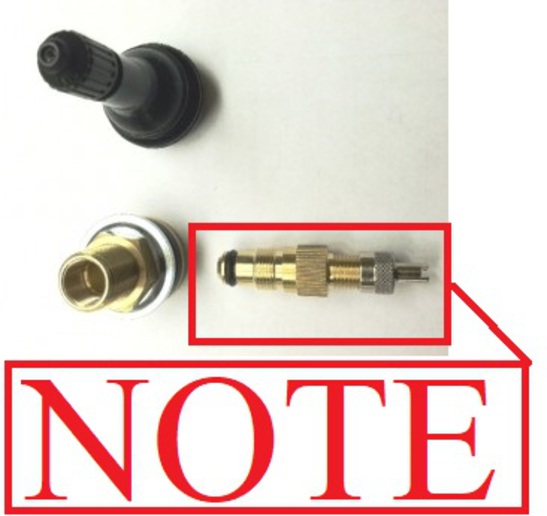
All my Tractors that are 50 years + have had the VALVE STEMs replaced...Calcium Valve stems are not one piece valve stems.....When they start to leak...you shall obtain a head ack with in a few seconds after trying to separate the two main sections so as to replace parts.

I would never add Calcium for Traction given the usage for the Tractors I run.

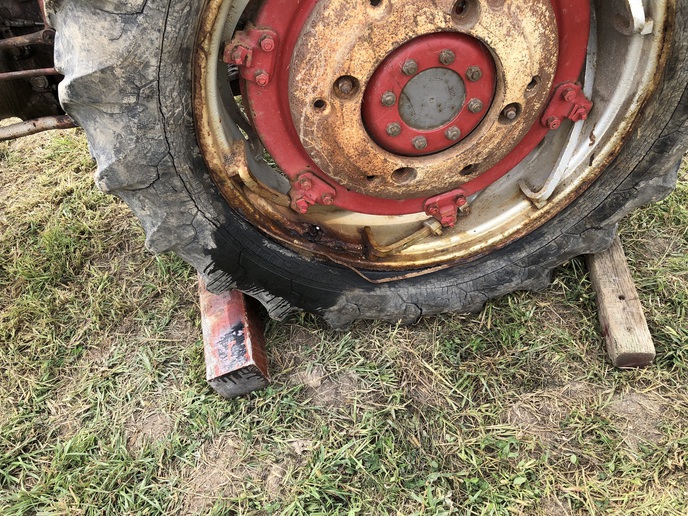
Bob....Just Replaced a Rear Tire / wheel assembly on a Ford 2-N due to Calcium leakage and destroying Rim...

cvphoto33269.jpg
 
I'm doing away with fluid in all my tractor tires as I need to change them for some reason.These days its pretty expensive to have the fluid put in and out and if you have a flat the fluid
is gone most times.With weights you buy them once and they last forever,plus they can be taken on and off the tractor pretty easily as needed.Most tire places in my area
have gone to Methanol anyway.
 
Is this a working tractor? If it doesn't need ballast don't add it.

It seems there are three popular options for ballast, and tire shops disagree over which to use. The issue is that shops typically only work with one ballast, so you're stuck using whatever your local shop uses.

Calcium chloride: cheap and heavy but corrosive
Rimguard (sugar beet juice): heavy and non-corrosive, but very expensive. Some shops have quit using it because their equipment doesn't like it.
Windshield washer fluid: less expensive than Rimguard and non-corrosive. Lighter than straight water.

I bought mounted tires and wheels with ballast from Miller Tire in Wauseon, OH. They sell a lot of tractor tires, and windshield washer fluid is all they use. Personally I would not use CaCl, since it has fallen out of favor and most shops are only doing either Rimguard or washer fluid.
 
My question is not about using calcium or not, but will you actually use the tractor for farm work, or just take it to shows? A tractor used with tillage equipment needs balanced to provide traction, not so important if you are just pulling a mower or rake. I don?t own show tractors, I own work tractors, and the loaded tires are a must for me. I am not too worried about rotting a rim away with calcium, if the tire has a leak, it?s going to go flat. Keep good tires and tubes and leaks aren?t much of a worry.
 
I have fluid in all mine, but they are all working tractors. Takes many years to rust a rim, most of those being repaired or replaced are original to the tractor on tractors that have been neglected and brought back. There is nothing that pulls as good as a tire with fluid in it. Now if it's a show tractor or light use then the advantage of not having to pump fluid for a flat out weighs the traction. I will say that the new tires and tubes don't seem to be as durable as older tires and flats are more common today because of it. But the chances that a good time today will rust out in your lifetime are pretty remote if you keep them in good shape.
 
Ask yourself how available are replacement rims for your tractor? If you can't find any then why add calcium (rust)?

I don't see a need for ballast in my tires. My tractors are lawn mowers in summer, push snow in winter. Extra weight to puts ruts in yard. I also trailer my tractors, I don't want heavier tractors.
 
My opinion is if you need much more weight than several sets of wheel weights add then you need a bigger tractor.Many tractors got a bad reputation with gearing and rears because they were way over
loaded with more weight than ever rated by the manufacturer.
 
Cutting wood. I do that far too much--October through April. This tractor's gonna replace my A for that, as far as I've planned at least.
 
I plan to use this tractor for plowing, discing and cutting wood. I intend to fix it up (got it fairly cheap) and sell it down the road for something more practical for what I'll need then. So yes, it'll be a working tractor, not a show tractor, at least at first. I keep my A light for hay work, but it's terrible in snow for cutting wood. I want to hit this winter with something heavier.

I hadn't heard of windshield fluid. I'll ask the tire company about that. I'ver heard of Miller Tire down there but haven't bought from them personally.

Thanks for the input. I appreciate it.
 
Have you ever had a problem with it in the cold? (I can't see where you're from, so I don't know if it gets cold where you are.) Maybe telling me it's hard to pump is just the tire company's story to sell me what they have.
 
(quoted from post at 20:39:56 08/12/19) I have replaced too many old tractor wheels because of Calcium....just my opinion.

Key word being OLD!!!

If you were replacing NEW rims because of calcium, it would be a whole other story, but the rims you are replacing are decades old.

The reason why you're replacing the rim is because the leaking tube was not fixed when it started leaking, decades ago.

In a nutshell CaCl is not an instant death sentence. Are you still going to be around in 40 years when the rim needs to be replaced again?
 
I'm not replacing the rims at this point. I hope I never need to. I need weight for cutting wood in the snow and for plowing and discing. I have one set of wheel weights that I took off my A, but I need more weight. Just considering the opinions here of people in the old tractor world for the day when I do sell this old thing.
 

Joel, this topic is actually discussed at length here EVERY month. The scientific fact to it is that CaCL has NEVER rusted out a rim. The cause is actually procrastination. Rust is OXIDATION. Oxidation requires the regular supply of more oxygen. Joel, you must be aware of tubeless radial tires. Well, they have been used on farm tractors for over 25 years. Tubeless radial tires on new tractors going to the field to work usually get CaCL installed at the dealer, WITH NO TUBE. If you will air a leaking tire up every other day instead of getting it fixed CaCL is not for you. If you take care of your equipment you have nothing to worry about.
 
Mark there is actually one more choice. Ever tire & and tractor dealer in this area installs a mix of methanol and water. Usually mixed 1/3 methanol and 2/3 water. And yes it weighs less but most folks get buy with it. We are too far south for the beet juice, freight makes it to costly.
 
I've seen rims that developed a leak away from the valve stem and the first sign of any problem was the hole that came in the rim,Calcium in tractor tires is like playing with a Rattlesnake
sooner or later it'll get you.
 
I would try and avoid using it if you can. Your D should handle a plow fine without it. Should be pretty easy to find cast iron weights for the D unless you have spoked rear wheels ? You are limited to a trailer plow ,but if set up properly you can get them to pull down on the tractor to aid traction. The owners manuals have good info on adjusting them.
I only have fluid in loader tractors. Hard to get enough wheel weights alone for them. My newer one has the washer fluid stuff in it. Not as heavy as I would like to be safe ,but a 3 pt counter weight can be hooked up for heavy lifting.
 
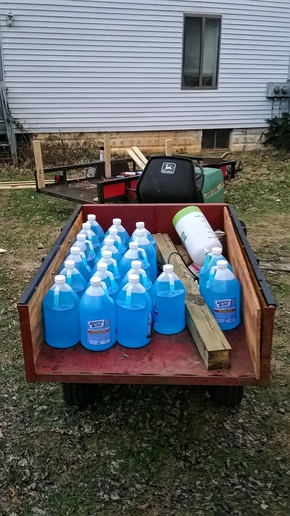
Read through the replys. That salt will rot evrything out if you don't catch it or fix it. Now after you replace your rims. Last fall around November Home Depot had a special on -20 ? Washer fluid for $.98 per gallon. I bought ten and then a day latter bought another ten. There were a couple waging tongues saying what in the world will you do with all of it. Well I sold a coulpe to a neighbor, used four in my Expedition, all but one remaining bottle went in the rear tires of three lawn and garden tractors. It drops the center of gravity several inches on lawn tractors and it gives you much better traction. ONE bottle left. Works great although just a bit lighter. Doesn't rot stuff and low toxicity. This fall if Home Depot has the special again I think several cases will follow me home.
cvphoto33283.jpg
 
Fluid is fluid, whether it's CaCl, wiper fluid, methanol & water, or beet juice, you get a leak in the tube it all has to get pumped out to patch the tube. I've gone to cast iron weights on both my loader tractors, and for traction in mud & snow I run tire chains. Seen guys use tire chains doing fieldwork too.
My one tractor is 68 years old, never had fluid, rims still look like new. Other tractor is 65 yrs old, had fluid since new till 5-6 years ago, had a slow leak in one tube, maybe both, got the tires/tubes off and lots and lots of rust on the rims, sand blasted and primed and painted them and rust is coming back! I see new rims for that tractor in my future!
 
Well, I figured it's been brought up before. Sorry to be repetitive and not know what's going on here.

That's an interesting take on it. I didn't know chloride was ever put in a tubeless tire.

I was kind of wondering if chloride is a turn-off to someone buying a tractor as a show or otherwise non-farming machine. Maybe I should have asked that outright from the start.
 
Hmmmm. So you're saying wet is wet, and any of them are a problem?

The tire company told me the fluid in these tires, which are 16.9-30s, would weight about 1400 pounds. That would be 9 wheel weights if they weigh 150 pounds a piece. I think that's their weight anyway. I have only one set.
 
Good advice. Thanks. I plan to pull a 4-14 plow in sod, plowing up old hayfields next year. I hope it can do it. Since my A's manual says it can pull 3-14's in "good conditions" it seems like the D should pull one more bottom in average conditions. We're on sandy loam here. My dad's 80's manual calls for 4-16's, and he pulls 5-16s with it all the time, if that tells us anything.
 
I had my A's tires worked on several years ago, and I considered changing them, since they're old, dried and cracked all over the surface. They even have cords showing through on the sidewalls. I asked the tire guy his opinion, and he told me the new tires aren't nearly as thick and good as these old ones. He showed me the walls on mine and how thick they are and said the new ones are half that. He said my old tires will last a long, long time yet. I was impressed by his honesty and also by what sounds like cheap modern stuff.
 
It'll be worked as long as I own it: plowing, discing, cutting wood in snow. I'll probably keep it five to ten years and sell it as my farming needs increase and change. I should get more than I payed for it so I can buy a 620 or 720 or whatever I need then, depending on the work.
 
Agreed but first of all we buy the methanol in 55 gallon barrels and do the mix here. Saves freight on all that washer fluid and the end cost is about 1/2 the cost of washer fluid or less.
 
You can't get that damn salt out of the steel. There is supposed to be something from NAPA but don't know the name.
 
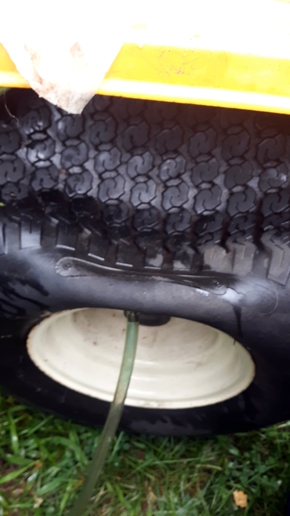
Yes but it isn't that pretty blue color. :) As soon as Home Depot has a special with that -20? wash fluid I will let everyone know. Can't beat $.98 a gallon with a stick. If you have a little lawn or garden tractor fill the rears with washer fluid to the top of the rim. Do NOT try to fill the tire to the top cause it will ride like a brick. You need some air so the tire can flex. It drastically lowers the center of balance on the machine. No more high side wheel just spinning in the air on an embankment. Jack up the rear and remove the valve core. Use a little plastic tube and a funnel. Push down on the tire to expell some air and then start pouring wash fluid in and let it suck into the tire. Take about half an hour per tire and many need a little more than three gallons .
cvphoto33332.jpg
 
Showcrop, the last thing I want to do is start an argument here, but you are very wrong. In 1996, we sold
a customer a new Massey 8150 tractor, only to be told it would be 4-6 months before it was built. We
tranferred a tractor that was on a dealer's lot in the next state. When the truck showed up, the tractor
wasn't on the lot, it was "out on demo", so the trucker had to pick it up at the farm. The farmer was mad
that they were "taking the tractor he'd leased before the lease was up!" The dealer had filled the
tubeless tires with calcium chloride, when the owner's manual clearly stated to install tubes when doing
so. The 20.8R42 tires were ruined from being run in rocky ground. Our customer finally agreed to accept
it, with a discount for the hours because he needed it, but only if the tires were replaced. We pumped
the CaCl out, removed the tires, and the rims were already extremely rusty.

You say they need oxygen to rust, and you are right, but no tire is completely filled with liquid. The
all run at least 25% air, and the last I heard, air still contained oxygen.
 

Jwmfarms, You are entitled to your opinion. I will have to check on some owners manuals. I will also check with my friend at GCR tire. Last I knew radials chewed tubes up, and I know that a dealer near me filled them with no tubes. So far as oxygen in air, yes, there still is, but try putting a plastic bag over your head and see how long you can keep getting oxygen out of the air that is in it.
 
I used a forged iron fireplace poker to get the salty snow out of my car's underparts once, and the piece immediately rusted (of course). I washed it, wired brushed it, varnished it, and it still rusted. I did that three times. I never was able to get it to quit rusting, so I just left it with a brown patina--permanent rust. I can imagine the same is true with a chloride leak. Thanks for the input, Jeffcat.

I'd like to know if having chloride in an antique tractor hurts its value to collectors. I called my tire place yesterday, and they don't use windshield washer fluid. They said it's too expensive. Chloride is what they recommend.
 
So is it flammable at that point? Our neighbor lost his barn last year. I'd heard it was a block heater that started it, and the tractor tires caught on fire. Maybe he had them filled with alcohol. Don't know, but it seemed really odd to me that tires would burn like they did.
 
Yesterday's Tractor Forums

We sell tractor parts! We have the parts you need to repair your tractor - the right parts. Our low prices and years of research make us your best choice when you need parts. Shop Online Today.

Back
Top