


I have a 12 volt coverted front mount distributor and going to upgrade my coil to 12 volt type. I read one of Bruce"s tips that said the top wire on the coil should be battery voltage. I have a GM alternator with internal regulator and was wondering if I still needed the factory resistor on the tractor. My lights have all been changed over to 12 volt also. Also does anybody know what the voltage and amp readings should be at the coil top wire? Thanks.
You are using an out of date browser. It may not display this or other websites correctly.
You should upgrade or use an alternative browser.
You should upgrade or use an alternative browser.
Bruce (VA)
Well-known Member
Technology & materials being what they were in the 30's, that square coil would melt if it ran on much more than 4 amps for any length of time. (see tip # 38 for an example). In order to get a hot spark at the same time the starter was drawing max current from the battery, a ballast resistor was added in the ignition circuit. What that did was add about .3 ohms of resistance in the circuit, added to the 1.5 ohms of the coil. That got you 3.5 amps or so at start up. As the voltage increased when the engine was running to about 7.5 volts, the resistor heated up, adding more resistance in the circuit. 1.0 ohms hot, plus 1.5 ohms of the coil got you down to 3 amps or so to keep from melting the coil. The same rule (actually, Ohm's Law) applies to a 12v circuit. I= E/R. Current equals voltage divided by resistance.
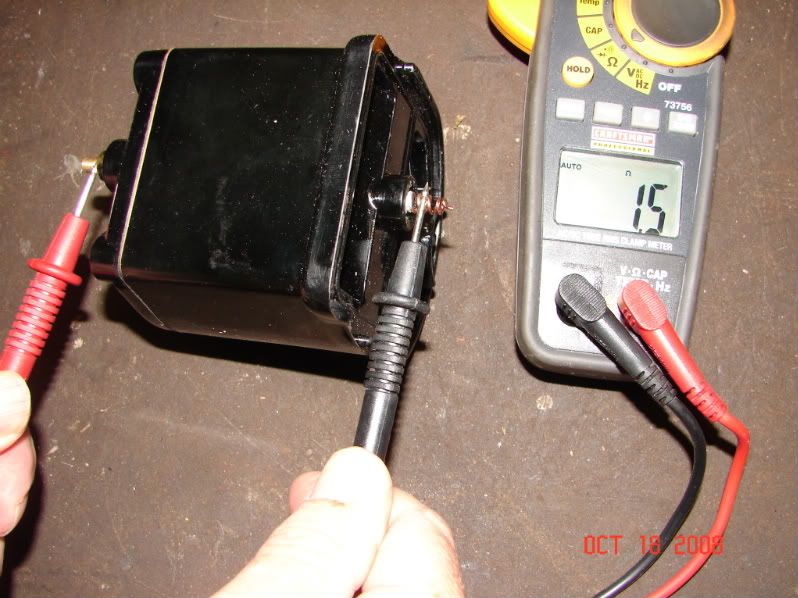
It used to be before the "Land of Almost Right" started making coils that you could count on a 12v frontmount coil as having 3 ohms of internal resistance & the 6v coils as having 1.5 ohms or less. Thus, thanks to Ohm's Law, you could calculate what additional resistance you needed in the circuit to limit coil current to 3.5 amps. So, you will need to measure the internal resistance of that alleged 12v coil & see what it is. A digital multi-meter has two probes & a switch. Set the switch on resistance. Put one probe on the top of the coil & the other on the pigtail at the bottom. It will give you a reading in ohms. Lets just say it reads 3.0 ohms. Your OEM ballast resistor (which you must use) is about 1 ohm hot. A coil a 3.0 ohms, plus the ballast resistor at 1 ohm (hot) gives you 4.0 ohms resistance in the circuit. Your 12 volt alternator puts out 14.5 volts. You need to determine current (amps). 14.5 v divided by 4.0 ohms gets you 3.6 amps; that's ok. But, and this is the problem......what if the coil is only 2 ohms? Do the math. 14.5 volts divided by 3.0 ohms gets you 4.8 amps! Not good! And, if the coil is less than 2 ohms (and some are) it will fry quickly. So, to get it to 3.5 amps, you need another resistor in the circuit. Either that, or keep spare $30 coil around.
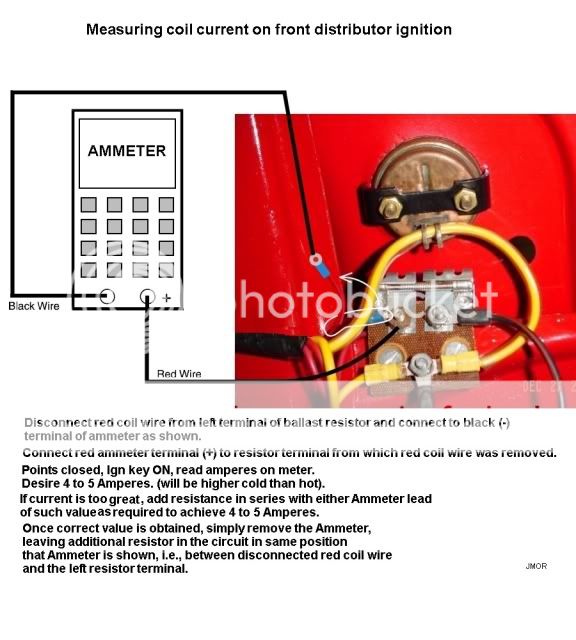
Or, you can not worry about measuring the resistance; just use an ammeter per the other picture & directions that JMOR put together.
Or......if you know the coil is at least 2.5 ohms because you got it from a reputable source AND you use the OEM ballast resistor, just hook it up & be done w/ it.
50 Tips
It used to be before the "Land of Almost Right" started making coils that you could count on a 12v frontmount coil as having 3 ohms of internal resistance & the 6v coils as having 1.5 ohms or less. Thus, thanks to Ohm's Law, you could calculate what additional resistance you needed in the circuit to limit coil current to 3.5 amps. So, you will need to measure the internal resistance of that alleged 12v coil & see what it is. A digital multi-meter has two probes & a switch. Set the switch on resistance. Put one probe on the top of the coil & the other on the pigtail at the bottom. It will give you a reading in ohms. Lets just say it reads 3.0 ohms. Your OEM ballast resistor (which you must use) is about 1 ohm hot. A coil a 3.0 ohms, plus the ballast resistor at 1 ohm (hot) gives you 4.0 ohms resistance in the circuit. Your 12 volt alternator puts out 14.5 volts. You need to determine current (amps). 14.5 v divided by 4.0 ohms gets you 3.6 amps; that's ok. But, and this is the problem......what if the coil is only 2 ohms? Do the math. 14.5 volts divided by 3.0 ohms gets you 4.8 amps! Not good! And, if the coil is less than 2 ohms (and some are) it will fry quickly. So, to get it to 3.5 amps, you need another resistor in the circuit. Either that, or keep spare $30 coil around.
Or, you can not worry about measuring the resistance; just use an ammeter per the other picture & directions that JMOR put together.
Or......if you know the coil is at least 2.5 ohms because you got it from a reputable source AND you use the OEM ballast resistor, just hook it up & be done w/ it.
50 Tips
Thank you Bruce. Great information. I am getting ready to do a tune up and was going with the original square type 12 volt coil. It is currently the original 6 volt with 2nd resistor and was wanting to increase my spark with the 12 volt. The last time I used th tractor, I had to jump the last resistor with a 12 volt jumper wire to get it started.
Bruce (VA)
Well-known Member
Bruce (VA)
Well-known Member
Bruce (VA)
Well-known Member
(quoted from post at 06:16:00 04/15/11) Thank you Bruce. Great information. I am getting ready to do a tune up and was going with the original square type 12 volt coil. It is currently the original 6 volt with 2nd resistor and was wanting to increase my spark with the 12 volt. The last time I used th tractor, I had to jump the last resistor with a 12 volt jumper wire to get it started.
Funny thing about spark and coils. You have a predetermined plug gap. If per example your coil is able to make 60,000 volts and the resistance of the gap sparks at 12,000 volts it's sparking at 12,000 volts. Thats why the newer stuff has big gaps and high output coils. It increases the resistance because of the distance the spark has to jump. So if your N has bright blue spark you are really throwing money at a problem that I will bet has nothing to do with the coil or points. Remember your are dealing with a low compression engine. The lower compression engines require less voltage to make the plugs spark under pressure. Plugs can and will spark at atmospheric pressure but fail to spark at pressures inside the engine.
Read Bruce's 50 tips. Your ballast resistor may be bad, dirty/bad connections (just worked on an IH H for a friend that was having starting problems.....plug/coil wires were not seated in the cap), dirty fuel system/stale gas or low compression are more likely to be the problems.
Trouble shoot the system. Takes a little learning but saves a lot of money in the long run.
Rick
Old tanker, I do have weak spark. I purchased a 12 volt coil from Rural King during my lunch. It is a Tisco. I ohm tested at work. .3 ohms from the leads. coil tested 2.8. 2.5 after subracting my lead of .3. I am going to replace the coil with 12 volt type to get rid of all the extra connections and resistor. My engine is sound, I rebuild it a few years ago with new sleeves and pistons, milled heads and block. I use my tractor with a 72 in finish mower to mow my yard, 5 acres and I love it. Mower is rear discharge and my yard looks good after mowing.
(quoted from post at 11:37:00 04/15/11) Old tanker, I do have weak spark. I purchased a 12 volt coil from Rural King during my lunch. It is a Tisco. I ohm tested at work. .3 ohms from the leads. coil tested 2.8. 2.5 after subracting my lead of .3. I am going to replace the coil with 12 volt type to get rid of all the extra connections and resistor. My engine is sound, I rebuild it a few years ago with new sleeves and pistons, milled heads and block. I use my tractor with a 72 in finish mower to mow my yard, 5 acres and I love it. Mower is rear discharge and my yard looks good after mowing.
Ah ok. I would have replaced the coil myself just for the reason that it gets rid of extra connections that can cause problems.
I mow about 5 acres. Was using an old Wheel Horse 12HP with a 42" deck. Then I got the N and a Woods 60" rear mount side discharge. What took 4-4 1/2 hours now takes about 1 1/4, mows better and at about 1/4 the gas. Not only am I mowing an extra 18" at a pass I'm able to get a better cut at about twice the ground speed. Even the wife was impressed with the cut and liked the fact that I have more time to do other things.....like farm and fish!
Rick
I know what you mean, smooth ride, and I can mow my 5 acres on about 3 to 3 1/2 gallons of fuel. I am thinking of changing a pulley on my finish mower to increase my blade tip speed a little because I like to mow in 3rd and it leaves some pieces of grass uncut at times. Thought about going to about an inch smaller pulley under the gear box, but need to investigate a little more. I don't want to grenade my mower, but I think it will handle a little more speed. If it sucks the worms out of the ground, I'll know I went to much, LOL.

We sell tractor parts! We have the parts you need to repair your tractor - the right parts. Our low prices and years of research make us your best choice when you need parts. Shop Online Today.
Copyright © 1997-2025 Yesterday's Tractor Co.
All Rights Reserved. Reproduction of any part of this website, including design and content, without written permission is strictly prohibited. Trade Marks and Trade Names contained and used in this Website are those of others, and are used in this Website in a descriptive sense to refer to the products of others. Use of this Web site constitutes acceptance of our User Agreement and Privacy Policy TRADEMARK DISCLAIMER: Tradenames and Trademarks referred to within Yesterday's Tractor Co. products and within the Yesterday's Tractor Co. websites are the property of their respective trademark holders. None of these trademark holders are affiliated with Yesterday's Tractor Co., our products, or our website nor are we sponsored by them. John Deere and its logos are the registered trademarks of the John Deere Corporation. Agco, Agco Allis, White, Massey Ferguson and their logos are the registered trademarks of AGCO Corporation. Case, Case-IH, Farmall, International Harvester, New Holland and their logos are registered trademarks of CNH Global N.V.
Yesterday's Tractors - Antique Tractor Headquarters
Website Accessibility Policy