


I have a 1946 2N, front mount distributor with 12 volt conversion. I need to replace the coil and my local tractor supply has 2 different coils, both boxes read that they fit 1939-1950 9n-2n-8n tractors with frnt mnt distr to s/n 263843 one has p/n on package 0238001 and the other 0236588. They both look like mine (the square type). The people that work in my local store dont even know what a tractor is much less which one I need (however, neither do I). Would anybody be able to help me out with which one I would need.
You are using an out of date browser. It may not display this or other websites correctly.
You should upgrade or use an alternative browser.
You should upgrade or use an alternative browser.
Bruce (VA)
Well-known Member
" my local tractor supply"
That's your first problem. Many folks around here have had a lot of problems w/ ignition parts sold by TSC. The fact that they don't know the difference between the two should tell you something.
Chances are one is a "6v" coil & the other is a "12v" coil.
You have a number of options for vendors; this site, nnalert's, NAPA, etc.
But, you first need to figure out which coil you need.
If all you have for resistors in the ignition circuit is the OEM ballast resistor, the "12v" coil should work just fine.
If you have any other resistors, you will need to remove them & use the "12v" coil or measure the additional resistors & match them to a "6v" coil.
Technology & materials being what they were in the 30's, that square coil would melt if it ran on much more than 4 amps for any length of time. (see tip # 38 for an example). In order to get a hot spark at the same time the starter was drawing max current from the battery, a ballast resistor was added in the ignition circuit. What that did was add about .3 ohms of resistance in the circuit, added to the 1.5 ohms of the coil. That got you 3.5 amps or so at start up. As the voltage increased when the engine was running to about 7.5 volts, the resistor heated up, adding more resistance in the circuit. 1.0 ohms hot, plus 1.5 ohms of the coil got you down to 3 amps or so to keep from melting the coil. The same rule (actually, Ohm's Law) applies to a 12v circuit. I= E/R. Current equals voltage divided by resistance.
It used to be before the "Land of Almost Right" started making coils that you could count on a 12v frontmount coil as having 3 ohms of internal resistance & the 6v coils as having 1.5 ohms or less. Thus, thanks to Ohm's Law, you could calculate what additional resistance you needed in the circuit to limit coil current to 3.5 amps.
50 Tips
That's your first problem. Many folks around here have had a lot of problems w/ ignition parts sold by TSC. The fact that they don't know the difference between the two should tell you something.
Chances are one is a "6v" coil & the other is a "12v" coil.
You have a number of options for vendors; this site, nnalert's, NAPA, etc.
But, you first need to figure out which coil you need.
If all you have for resistors in the ignition circuit is the OEM ballast resistor, the "12v" coil should work just fine.
If you have any other resistors, you will need to remove them & use the "12v" coil or measure the additional resistors & match them to a "6v" coil.
Technology & materials being what they were in the 30's, that square coil would melt if it ran on much more than 4 amps for any length of time. (see tip # 38 for an example). In order to get a hot spark at the same time the starter was drawing max current from the battery, a ballast resistor was added in the ignition circuit. What that did was add about .3 ohms of resistance in the circuit, added to the 1.5 ohms of the coil. That got you 3.5 amps or so at start up. As the voltage increased when the engine was running to about 7.5 volts, the resistor heated up, adding more resistance in the circuit. 1.0 ohms hot, plus 1.5 ohms of the coil got you down to 3 amps or so to keep from melting the coil. The same rule (actually, Ohm's Law) applies to a 12v circuit. I= E/R. Current equals voltage divided by resistance.
It used to be before the "Land of Almost Right" started making coils that you could count on a 12v frontmount coil as having 3 ohms of internal resistance & the 6v coils as having 1.5 ohms or less. Thus, thanks to Ohm's Law, you could calculate what additional resistance you needed in the circuit to limit coil current to 3.5 amps.
50 Tips
t is one of those times when there are no easy answers. If someone converted your tractor to 12v in the past & used the original 6v (0.5 ohm coil) then it should have additional resistance in series with the original 12250 ballast resistor. If they changed to the so-called-12v coil (2.5 ohms), then only the original ballast resistor should be used....no additional resistor. The TSC web site only shows the 0236588 number with no indication as to 6/12 or 0.5/2.5, so who knows what it is??? Sometimes there are voltage or resistance markings on the box. If you have an ohmmeter, you can measure resistance.(quoted from post at 09:44:16 10/03/10) I have a 1946 2N, front mount distributor with 12 volt conversion. I need to replace the coil and my local tractor supply has 2 different coils, both boxes read that they fit 1939-1950 9n-2n-8n tractors with frnt mnt distr to s/n 263843 one has p/n on package 0238001 and the other 0236588. They both look like mine (the square type). The people that work in my local store dont even know what a tractor is much less which one I need (however, neither do I). Would anybody be able to help me out with which one I would need.
Thanks for the replies, but I am one of those guys that probably needs to read the book "electricity for dummies". I do understand how to read ohms with my digital meter and I gather from the replies that the 6v coil should read 0.5 ohms resistance and the 12v coil should read 1.5 ohms, is that with the engine not running and key off? coil installed or removed? and where would I connect the gator clamps onto my coil to check for resistance to find out which one I have on tractor ?
I converted my 1949 front mount 8N to 12 volts. I gutted out the old square can coil as shown on Hobo's web site and installed a real 12 volt no resister needed round oil filled coil. If you do this you don't need to worry about what size resister to use because none is needed and you will have an almost indestructible coil opposed to the to the suspect design of the front mount coil.
bout like this (ignore the lower alligator clip leads).(quoted from post at 13:14:45 10/03/10) Thanks for the replies, but I am one of those guys that probably needs to read the book "electricity for dummies". I do understand how to read ohms with my digital meter and I gather from the replies that the 6v coil should read 0.5 ohms resistance and the 12v coil should read 1.5 ohms, is that with the engine not running and key off? coil installed or removed? and where would I connect the gator clamps onto my coil to check for resistance to find out which one I have on tractor ?
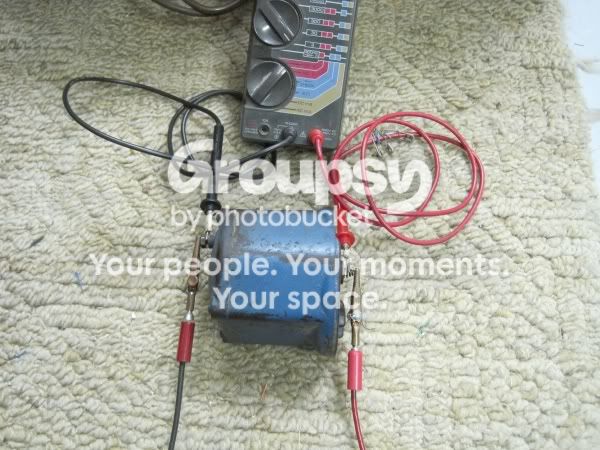

Ultradog MN
Well-known Member
- Location
- Twin Cities
I would suggest you gut the coil ala Hobo's method and add a roundcan coil that uses a full 12v.
both boxes read that they fit 1939-1950 9n-2n-8n tractors with frnt mnt distr to s/n 263843 one has p/n on package 0238001 and the other 0236588.
Ignition Coil, Ford, 2N, 8N, 9N, 1939-50 with Front Distributor
6 V
0236588
Availability: Online/In-Store
Price: $39.99
Ignition Coil, Ford, 2N, 8N, 9N, 1939-50 with Front Distributor
12 V
0238001
Availability: In Stores Only
Price: $44.99
Ignition Coil, Ford, 2N, 8N, 9N, 1939-50 with Front Distributor
Hobo Conversion to Round Can
Not Availability In Stores
Priceless
http://www.theviperr.info/hobo_dnn/Default.aspx?tabid=69
Home page :
http://www.theviperr.info/hobo_dnn/Default.aspx?tabid=36
o problem with Ohm's Law. Applies to AC, DC, any unusual waveform you can define. It is up to the user to correctly apply it.(quoted from post at 18:08:19 10/05/10) Small problem with Ohms law.When the engine ie running this is is an alternating current circuit.

TheOldHokie
Well-known Member
- Location
- Myersville, MD 21773
(quoted from post at 18:08:19 10/05/10) Small problem with Ohms law.When the engine ie running this is is an alternating current circuit.
Perhaps you will find this helpful in understanding the finer points:
[u:b1a4a128c3]Ohm's Law in AC Circuits[/u:b1a4a128c3]
TOH

We sell tractor parts! We have the parts you need to repair your tractor - the right parts. Our low prices and years of research make us your best choice when you need parts. Shop Online Today.
Copyright © 1997-2025 Yesterday's Tractor Co.
All Rights Reserved. Reproduction of any part of this website, including design and content, without written permission is strictly prohibited. Trade Marks and Trade Names contained and used in this Website are those of others, and are used in this Website in a descriptive sense to refer to the products of others. Use of this Web site constitutes acceptance of our User Agreement and Privacy Policy TRADEMARK DISCLAIMER: Tradenames and Trademarks referred to within Yesterday's Tractor Co. products and within the Yesterday's Tractor Co. websites are the property of their respective trademark holders. None of these trademark holders are affiliated with Yesterday's Tractor Co., our products, or our website nor are we sponsored by them. John Deere and its logos are the registered trademarks of the John Deere Corporation. Agco, Agco Allis, White, Massey Ferguson and their logos are the registered trademarks of AGCO Corporation. Case, Case-IH, Farmall, International Harvester, New Holland and their logos are registered trademarks of CNH Global N.V.
Yesterday's Tractors - Antique Tractor Headquarters
Website Accessibility Policy