Delco 10si alternator

I converted my M to 12v using a 1 wire alternator wired up as shown in the pic when I posted the conversion I got some helpful advice from
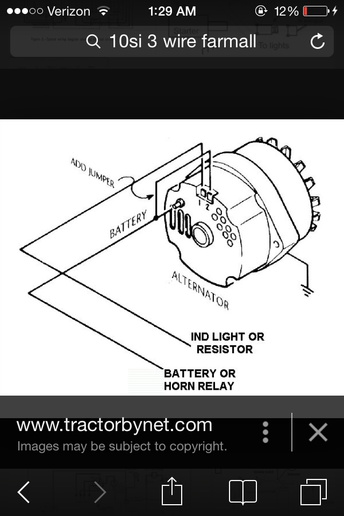
fellow forum members tellin me that I should convert the 1 wire alt to a 3 wire alt and it would begin charging at lower rpms is this true? Attached is a pic of a way u can wire up a delco alt using three wires is this how it is done? Bc I was told that it is done by takin the alt to a shop and have them rewire it internally to make it 3 wire.The pic shows going from the Batt terminal to #2 on the alt and coming from the ignition through a light to terminal #1 on the alt. My alt has all three terminals and when I bought it in the conversion kit it was listed as a 1 wire alt but I was jus curious as to if it was already a 3 wire alt. Thanks to all who replies
a191571.jpg

a191572.jpg
 
There's a man named CharlieU, sells a diode assembly that plugsinto where that black plug is on top of the altenator. Makes the thing charge right up when you start the thing, than tapers off. I installed one on my H, very economical. Best part, I don't understand a thing about electrtical, and I did this, and it works. Try it.
Charlie Uthke, Charlie's Repair, 22195 State Hwy 56, Austin, MN 55912 [email protected]
 
I work on x-ray equipment and know a little about electricity <grin> it is probably charging more than you think. I ran a Delco SI10 on a Case SC for years with zero problems after installing it. Don't go by the ammeter unless you are seeing a discharge. If you are seeing a discharge on the ammeter something is wrong. These old tractors pull very, very little current, especially if you M has a mag. It is just trickle charging the battery after you start it, very little amperage. Here's how to tell for sure. Put a volt meter direcctly across the battery before starting the engine. It should read about 12.5 volts on a well charged battery. Start it up, if the volt meter goes up to 13.5 - 14.0 volts your battery is charging. Vary the engine speed down to idle to see if the output voltage drops below 13 volts. If this is all good no need to dump excessive amperage into the battery, it will just boil it and shorten the life. The Delco SI10 is a very good basic effcient alternator. If your tractor is starting properly and the lights are bright at idle the alternator is working, leave it alone.
 
There are several companies converting OEM style 10SI alternators to "one Wire" operation. How they do the conversion is to in some way self excite the field rotor this may include leaving the regulator in a partially on state all the time, or sensing residual voltage generated within the stator to excite. Some of these methods will be able to excite earlier with the three wire approach overriding the modifications. Others might not respond, or be missing the terminals. Putting a original (three wire) regulator in it is simple and cheap. If you are uncomfortable in an alternator, it is an easy replacement at an electrical shop. Jim
 
I have been converting 3 wire SI series Delco alternators to 1 wire for 30+ years, and have only found one system that has internal wiring changes. That was Delco's own 1 wire setup that had a special regulator with an extra stud on the regulator that connected to the BAT stud inside the alternator. I have not seen one of those for many years, but you can identify them by the regulator plug with the red plug cap that can be installed one of 4 ways so you can adjust the output voltage to 4 low to high voltage settings.

All the aftermarket 1 wire units I have used have no internal wiring changes from a 3 wire unit, they simply replace the stock 3 wire regulator with a new one that self excites easier (at lower rpm) than the stock regulator, to make it a 1 wire alternator.

Did you know that any stock 3 wire alternator will self excite with nothing connected to the #1 regulator terminal if you spin it fast enough ?? It takes about 7000 alternator rpm, but any stock 3 wire SI series Delco will self excite at high rpm. On many applications where the alternator spins at 3 times engine speed, that is not too difficult.

The one wire conversion regulators I have used for many years, have an instruction sheet packaged with the regulators, stating that If a lower excitation rpm is desired or if a generator light is wanted, just connect the gen light to the #1 terminal as you would with the 3 wire regulator and it(the 1 wire regulator) will function as a normal 3 wire regulator.
This works well for someone who wanted to try a 1 wire alternator for the simple clean 1 wire hookup. If not satisfied with the excitation rpm, or if a charge light is desired, the same 1 wire regulator will work just fine as either a 1 wire or 3 wire unit.

Also, did you guys know that a small 37 amp 1 wire alternator will self excite at about 1/2 as much rpm as a big 61 or 72 amp 1 wire alternator.
In most cases, 37 amps is more than is needed and is much more likely to give satisfactory performance on an old slow turning tractor engine.

The 37 amp 1 wire unit is harder to find than the 61 or 72 amp 1 wire units, unless you special order it.
Most parts stores only stock the large 61 or 72 amp 1 wire units, as it cuts their inventory needs, thinking in most cases a large alternator will replace a small one, so they only need to stock the large ones.
The problem with that theory is that on an old slow turning tractor, the 37 amp 1 wire will self excite at low enough rpm to give good service, while that same slow turning old engine may not turn fast enough to self excite one of the large 1 wire alternators.

Nothing at all wrong with a 1 wire alternator,IF properly sized and installed correctly. (37 amp 1 wire with a small alternator pulley).
 
I have found the kick in rpm of the alternators in which I have installed the single wire regulator ranges from about 700 on the low end with a 37 amp alternator to 2700 on some 72 amp alternators.
 
Yesterday's Tractor Forums

We sell tractor parts! We have the parts you need to repair your tractor - the right parts. Our low prices and years of research make us your best choice when you need parts. Shop Online Today.

Back
Top