You check the point gap w/ a blade type feeler gauge. If you can't get the gap open to .025 (not .020) then you have a junk set of points or you don't know how to set them.
Quality parts are critical to longevity. Having learned the hard way, I most always use Blue Streak brand points. They are made by Standard parts & available at many auto parts stores. (frontmount points also fit a 48 Ford as I recall) Beware of sticker shock: $16-18 a set. My next choices are Wells or Echlin. Look for a brown rubbing block. Unfortunately, many folks have experienced problems w/ points made by Tisco, Sparex, A&I Products and any TSC ignition parts.
Correct points installation & gap is also important. Close only counts in horseshoes & hand grenades. Make sure the blade is at a perfect right angle to the points & you want to feel just the slightest bit of drag when you pull the blade through the points. Make sure the blade is clean & that you dress the new points by running some card stock or a piece of brown paper bag through them. Gap is .025 on the sidemount on all four lobes of the cam. Make sure the points align correctly.
Good hold-down screws are important. (tip # 37) If the heads are wallowed out, what do you think the threads look like? You can use machine screws as temporary replacements, but you should use the OEM Fillister head screws. The larger head is there for a reason. If you do use standard machine screws, make sure they aren’t too long & interfere w/ the advance weights. Always use star washers under the screws.
Timing is important not only to engine performance but points longevity as well. Make sure you set the point gap before you set the timing. Timing a sidemount is pretty straight forward; it has marks on the flywheel.
The next trick to points lasting a long, long time is annual maintenance. (tip # 40) No matter how well it's running, pull the distributor (or cap for a sidemount), check the gap & put a dab of points lube on the cam. Not bearing grease or Vaseline; use the correct lube.
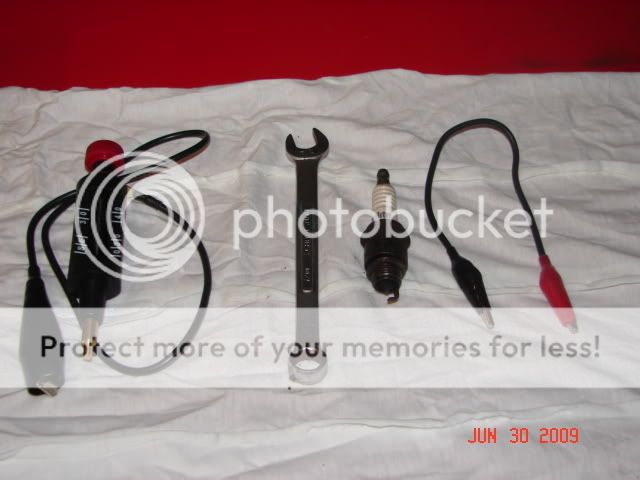
There are ways to check for spark that work & ways that don't. Some folks think that checking for spark means pulling a plug wire off & looking for one. Well, it's the distance the spark jumps at the plug that gives you the info you want. It takes about 17kv to jump a 3/16" gap & 22kv to jump ¼” in the open air, so that's why you need to use a spark plug. Or, a store bought plug checker. (on the left in the picture) Remember, it’s 14psi outside of the engine & about 90psi at a 6:1 compression ratio in the cylinders & compressed air creates electrical resistance, so you really need the 17-22kv to fire the plugs when the engine is running.
50 Tips