


My 8N tractor stalls after about 20-30 minutes, especially when the temp is warm and I am mowing thick grass. It won't start for at least an Thanks.hour. This last time, I stopped moving and disengaged the brush hog. It continued to stay running when the engine was not under load. I was thinking the coil was heating up or it was a vapor lock problem??
You are using an out of date browser. It may not display this or other websites correctly.
You should upgrade or use an alternative browser.
You should upgrade or use an alternative browser.
Bruce (VA)
Well-known Member
While there are a number of things that could cause that problem, one of them isn't vapor lock. You won't vapor lock an updraft carb on a gravity fed system.
Yes, it could be the coil, but you need to check other likely possibilities because coil problems are difficult to diagnose. For starters, round coils are pretty robust & square coils aren’t (because of the difference in insulation used), but neither one will hold up to a poorly done 12v conversion that allows too much current to the coil or leaving the key on (see tip # 38). Too much current creates heat which melts the insulation. Insufficient resistance in a 12v conversion will do the same thing. Rarely do coils just “go bad.”
There are a few ways to see if a coil is bad, but it’s not possible to determine if a coil is good w/o some expensive testing equipment. If you detect a dead short or high resistance in the coil w/ an ohm meter, it’s bad. If it’s cracked, it’s bad. If a sidemount coil w/ battery voltage to the primary will not jump a ¼” gap from the secondary wire to the block, it’s bad. But, here is the hard part: even if you do not detect a short, even if it will produce a spark, even if it’s not cracked, that doesn’t mean the coil will work when it’s hot & under a load. So, it’s a process of elimination. If the tractor starts & runs fine for 30 minutes or an hour then cuts off & refuses to re-start, and you checked for spark at the plugs & it had no spark at all, AND you have the correct voltage at the coil that’s a good sign that you have a bad coil. Let it cool off, restart it & if you have a good spark, odds are it’s a bad coil. But, even then, you might end up w/ a spare coil on the shelf!
Bottom line.......coils do go bad, but I'll venture a guess that 75% of new N coils sold today are sold to folks who do not understand how to diagnose a poor spark problem or how a coil works. So, for those who don’t know any better, in a no spark situation the first suspect is usually the coil……and, more often than not, it isn’t the problem.
It is important for you to tell us if your tractor has a 6 volt or 12 volt electrical system & if the distributor is on the front of the engine or on the side. The troubleshooting is different based upon the configuration of your engine.
It takes three things for an engine to run: spark at the right time, compression, & fuel in the right mixture. For the moment, forget about compression & concentrate on narrowing the problem down to spark or fuel.
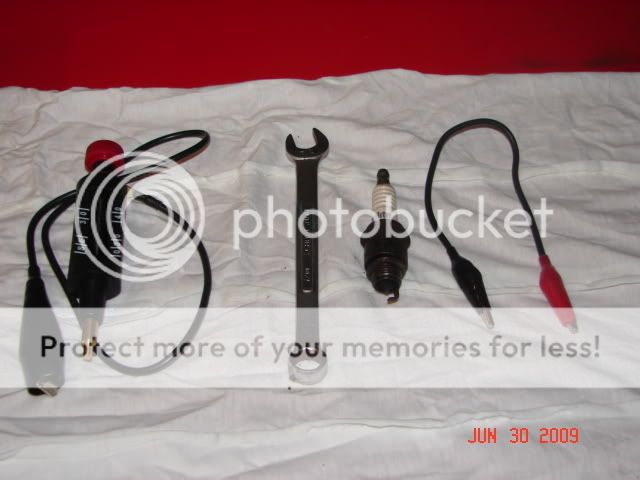
There are three very important tools you always need to have in your N tool box: a 3 inch piece of wire w/ alligator clips on each end, an old spark plug w/ the gap opened to at least 3/16” ( ¼” is better) and a 7/16 box end wrench. (see tip # 50 at the link below) And, you really do need a working ammeter on the tractor; it is a very important diagnostic tool. With these tools, you can quickly narrow down most N problems to spark or fuel.
Next time it stops, check quickly for fuel then spark. When I say quickly, I mean get off the seat, grab the tools & do it right then. Do not wait a minute or two. First, check for fuel. Get a can & put it under the carb. Remove the bolt in the bottom of the carb; as long as the fuel is turned on, you should see gas flowing out of the carb. Let it run for at least 30 seconds. If it’s a dribble, or runs for 5 seconds & stops, or none at all, you have solved half the problem: it’s fuel related. If gas flows well out of the carb & only stops when you turn it off at the sediment bowl, chances are very good it’s not a fuel problem. So, next, turn the key on, crank the engine & look at the ammeter. What is the needle doing? Does it show a constant discharge, no movement at all, or does it move back & forth slightly? Next, get the old plug, ground it to a rust & paint free spot on the engine, turn the key on & crank the engine. If the spark jumps the 3/16” gap, you probably don’t have a spark problem. If it won’t jump the 3/16” gap, you have a spark problem. If the ammeter needle shows a constant discharge, or doesn’t move at all, that also tells you that you have a spark problem. Jump the ignition switch w/ your jumper wire & see what happens. If it runs, you found the problem. If it doesn’t have spark after you jump the ignition switch, post back for more info on further troubleshooting. (and do not forget to turn the ignition switch off; see tip # 38)
If it does not have gas coming out of the carb at a steady stream w/ the bolt out for at least 30 seconds, you have a fuel problem. First, remove the gas cap. Your vent could be clogged & it vacuum locked. If that doesn’t work, tap the carb bowl w/ a hammer handle in case the float is sticking closed. (don’t whack it w/ the head of the hammer; you can crack the bowl). If you still don’t see gas flowing, the N has three fuel screens; one in the brass elbow, one in the top of the sediment bowl & one on the stem of the sediment bowl in the gas tank. Check the screen in the elbow & the screen in the top of the sediment bowl. (don’t worry about the one in the tank) Both probably need to be cleaned. If you have the fuel knob turned on all the way, & 1 gallon or less in the tank, it may be trying to feed off of the reserve inlet which is probably clogged. Only open it 2 full turns. Put at least 2 gallons in the tank. (and do not forget to turn the gas off; see tip # 9)
There are ways to check for spark & fuel that work & ways that don't. For example, having gas to the carb is nice, but having it past the float is what counts! That’s why removing the bolt in the bottom of the carb is the way to do it. And, same thing w/ spark at the plugs. Some folks think that checking for spark means pulling a plug wire off & looking for one. Well, it's the distance the spark jumps at the plug that gives you the info you want. It takes about 17kv to jump a 3/16" gap & 22kv to jump ¼” in the open air, so that's why you need to use a spark plug. Or, a store bought plug checker (on the left in the picture). Remember, it’s 14psi outside of the engine & about 90psi at a 6:1 compression ratio in the cylinders & compressed air creates electrical resistance, so you really need the 17-22kv to fire the plugs when the engine is running.
50 Tips
Yes, it could be the coil, but you need to check other likely possibilities because coil problems are difficult to diagnose. For starters, round coils are pretty robust & square coils aren’t (because of the difference in insulation used), but neither one will hold up to a poorly done 12v conversion that allows too much current to the coil or leaving the key on (see tip # 38). Too much current creates heat which melts the insulation. Insufficient resistance in a 12v conversion will do the same thing. Rarely do coils just “go bad.”
There are a few ways to see if a coil is bad, but it’s not possible to determine if a coil is good w/o some expensive testing equipment. If you detect a dead short or high resistance in the coil w/ an ohm meter, it’s bad. If it’s cracked, it’s bad. If a sidemount coil w/ battery voltage to the primary will not jump a ¼” gap from the secondary wire to the block, it’s bad. But, here is the hard part: even if you do not detect a short, even if it will produce a spark, even if it’s not cracked, that doesn’t mean the coil will work when it’s hot & under a load. So, it’s a process of elimination. If the tractor starts & runs fine for 30 minutes or an hour then cuts off & refuses to re-start, and you checked for spark at the plugs & it had no spark at all, AND you have the correct voltage at the coil that’s a good sign that you have a bad coil. Let it cool off, restart it & if you have a good spark, odds are it’s a bad coil. But, even then, you might end up w/ a spare coil on the shelf!
Bottom line.......coils do go bad, but I'll venture a guess that 75% of new N coils sold today are sold to folks who do not understand how to diagnose a poor spark problem or how a coil works. So, for those who don’t know any better, in a no spark situation the first suspect is usually the coil……and, more often than not, it isn’t the problem.
It is important for you to tell us if your tractor has a 6 volt or 12 volt electrical system & if the distributor is on the front of the engine or on the side. The troubleshooting is different based upon the configuration of your engine.
It takes three things for an engine to run: spark at the right time, compression, & fuel in the right mixture. For the moment, forget about compression & concentrate on narrowing the problem down to spark or fuel.
There are three very important tools you always need to have in your N tool box: a 3 inch piece of wire w/ alligator clips on each end, an old spark plug w/ the gap opened to at least 3/16” ( ¼” is better) and a 7/16 box end wrench. (see tip # 50 at the link below) And, you really do need a working ammeter on the tractor; it is a very important diagnostic tool. With these tools, you can quickly narrow down most N problems to spark or fuel.
Next time it stops, check quickly for fuel then spark. When I say quickly, I mean get off the seat, grab the tools & do it right then. Do not wait a minute or two. First, check for fuel. Get a can & put it under the carb. Remove the bolt in the bottom of the carb; as long as the fuel is turned on, you should see gas flowing out of the carb. Let it run for at least 30 seconds. If it’s a dribble, or runs for 5 seconds & stops, or none at all, you have solved half the problem: it’s fuel related. If gas flows well out of the carb & only stops when you turn it off at the sediment bowl, chances are very good it’s not a fuel problem. So, next, turn the key on, crank the engine & look at the ammeter. What is the needle doing? Does it show a constant discharge, no movement at all, or does it move back & forth slightly? Next, get the old plug, ground it to a rust & paint free spot on the engine, turn the key on & crank the engine. If the spark jumps the 3/16” gap, you probably don’t have a spark problem. If it won’t jump the 3/16” gap, you have a spark problem. If the ammeter needle shows a constant discharge, or doesn’t move at all, that also tells you that you have a spark problem. Jump the ignition switch w/ your jumper wire & see what happens. If it runs, you found the problem. If it doesn’t have spark after you jump the ignition switch, post back for more info on further troubleshooting. (and do not forget to turn the ignition switch off; see tip # 38)
If it does not have gas coming out of the carb at a steady stream w/ the bolt out for at least 30 seconds, you have a fuel problem. First, remove the gas cap. Your vent could be clogged & it vacuum locked. If that doesn’t work, tap the carb bowl w/ a hammer handle in case the float is sticking closed. (don’t whack it w/ the head of the hammer; you can crack the bowl). If you still don’t see gas flowing, the N has three fuel screens; one in the brass elbow, one in the top of the sediment bowl & one on the stem of the sediment bowl in the gas tank. Check the screen in the elbow & the screen in the top of the sediment bowl. (don’t worry about the one in the tank) Both probably need to be cleaned. If you have the fuel knob turned on all the way, & 1 gallon or less in the tank, it may be trying to feed off of the reserve inlet which is probably clogged. Only open it 2 full turns. Put at least 2 gallons in the tank. (and do not forget to turn the gas off; see tip # 9)
There are ways to check for spark & fuel that work & ways that don't. For example, having gas to the carb is nice, but having it past the float is what counts! That’s why removing the bolt in the bottom of the carb is the way to do it. And, same thing w/ spark at the plugs. Some folks think that checking for spark means pulling a plug wire off & looking for one. Well, it's the distance the spark jumps at the plug that gives you the info you want. It takes about 17kv to jump a 3/16" gap & 22kv to jump ¼” in the open air, so that's why you need to use a spark plug. Or, a store bought plug checker (on the left in the picture). Remember, it’s 14psi outside of the engine & about 90psi at a 6:1 compression ratio in the cylinders & compressed air creates electrical resistance, so you really need the 17-22kv to fire the plugs when the engine is running.
50 Tips
Tnanks. I am learning a lot just by reading your reply. I will implement your advice, but was able to get all the grass knocked down, and am hoping the monsoons have abated. When I get caught up on the remainder of the outside chores, I will investigate the tractor problem in detail.
Thanks a lot.
Thanks a lot.
The tractor won't start at all. I have replaced plugs, points, condensor, and distributor cap. It has been a while.The distributor is a side mount,and the copper peice where the condenor connects broke when I was fiddling around there. I replaced it. I will clean the screens, and the tank is low on fuel. Where am I connecting the alligator clip wire for juice? I don't have clips, but will use a wire. Also can't find my feeler guage, so am guessing on the gap. I'm a mess with mechanics.
thanks.
thanks.
Bruce (VA)
Well-known Member
Put at least 3 gallons of gas in the tank.
Go to WallyWorld & get a multi-meter. ($10) Get some alligator clips too.
Go to the parts store & replace the feeler gauge. I've been doing this for years & I can't 'guess' at what .025 is.
Charge the battery. You need battery voltage to turn the starter AND power the ignition circuit.
After all that is done, it's time to find the source of the problem.
If you do not have battery voltage at the distributor w/ the key on, jump the ignition switch by connecting the two posts on the switch w/ the wire & alligator clips.
Do you have battery voltage across the points when they are open? Verify the gap on the points at .025. Then, dress the points by running a piece of card stock or brown paper bag through them. New points sometimes have an anti-corrosive dielectric coating on them & old points can corrode or pick up grease from a dirty feeler gauge or excessive cam lubricant. (I always spray my feeler guage blade off w/ contact cleaner.) Make sure you have voltage across the points, as in past the insulator on the side of the distributor. That is a very common failure point on sidemounts, along w/ the attached copper strip. It's hard to find a short there because it is usually an intermittent . So 'wiggle' the insulator & the copper strip a bit when you are doing your checking. If you find the short there, the Master Parts catalog lists everything you need on page 154. You can make the strip and you could also make the insulators as well. But, somethings are just easier & in the long run cheaper to buy. Get the strip, 12209, screw 350032-S, 12233 bushing & 12234 insulator & just replace it all. If you just replaced the rotor & lost spark, put the old one back in. Insure that the rotor fits firmly on the shaft & that the little clip is there. Make sure the distributor cap is not cracked & doesn't have carbon tracks. Check continuity on the secondary coil wire. Make sure it is firmly seated in both the cap & the coil. In fact, replace it temporarily w/ a plug wire. Next, remove the secondary coil wire from the center of the distributor cap, turn the key on & crank the engine while holding the end of the wire 1/4" from a rust & paint free spot on the engine. You should see & hear a nice blue/white spark. If not, you have a bad coil or condenser. Just put the old condenser back in to eliminate that as a possibility.
Post back w/ results; I'll be interested in what the problem was.
50 Tips
Go to WallyWorld & get a multi-meter. ($10) Get some alligator clips too.
Go to the parts store & replace the feeler gauge. I've been doing this for years & I can't 'guess' at what .025 is.
Charge the battery. You need battery voltage to turn the starter AND power the ignition circuit.
After all that is done, it's time to find the source of the problem.
If you do not have battery voltage at the distributor w/ the key on, jump the ignition switch by connecting the two posts on the switch w/ the wire & alligator clips.
Do you have battery voltage across the points when they are open? Verify the gap on the points at .025. Then, dress the points by running a piece of card stock or brown paper bag through them. New points sometimes have an anti-corrosive dielectric coating on them & old points can corrode or pick up grease from a dirty feeler gauge or excessive cam lubricant. (I always spray my feeler guage blade off w/ contact cleaner.) Make sure you have voltage across the points, as in past the insulator on the side of the distributor. That is a very common failure point on sidemounts, along w/ the attached copper strip. It's hard to find a short there because it is usually an intermittent . So 'wiggle' the insulator & the copper strip a bit when you are doing your checking. If you find the short there, the Master Parts catalog lists everything you need on page 154. You can make the strip and you could also make the insulators as well. But, somethings are just easier & in the long run cheaper to buy. Get the strip, 12209, screw 350032-S, 12233 bushing & 12234 insulator & just replace it all. If you just replaced the rotor & lost spark, put the old one back in. Insure that the rotor fits firmly on the shaft & that the little clip is there. Make sure the distributor cap is not cracked & doesn't have carbon tracks. Check continuity on the secondary coil wire. Make sure it is firmly seated in both the cap & the coil. In fact, replace it temporarily w/ a plug wire. Next, remove the secondary coil wire from the center of the distributor cap, turn the key on & crank the engine while holding the end of the wire 1/4" from a rust & paint free spot on the engine. You should see & hear a nice blue/white spark. If not, you have a bad coil or condenser. Just put the old condenser back in to eliminate that as a possibility.
Post back w/ results; I'll be interested in what the problem was.
50 Tips
Tractor is running. However, it quit after 20 minutes.It restarted 1 hour later, but stalled when I started moving with the brush hog running. Perhaps it didn't cool down as much as it has in the past when I restarted it a couple of hours later. There is a strong fuel smell, so I am wondering if the choke is sticking. It was not running evenly at start up. Checked the flow of gas from bottom of carb immediately after stalling. The gas flowed freely and stopped when I closed flow at settling bulb. I will check the spark from wire which runs to center of distributor by removing to rust free area.
Tractor is running. However, it quit after 20 minutes.It restarted 1 hour later, but stalled when I started moving with the brush hog running. Perhaps it didn't cool down as much as it has in the past when I restarted it a couple of hours later. There is a strong fuel smell, so I am wondering if the choke is sticking. It was not running evenly at start up. Checked the flow of gas from bottom of carb immediately after stalling. The gas flowed freely and stopped when I closed flow at settling bulb. I will check the spark from wire which runs to center of distributor by removing to rust free area.
Bruce (VA)
Well-known Member
" There is a strong fuel smell, so I am wondering if the choke is sticking. "
No, it's not. It wouldn't run at all if it was. Check for fuel leaks.
'I will check the spark from wire which runs to center of distributor by removing to rust free area. "
That's how to check the coil (or condenser). Check for spark at the plugs FIRST as soon as it stops! If you don't have spark at the plugs, THEN check for it at the coil.
There is a reason to do this stuff in a systematic, orderly way.
Go back & re-read my reply to you of 5/23.
50 Tips
No, it's not. It wouldn't run at all if it was. Check for fuel leaks.
'I will check the spark from wire which runs to center of distributor by removing to rust free area. "
That's how to check the coil (or condenser). Check for spark at the plugs FIRST as soon as it stops! If you don't have spark at the plugs, THEN check for it at the coil.
There is a reason to do this stuff in a systematic, orderly way.
Go back & re-read my reply to you of 5/23.
50 Tips
Bruce (VA)
Well-known Member
As I said earlier today, go back & re-read my reply to you of 5/23.
It does not matter what color the spark is. It's the distance it jumps that counts when you check for spark at the plugs.
The fact the coil wire jumps a 1/4" gap tells you that the coil & condenser is ok. Now, you need to check the distance the spark jumps at the plugs.
It does not matter what color the spark is. It's the distance it jumps that counts when you check for spark at the plugs.
The fact the coil wire jumps a 1/4" gap tells you that the coil & condenser is ok. Now, you need to check the distance the spark jumps at the plugs.
elmersooner
Member
shouldn't matter which one. just check if it can jump a 1/4 inch gap.

We sell tractor parts! We have the parts you need to repair your tractor - the right parts. Our low prices and years of research make us your best choice when you need parts. Shop Online Today.
Copyright © 1997-2025 Yesterday's Tractor Co.
All Rights Reserved. Reproduction of any part of this website, including design and content, without written permission is strictly prohibited. Trade Marks and Trade Names contained and used in this Website are those of others, and are used in this Website in a descriptive sense to refer to the products of others. Use of this Web site constitutes acceptance of our User Agreement and Privacy Policy TRADEMARK DISCLAIMER: Tradenames and Trademarks referred to within Yesterday's Tractor Co. products and within the Yesterday's Tractor Co. websites are the property of their respective trademark holders. None of these trademark holders are affiliated with Yesterday's Tractor Co., our products, or our website nor are we sponsored by them. John Deere and its logos are the registered trademarks of the John Deere Corporation. Agco, Agco Allis, White, Massey Ferguson and their logos are the registered trademarks of AGCO Corporation. Case, Case-IH, Farmall, International Harvester, New Holland and their logos are registered trademarks of CNH Global N.V.
Yesterday's Tractors - Antique Tractor Headquarters
Website Accessibility Policy