


When you are a small time wannabe farmer like me you have to improvise when you just cant justify spending a lot of money on stuff you only use once or twice a year. Total investment in my field "triroller" probably less than $300. The lead roller is one my grandfather had that is likely over a hundred years old? The one on the near side I bought at sale for $25. The one that still needs a rockbox was from a nieghbour who has pretty much retired from farming. I used to harrow and roll with a single 9 foot roller, but even on my small little fields ( I am the oddball who doesnt believe in taking out every fencerow on the farm) it seemed to take forever. I know most guys will laugh at me, but this rig worked great, and field looked nice and flat when I was done. Picture doesnt really do it justice. This was yesterday and just sitting here today watching it rain so thought I would share.
You are using an out of date browser. It may not display this or other websites correctly.
You should upgrade or use an alternative browser.
You should upgrade or use an alternative browser.


flying belgian
Well-known Member
That's a fine looking imp. Finished field looks super.When you are a small time wannabe farmer like me you have to improvise when you just cant justify spending a lot of money on stuff you only use once or twice a year. Total investment in my field "triroller" probably less than $300. The lead roller is one my grandfather had that is likely over a hundred years old? The one on the near side I bought at sale for $25. The one that still needs a rockbox was from a nieghbour who has pretty much retired from farming. I used to harrow and roll with a single 9 foot roller, but even on my small little fields ( I am the oddball who doesnt believe in taking out every fencerow on the farm) it seemed to take forever. I know most guys will laugh at me, but this rig worked great, and field looked nice and flat when I was done. Picture doesnt really do it justice. This was yesterday and just sitting here today watching it rain so thought I would share.
farmersamm
Member
Not trying to get into an argument.............but something to consider.
This is my humble opinion, and is my take on the situation.
I'm not a fan of cultipackers, rollers, or anything that makes a field into "fines".
A powdery field is susceptible to wind erosion, and also subject to rain damage............washing the seed out, or burying it under washed in seed furrows.
A mildly cloddy field can be your friend. While it may look like a rough seedbed, it's actually a protective seedbed. The clods provide protection.........and don't interfere with the seed drill.
I'm sure this has gone out of style since The Dirty 30's. People have forgotten how bad it was.
Anyways........that field is susceptible to washing.
This is my humble opinion, and is my take on the situation.
I'm not a fan of cultipackers, rollers, or anything that makes a field into "fines".
A powdery field is susceptible to wind erosion, and also subject to rain damage............washing the seed out, or burying it under washed in seed furrows.
A mildly cloddy field can be your friend. While it may look like a rough seedbed, it's actually a protective seedbed. The clods provide protection.........and don't interfere with the seed drill.
I'm sure this has gone out of style since The Dirty 30's. People have forgotten how bad it was.
Anyways........that field is susceptible to washing.
farmersamm
Member
I used to do conventional tillage, like you're doing. I'm trying to go back over my hard drives to give ya pic of a well done field.
farmersamm
Member
Had to snag an old photo off the internet from some years ago. Was putting up some pics of dryland farming around here. I think the originals are on an old mechanical hard drive that's crapped out.
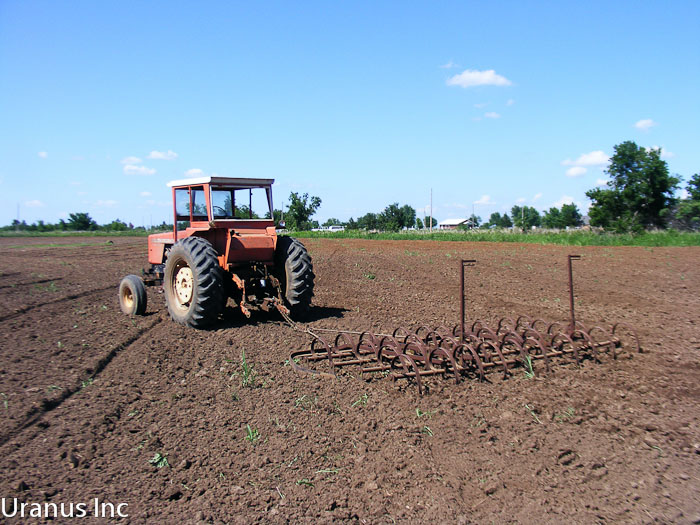
An old pic off of Weldingweb. This is the final pass before drilling. Note how the springtooth is run at an angle. This allows you to follow the last pass you made with the seed drill. The drill leaves a pattern that's cross hatched to the springtooth pass.
Anyways.............look at the field, compared to yours. Lottsa clods. This is as smooth as a field needs to be. The clods range between 2 to 4 inches in diameter......................your drill will work in these conditions. There's a ton of fines down in between those clods. Enough to provide good soil contact for your seeds.
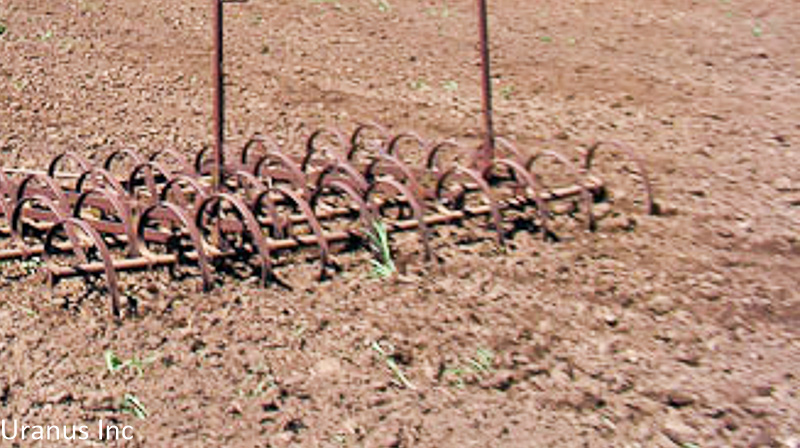
I had to work off the file that's on the internet, and crop a section. The original is on the bad hard drive.........sorry for the lousy image. But, you can see that this is anything but a pretty seedbed. It's a seedbed made for WEATHER. I generally used to get around 85%, and higher, germination. Right in line with the germination rate, as tested, for the seed used.
Lemme put it this way..............if you see dust blowin' off the field in moderate, to heavy, wind................ya did a lousy job. Your job is to conserve your soil.
An old pic off of Weldingweb. This is the final pass before drilling. Note how the springtooth is run at an angle. This allows you to follow the last pass you made with the seed drill. The drill leaves a pattern that's cross hatched to the springtooth pass.
Anyways.............look at the field, compared to yours. Lottsa clods. This is as smooth as a field needs to be. The clods range between 2 to 4 inches in diameter......................your drill will work in these conditions. There's a ton of fines down in between those clods. Enough to provide good soil contact for your seeds.
I had to work off the file that's on the internet, and crop a section. The original is on the bad hard drive.........sorry for the lousy image. But, you can see that this is anything but a pretty seedbed. It's a seedbed made for WEATHER. I generally used to get around 85%, and higher, germination. Right in line with the germination rate, as tested, for the seed used.
Lemme put it this way..............if you see dust blowin' off the field in moderate, to heavy, wind................ya did a lousy job. Your job is to conserve your soil.
farmersamm
Member
A springtooth does nothing but level the ruts you left when you disced your fertilizer in. It doesn't cultivate, or anything else.............it just fills ruts.
farmersamm
Member
It's a firming process.
The plow, or offset, brings it up, and loosens it.
The finishing disc firms it to the depth of the discs.
Then the springtooth firms it to the depth of the teeth.
Every pass is successively more shallow. Remember..........every pass releases soil moisture. You don't want to work ground down to China.
When you're done, you have a very firm seedbed.
Finally, if you use a hoe drill, as I used to...............you put that seed about 2" below the firm layer You hammer it in there. INTO MOISTURE. The hoe drill was the first "no till" tool. Very popular here in the Southern Plains back in the day.
The plow, or offset, brings it up, and loosens it.
The finishing disc firms it to the depth of the discs.
Then the springtooth firms it to the depth of the teeth.
Every pass is successively more shallow. Remember..........every pass releases soil moisture. You don't want to work ground down to China.
When you're done, you have a very firm seedbed.
Finally, if you use a hoe drill, as I used to...............you put that seed about 2" below the firm layer You hammer it in there. INTO MOISTURE. The hoe drill was the first "no till" tool. Very popular here in the Southern Plains back in the day.

Nice setup.
There are different situations, lot of times a bit rougher surface is better, lots of times a smooth field is better.
Hay field, or rolling a bean field flat is popular. Here it is typically right after planting, firm the seed in the ground.
Sometimes they blow or wash worse, sometimes it makes things better. Depends on the situation.
For my corn and beans in my dirt I wouldn’t bother, altho the smooth field for combining the beans might be a help.
Paul
There are different situations, lot of times a bit rougher surface is better, lots of times a smooth field is better.
Hay field, or rolling a bean field flat is popular. Here it is typically right after planting, firm the seed in the ground.
Sometimes they blow or wash worse, sometimes it makes things better. Depends on the situation.
For my corn and beans in my dirt I wouldn’t bother, altho the smooth field for combining the beans might be a help.
Paul

Absent Minded Farmer
Well-known Member
- Location
- Gehl Country, Wis.
My field was rather chunky when it was planted. I broadcast oats on it & crumbled it in with a rotary hoe, as I didn't have a roller. The hoe turned the chunks into something that looked like coarse gravel & I ended up with a great, well drained stand of oats. Hadn't thought of it as being beneficial at the time.Not trying to get into an argument.............but something to consider.
This is my humble opinion, and is my take on the situation.
I'm not a fan of cultipackers, rollers, or anything that makes a field into "fines".
A powdery field is susceptible to wind erosion, and also subject to rain damage............washing the seed out, or burying it under washed in seed furrows.
A mildly cloddy field can be your friend. While it may look like a rough seedbed, it's actually a protective seedbed. The clods provide protection.........and don't interfere with the seed drill.
I'm sure this has gone out of style since The Dirty 30's. People have forgotten how bad it was.
Anyways........that field is susceptible to washing.
Mike

Fixingfarmer
Well-known Member
Yes they also roll beans in here when it’s dry. I don’t have one either have wanted one. it’s supposed to push down a few rocks as well less likely to pick them up with the head
caterpillar guy
Well-known Member
Yes on the plains smooth fine soil is a blowing problem. And has been since before the dirty 30's just was not the idea at the time. Just as some places don't have as dry a climates as the other. I had some dust in the air after chisel plowing the other day from higher winds where it was windy for a few days. Not blowing much of any soil but a bit of dust. It is according to some kind of dry here. That got solved in the last 36 hours with rain. The rolling flat is a washing erosion possibility on some land in some places. It got started around here to punch the stones down so they all didn't jump into the combine head during harvest. As for the clods.Dad never wanted a packer either till he saw the difference it mad in the surface last year when I got one to pull behind the disk or field cultivator. We also used it like a roller to smooth out the ridges and such from planting .I think I would like to roll them just before planting so it doesn't want to crust on top from it. as the planter will make a slit in there for the seed. It is nice to not be bouncing all over in the seat with the grain cart loaded as you run the the truck in fall to dump. I also twisted an ankle a few years ago that has not completely gotten better so on rough ground if it twists I fall flat from it yet. SO flatter is better for me. OR I drive if not to wet. Field looks good for a hay field or cutting beans off from. My buget was a bit bigger I got a 30 foot packer for a lot more than you spent.Less work than those egg beater deals though. to work on.
Farmer Sam: If I didnt roll field after sewing I would be picking rocks till I turned into a rock! I agree with you that people forget about the dirty 30,s. My Dad used to talk about how bad it was especially out west. That is one of the reasons I dont like to see whole farms, sometimes multiple farms turned into one big field. I am sure there are lots of things I could do better and I appreciate the constructive critisism, right or wrong I am pretty set in my ways as far as tillage/planting/finishing goes. My old man successfully farmed his whole life and grew some bumper crops along the way so I figure if its working why change what he taught me?

BarnyardEngineering
Well-known Member
- Location
- Rochester, NY
That is why you plant a fast-growing cover crop such as oats, which not only prevents erosion but also suppresses the weeds.Not trying to get into an argument.............but something to consider.
This is my humble opinion, and is my take on the situation.
I'm not a fan of cultipackers, rollers, or anything that makes a field into "fines".
A powdery field is susceptible to wind erosion, and also subject to rain damage............washing the seed out, or burying it under washed in seed furrows.
A mildly cloddy field can be your friend. While it may look like a rough seedbed, it's actually a protective seedbed. The clods provide protection.........and don't interfere with the seed drill.
I'm sure this has gone out of style since The Dirty 30's. People have forgotten how bad it was.
Anyways........that field is susceptible to washing.
Rolling provides a smooth surface and pounds any rocks back in, both of which are beneficial during harvest. Instead of having to mow at 1MPH and leaving a trail of broken guards and knives across the field, even if you mow 6" off the ground, you can travel at a reasonable speed and not smash your equipment to pieces.
But... that field is FLAT. You could watch your dog run away for three days. It's not eroding.
Farmer Sam: If I didnt roll field after sewing I would be picking rocks till I turned into a rock! I agree with you that people forget about the dirty 30,s. My Dad used to talk about how bad it was especially out west. That is one of the reasons I dont like to see whole farms, sometimes multiple farms turned into one big field. I am sure there are lots of things I could do better and I appreciate the constructive critisism, right or wrong I am pretty set in my ways as far as tillage/planting/finishing goes. My old man successfully farmed his whole life and grew some bumper crops along the way so I figure if its working why change what he taught me?
I try to learn and improve every year. In the end a lot of what is tried and true continues to work best here.
Frozen over and covered in snow most winters 5+ months a year, rolling hills, too much rain on clay based high organic soils that is wet and dense so rarely blows much….
Fall tillage and spring light tillage and plant works best 6 out of 7 years here which is a better average than other methods. The other methods can work fine or be best one or two years, but a disaster other ‘normal’ years. I wish we knew the weather for the next 12 months and I could do things right every year! Ha.
We all look at our on back yard and forget farming, conditions, soil and weather can be very different in the next county, much less half way across the country. I know I’m guilty of that, I try not to be.
Paul

Bruce from Can.
Well-known Member
- Location
- Woodville, Ontario, Canada
I used to do everything in conventional tillage, drag a mouldboard plough across 100-130 acres each year. Grew corn mostly for silage on roughly 30 acres each year and 80-100 acres of mixed grain ( Oats and Barley) for feed grain and straw. I hooked a set of harrows behind the 18’ vibra-shank cultivator , and had a cultipacker hooked onto the back of the seed drill. Erosion has never been an issue for me, but time between morning milking and night milking was always at a premium. So trying to get two jobs accomplished in one pass was important to me. The last few years I dairy farmed I bought a high speed tillage piece, built by Pottinger, called a Terradisc. Now I no longer plant any hay or mixed grain, just corn , soy and wheat. The wheat gets planted directly into the soybean stubble with Zero tillage before planting. Once or twice across wheat stubble in the spring and the ground is ready to plant corn. Similar with the corn stalks, 2 passes over the corn stalks behind the combine, and one maybe two passes again in the spring and ready to plant corn or beans. Beans always get rolled in so field is as smooth as possible for harvest day. So I have done it both ways, conventional tillage takes far more time and uses more fuel. The way I do soil preparation now is fast and only requires one piece of equipment. Cuts, mulches levels and rolls all in one pass, and in less time then it would take to plough. First picture is mulching corn stalks last fall after harvest. Second picture is a rear view of the tillage piece.
Attachments


More and more of these terradiscs are showing up around me too. From what I see they are quite the unit as far as finishing a field goes. But they can take a lot of HP to pull at the right speeds.I used to do everything in conventional tillage, drag a mouldboard plough across 100-130 acres each year. Grew corn mostly for silage on roughly 30 acres each year and 80-100 acres of mixed grain ( Oats and Barley) for feed grain and straw. I hooked a set of harrows behind the 18’ vibra-shank cultivator , and had a cultipacker hooked onto the back of the seed drill. Erosion has never been an issue for me, but time between morning milking and night milking was always at a premium. So trying to get two jobs accomplished in one pass was important to me. The last few years I dairy farmed I bought a high speed tillage piece, built by Pottinger, called a Terradisc. Now I no longer plant any hay or mixed grain, just corn , soy and wheat. The wheat gets planted directly into the soybean stubble with Zero tillage before planting. Once or twice across wheat stubble in the spring and the ground is ready to plant corn. Similar with the corn stalks, 2 passes over the corn stalks behind the combine, and one maybe two passes again in the spring and ready to plant corn or beans. Beans always get rolled in so field is as smooth as possible for harvest day. So I have done it both ways, conventional tillage takes far more time and uses more fuel. The way I do soil preparation now is fast and only requires one piece of equipment. Cuts, mulches levels and rolls all in one pass, and in less time then it would take to plough. First picture is mulching corn stalks last fall after harvest. Second picture is a rear view of the tillage piece.
Bruce from Can.
Well-known Member
- Location
- Woodville, Ontario, Canada
They do require some hp, but I never have been able to figure the equation of time vs hp over fuel consumption. Multiplied by capital cost ?? For me it really comes down to the number of acres I need to get prepared, and the time in which to achieve that goal. I used to get one of my boys pulling a disc harrow behind one of my 100 hp tractors while I dragged a cultivator behind another tractor the same , both tractors burning diesel fuel. Now it’s just me with one 155hp tractor burning the same or less fuel in a day getting the same job done. Both ways work, but one way requires more man hours/tractor hours to get the same work done.More and more of these terradiscs are showing up around me too. From what I see they are quite the unit as far as finishing a field goes. But they can take a lot of HP to pull at the right speeds.
farmersamm
Member
I suppose I got a little out of hand. Been thinking about this for a few days.
I have a limited amount of rocks in my fields.............but I do have some in certain areas. So.........I can see rolling the ground to get them pushed down.
But, I can't see smoothing a field when it just comes to dirt clods. Clods, like a plowed field, mellow with time..........and precipitation. Rain generally flattens a field after planting. Smooth as a baby's butt when a few rains hit during the growing season.
Anyways..................In case I never put this stuff up in a thread.............
I do NOT like a cutting head down in the dirt. Just plain stupid if you're growing grass. Not so stupid if you're maybe growing other crops. I dunno, so I can't say.
I hedge my bets, always have. I like high stubble, and I like protecting my header.
This is for you guys that run disc mowers.
I generally run a sickle head. Last year, I had to run a disc mower. When running a sickle machine, I set my gauge wheels to run at least 6" above the dirt.
However, facing using a disc mower (I hope I haven't posted this before), I needed to lift the cutting bed out of the dirt.

This is just plain STUPID. These machines, if you run them level, will literally run in the dirt.
I decided to make some skids to keep the bed up where it should be. (I don't/didn't rely on tilting the bed..........if it's made to run level, it ought to run level)

Get ya some plate, mark it, and slit it with a razor wheel. Bend it further than it needs to be bent..........to compensate for welding.

Tack it up to hold dimensions when it's finish welded. The tacks will hold the angle from changing when welding.
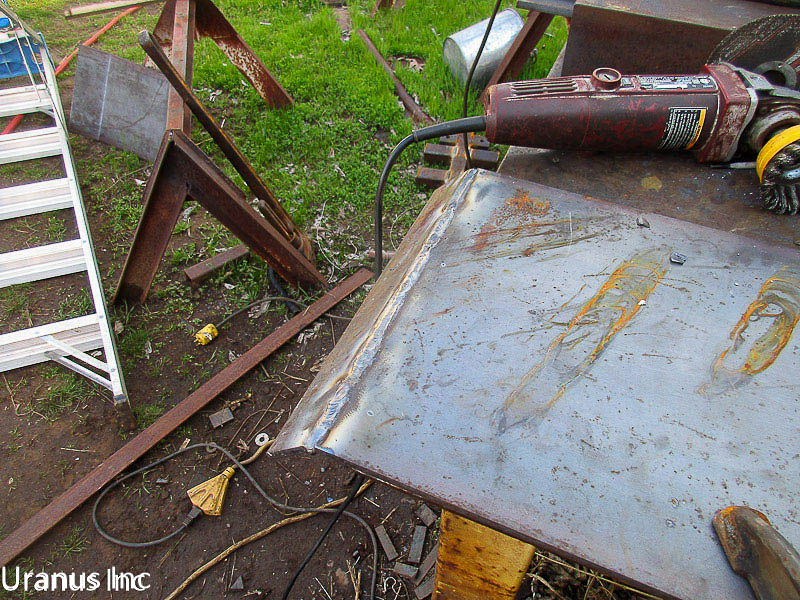
Weld 'er out. Just concentrate on filling the bevel/bend. You'll grind it smooth later.

If you did it right, you held your angle. Usually, you need to bend about 5* beyond what you want to wind up with.

Smooth it all out, and you have some skids that would cost you about 5 bills to buy. Note the lip at the back of the skid. This is to prevent the skid from digging in should you need, for some reason, to back up when the cutter bed is on the ground.
I won't go into the structure to actually mount the skids on the Krone mower. Mowers vary, and it's not my job to do your thinking for you. You should be able to figure this out for yourself.

We're good to go. The bed has been lifted enough to provide an acceptable amount of stubble, for quick recovery, and weed prevention..............and to protect the knives from obstructions (like rocks)

With float, the effective clearance will go as high as 6 inches when you encounter an obstruction. I had scarring on the skids when finished with the field.........which tells me it encountered rocks. But, due to the lift................no drama.
Have one more field to recondition this year. But no worries. We're equipped to do it. The next one involves stumps from cutting saplings.............no biggie with the high cut skids.
I have a limited amount of rocks in my fields.............but I do have some in certain areas. So.........I can see rolling the ground to get them pushed down.
But, I can't see smoothing a field when it just comes to dirt clods. Clods, like a plowed field, mellow with time..........and precipitation. Rain generally flattens a field after planting. Smooth as a baby's butt when a few rains hit during the growing season.
Anyways..................In case I never put this stuff up in a thread.............
I do NOT like a cutting head down in the dirt. Just plain stupid if you're growing grass. Not so stupid if you're maybe growing other crops. I dunno, so I can't say.
I hedge my bets, always have. I like high stubble, and I like protecting my header.
This is for you guys that run disc mowers.
I generally run a sickle head. Last year, I had to run a disc mower. When running a sickle machine, I set my gauge wheels to run at least 6" above the dirt.
However, facing using a disc mower (I hope I haven't posted this before), I needed to lift the cutting bed out of the dirt.
This is just plain STUPID. These machines, if you run them level, will literally run in the dirt.
I decided to make some skids to keep the bed up where it should be. (I don't/didn't rely on tilting the bed..........if it's made to run level, it ought to run level)
Get ya some plate, mark it, and slit it with a razor wheel. Bend it further than it needs to be bent..........to compensate for welding.
Tack it up to hold dimensions when it's finish welded. The tacks will hold the angle from changing when welding.
Weld 'er out. Just concentrate on filling the bevel/bend. You'll grind it smooth later.
If you did it right, you held your angle. Usually, you need to bend about 5* beyond what you want to wind up with.
Smooth it all out, and you have some skids that would cost you about 5 bills to buy. Note the lip at the back of the skid. This is to prevent the skid from digging in should you need, for some reason, to back up when the cutter bed is on the ground.
I won't go into the structure to actually mount the skids on the Krone mower. Mowers vary, and it's not my job to do your thinking for you. You should be able to figure this out for yourself.
We're good to go. The bed has been lifted enough to provide an acceptable amount of stubble, for quick recovery, and weed prevention..............and to protect the knives from obstructions (like rocks)
With float, the effective clearance will go as high as 6 inches when you encounter an obstruction. I had scarring on the skids when finished with the field.........which tells me it encountered rocks. But, due to the lift................no drama.
Have one more field to recondition this year. But no worries. We're equipped to do it. The next one involves stumps from cutting saplings.............no biggie with the high cut skids.
Similar threads
- Replies
- 21
- Views
- 32K

We sell tractor parts! We have the parts you need to repair your tractor - the right parts. Our low prices and years of research make us your best choice when you need parts. Shop Online Today.
Copyright © 1997-2025 Yesterday's Tractor Co.
All Rights Reserved. Reproduction of any part of this website, including design and content, without written permission is strictly prohibited. Trade Marks and Trade Names contained and used in this Website are those of others, and are used in this Website in a descriptive sense to refer to the products of others. Use of this Web site constitutes acceptance of our User Agreement and Privacy Policy TRADEMARK DISCLAIMER: Tradenames and Trademarks referred to within Yesterday's Tractor Co. products and within the Yesterday's Tractor Co. websites are the property of their respective trademark holders. None of these trademark holders are affiliated with Yesterday's Tractor Co., our products, or our website nor are we sponsored by them. John Deere and its logos are the registered trademarks of the John Deere Corporation. Agco, Agco Allis, White, Massey Ferguson and their logos are the registered trademarks of AGCO Corporation. Case, Case-IH, Farmall, International Harvester, New Holland and their logos are registered trademarks of CNH Global N.V.
Yesterday's Tractors - Antique Tractor Headquarters
Website Accessibility Policy