Finding Top Dead Center

I'm building a home brew electronic ignition. And in doing so I will lose the point opening reference for setting timing. That leads me to need to create a timming mark at TDC. With the spark plug hole not above the piston I cannot use a piston staop. Ideas ?

Kevin in MN
 
Take one of the valve covers off so you can see when the intake valve closes.
Then turn the engine over 1/2 turn more.
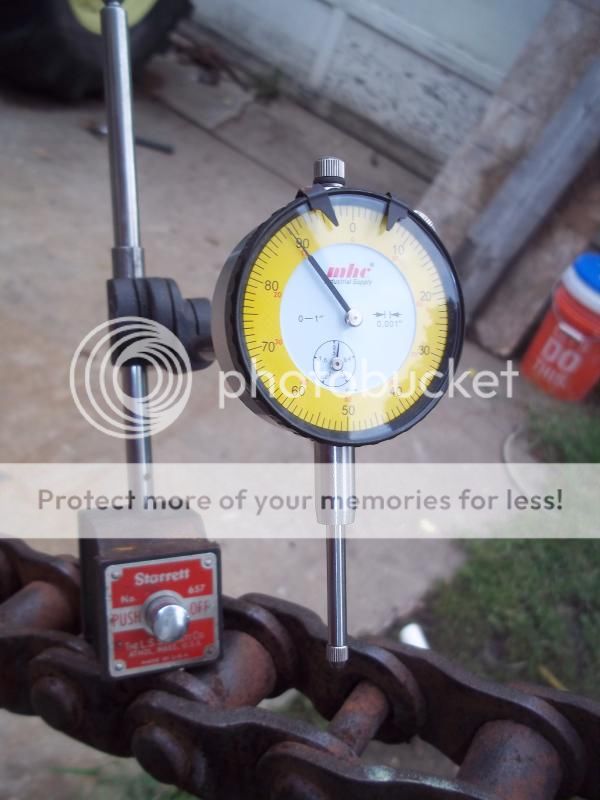
A dial indicator stuck down the spark plug hole would get you within within 3 tenths (.0003") of TDC pretty easily.
Not sure what 3 tenths would be in degrees but it would likely be close.
Someone here can do the math - 3.75"/180°

100_1780.jpg
 
maybe I didn't understand.
Is the head on or off?
I assumed the head was on.
Head on or off you could still use the dial indicator to find TDC very accurately.
Using the formula would give you .020"/°of crank rotation. I'm not sure what the timing is on an N but lets say it's 6° BTDC. So set your piston .120" below tdc, chisel a mark on your front pulley then adjust a pointer so it points to the correct firing position.
Then you could use a timing light to time it.
Am I on the right page here?
 
I might have just admitted how little I know about Ns. Someone here will tell us what is down the SP hole. I'm too used to working on later engines where the piston is directly below the SP

Ooops
 
(quoted from post at 05:22:34 09/05/14) maybe I didn't understand.
Is the head on or off?
I assumed the head was on.
Head on or off you could still use the dial indicator to find TDC very accurately.
Using the formula would give you .020"/°of crank rotation. I'm not sure what the timing is on an N but lets say it's 6° BTDC. So set your piston .120" below tdc, chisel a mark on your front pulley then adjust a pointer so it points to the correct firing position.
Then you could use a timing light to time it.
Am I on the right page here?

If he had the hood off he could use that dial indicator to check valve over lap on #4 with # 1 at TDC nuttin to it... I just look at it are drop a pin in the spark plug hole on #4 to get it closer...

He could google the numerous ways to verify TDC # 1 tricks...

BTW the ignition resistor applys to a front mount square coil points are EI 6 positive ground are 12V's negtive ground...

I am gonna say this tho its possible you are up chit creek if you depend on a bent wire going thru the spark plug hole on #1 to determine TDC... Pull your head out of your arse look elsewhere its not that hard to nail it with out a guess...
 
Get it close to TDC on the compression stroke, then connect a U-tube manometer to an appropriate adapter screwed into the sparkplug hole.

You can figure out the details.

BT, DT, finding TDC/timing on any engine is not too tough!
 
(quoted from post at 19:47:41 09/04/14) I'm building a home brew electronic ignition. And in doing so I will lose the point opening reference for setting timing. That leads me to need to create a timming mark at TDC. With the spark plug hole not above the piston I cannot use a piston staop. Ideas ?

Kevin in MN
A) FINDING TDC-COMPRESSION FOR #1 BY USING CYL #4 "ON THE ROCK" VALVE POSITION

As the video begins, #4 is at TDC-compression about to fire. It fires & piston moves down the cylinder on power stroke (both I & E valves closed). As piston reaches bottom (end of power stroke), the Ex valve begins to open & reaches full open as piston moves upward on the Ex stroke. As piston nears TDC on end of exhaust stroke, you can see the Ex valve begin closing and the Intake just beginning to open for the about-to-follow intake stroke. At TDC BOTH EX & I valves are in overlap, that is, both are slightly open, with Ex just about to complete closing and Intake just beginning to opening & heading for full opening on the intake stroke to follow. Here, I interrupt the engine rotation and turn it back and forth (normal/reverse rotation) a small amount so that you can easily observe the "on-the-rock" about TDC #4 where Intake & Exhaust valves are in overlap. When this occurs, cylinder #1 is at TCD-compression stroke ready to fire. This is a pretty good way to find TDC-compression of #1 and to verify valve-to-crank timing, as the visual movement of the I & E valves at this point give better resolution than simply observing that the piston is at top of cylinder, where it more or less dwells for a few degrees of crank rotation. Further more at #1, where both valves are closed at TDC-compression, there is no movement to be observed in homing in on TDC. An additional bonus of this method (especially on 9N/2N where there is no timing marks on flywheel or port to view through) is that the valves can be observed or probed through the spark plug hole (have done, hood on, wire probes rigged in place & observe as rotate engine).


B) Some say connect a balloon in place of spark plug and identify the null between expansion & contraction (never tried it).
C) Rig a manometer and watch the movement of the liquid in the tube (tried it once, worked pretty well).
D) This one takes a lot of patience: get as close as you can with your thumb, then connect high pressure air to spark plug hole and watch the crank pulley or flywheel for rotation to determine if your starting point was ahead or behind. Adjust accordingly & try again, etc. until you find exact center and then it won't rotate with application of air pressure. Works best on low friction motorcycle single, but not bad on an N.
E) fill cyl with oil & rotate to find end of flow & start of suck back into spark plug hole
F) Loosen plug and wet joint with kid’s Mr. Bubble or soap suds & rotate watching for expanding/contracting bubbles.


Thinking about this again this morning and having read the other posts - which would work btw -
I guess since I already have the tool, I would bend a heavy wire and do it as shown in the photo.
The tip on the dial indicator is removeable with a standard thread so it wouldn't be hard to add the probe and make it work.
This way would allow you to chisel a timing mark on your front pulley as I explained above and time the engine accurately in the future.
I'm not saying this is the only way but it's likely how I would go about it.

100_1784.jpg
 
It is a nice thought, but it is much tighter in there than the illustration looks & I have not even been able to get much of a "feel" on a wire thru the plug hole & onto top of piston. Seriously doubt success, but you may have better luck than I did with that.
 
I use something soft enough to crush between the piston and the head when it comes up to TDC you can feel it make contact as your turning the engine by hand. Using this method it doesn't matter which stroke it is on.

Mark
 
Yesterday's Tractor Forums

We sell tractor parts! We have the parts you need to repair your tractor - the right parts. Our low prices and years of research make us your best choice when you need parts. Shop Online Today.

Back
Top