Generator frequency

Russ from MN

Well-known Member
Location
Bemidji MN
Recently we had a nice discussion about setting the frequency on a generator, and I stated that I wasn't too fussy as I only run brush type
power tools anyhow, and they don't care. But, I do occasionally use a battery charger on that generator also, and its a nice Century 2-15-100
amp boost, and I would hate to have the smoke leak out of it. If the frequency is off a little is there any danger of damaging a charger?
Thanks!
 
I was told in 1968. When I first started out on generators. Generator freq range was 57/63.Anything in that range was ok. But the closer you can keep it at 60 the better.If you are off a little it will not matter.But some new equipment requires you to be at 59.5-60.5. This why there are electronic govenor systems. I don't believe the charger would care.
 
The only thing in a charger that would depend on or react to frequency is the timer, and it would just go faster or slower. Using converters in the UK for charging and lap top computer power supply worked fine at 50 Hz, and those power supplies had pretty sophisticated inverter based electronics. Jim
 
Frequency is very important to electronic stuff like computer but a battery charger is not likely to be hurt since it is pretty much a transformer and diodes both of which work with frequency differences. Yes it is best to keep it at close to 60hzr as one can but on many things it does not hurt to be of a bit
 
My boss's brother had a hunting cabin he ren in a generator for years, still does.

The generator he used was found at a garage sale, an ancient Onan air cooled diesel, in really bad condition due to "Bubba tinkering".

I got it all back to the way it should be and it ran great. Only problem was it ran slow. Never put a Hz meter on it, but it only produced 100/200 volts. Never could figure out how to adjust the governor, it was all internal, and was afraid to go in for fear of breaking something. There was no model or serial number, never found any place that could identify it or supply parts.

I suspect this was European military, probably 50Hz.

But he ran the cabin for years on it, ran AC and heat, refrigerator, microwave, charged phones, game cameras, just about anything that would be run in a typical house.

Never smoked anything to my knowledge.

Finally replaced it with a newer one a few years ago, said he didn't notice any difference in how everything run, but then he's not the type to be real observant of things like that.
 
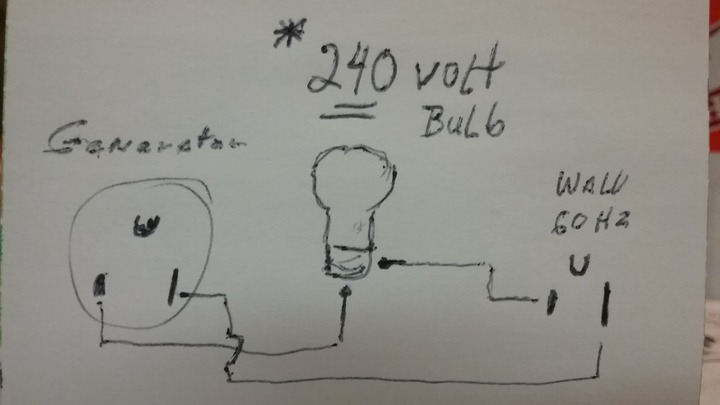
As Billy says you can bet your Bippy about modern day electronics and solidstate control systems. That high efficiency furnace in your basement better be getting 60hz. or a very thin wisker close to it. There is a whole lot of smoke in those control boards and big money too. Easy way to check is go to Lowes and buy a meter with a Hz symbol on it. Will be around $35.oo. My Fluke was around $300 but that is another story. There is a very old school way to adjust a generator using power from a wall socket. What is comming out of the wall is a pure 60 cycles. You want your generator to be putting out the same. With a 240 volt light bulb in a lamp fixture and wired up like this ,the bulb will pulse on and off till you adjust the engine speed till she is on the nose. The bulb will very slowly go from full bright to full off as the 60 cycle slowly matches or goes in and out of sync. AGAIN...a 240 volt bulb. 120+120= 240. Pick one up at your local electrical supply store. Try this at your own risk. So don't blame me.
a172774.jpg
 
As long as you are close (+- 10%) you will be fine. Today's electronics can take some shift in frequency. Because they are sourced for global consumption they are more flexible than they used to be. You have to watch total harmonic distortion (THD) for sensitive electronics.

In your case with the battery charger you will be fine. Power from the wall isn't perfect so they have built in ranges. Get it around 60 hertz and you will be fine.
 

Depending on the quality and who setup the governor , a no load frequency of 62 to 63hz will provide 59-60hz at full load .
 
Most home improvement stores and hardware stores will have a plug in meter that will measure voltage, frequncy, wattage, etc. Very convenient for all kinds of electrical measurements, including electrical consumption of an appliance over a period of time. Great for monitoring/adjustng a generator. Kill-a-watt is one brand name. Other than old fashioned motor driven clocks, I'm having a hard time identifying much of anything that is terribly frequency dependent. Most all of our solid state appliances use either transformer or switching power supplies which care not frequency dependent, and put out flat out DC which doesn't have frequency.
 
I see nothing terribly wrong with most of these responses, but IF you go too low on frequency with anything having a transformer in it(most battery chargers), it will draw excessive current & eventually smoke the transformer. What is too low? Probably OK with the mentioned +/- 10%, but almost sure smoke running a 60 Hz transformer on 30-40 Hz. Jeffcat's frequency set up is as perfect as almost anyone can get. If no 240v bulb, just series two 120v incandescent bulbs. Of course exercise safety in dealing with electricity, always.
 
It is just that some of the newer boards have clocked circuts in them. That is why those boards have 50 and 60 hz stickers on them. They mean it !! If you try to run your hi efficiency furnace with too small a gen set. When the blower tries to start the generator spead will pull down. That means there will be a frequency drop. That clock circut on the board goes bonkers and POOFFF. This is from the the tech suport guys at johnson controls tech line. Digital meters years ago very few had a Hz setting. Now you find quite a few of them have it now. Guess engineering folks are waking up to the need of meters like these.
 
Yesterday's Tractor Forums

We sell tractor parts! We have the parts you need to repair your tractor - the right parts. Our low prices and years of research make us your best choice when you need parts. Shop Online Today.

Back
Top