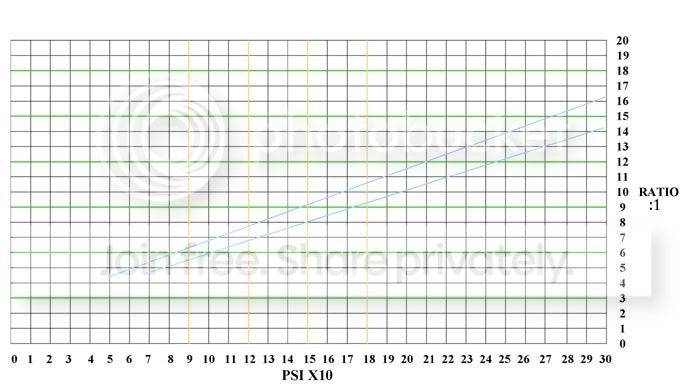
how to calculate compression?

Dan in CO

Well-known Member
I have been trying all afternoon to locate what the compression reading should be on my 1953 MG TD. Looked through all my shop manuals and googled many different ways to no good result. I know the engine has a 7.25 : 1 compression ratio and a bore of 2.618" with a stoke of 3.543".

Is there a math formula that will give a result in expected PSI?
 
[b:d336e256cf][i:d336e256cf]

I ain't got a clue, but I got a ??
You thinkin' about drivin' the TD to Florida. Gonna tick off "SHORTY"!! :lol:

Gary :shock: [/i:d336e256cf][/b:d336e256cf]
 

Nah, I won't drive that thing that far particularly without a heater or working top! Just getting ready for a Spring project to give the old girl some more pep. It is so bad now that I don't think it has the power to pull a sick Hoe (sp) out from an outhouse.
 
Here You Go.

CompChart.jpg
 

CJ:

That was exactly what I was looking for!! Thanks a bunch. Mine is a MkII so the compression should be 150 - 110, but that site has it all.

Did you find that via Google or do you have an MG?
 

Greg:

Yep, turns out the MkII is 8.0:1 so 150 is the right answer. Thanks, that will be a good chart for other engines as well!

Is there no end to the information contained on this forum?
 
Dan,
There is an ideal compression formula but because of the fact that the valves don't necessarily close at exactly BDC and don't seal perfectly, air is mixed with fuel, etc, etc (all the technical caveats), it provides a number that is too high.

Practical experience says that if you multipy the ideal number by 0.6 to 0.7, you get near the correct number. Here's the formula for the ideal, constant mass compression:

p2/p1 = (CR)^gamma, or p2 = p1*(CR)^1.4,

where CR is the compression ratio, gamma is the ratio of specific heats ~1.4, p1 is (strictly speaking) the pressure in the cylinder when the compression stroke starts,so for your 7.5 compression ratio, p2/p1 = 16.8.

If your barometric pressure at say 6000 ft is 12.28 psia. then the ideal compression pressure is 12.28 = 206 psia. Using the factor of 0.6 gives 124 psia and using 0.7, gives 144 psia. So I would say that the compression pressure would be between 124 and 144 psia @ 6000 ft pressure altitude.

You can screw around with the value of gamma and change these numbers bit but this is a practical way to get a cut at compression pressures.

Hope this helps you.

Regards,
Jerry
 
This chart can only be valid a one ambiemt pressure so I would take it that it's meant for sea level conditions like 14.7 psia. Is that your understanding?
 

Jerry:

I just knew you would have the formula. Now if I could only understand it. I guess if my Gamma is 6,000 ft, 124 is my expected pressure. But the real question is after 3-4 "Farmers freinds" does it change?

GB in Mt: did you get that?
 

Jerry:

I just knew you would have the formula. Now if I could only understand it. I guess if my Gamma is 6,000 ft, 124 is my expected pressure. But the real question is after 3-4 "Farmers friends" does it change?

GB in Mt: did you get that?
 
Burrrrrppppp!
I mushta misred the CR. You said 7.25 for CR so itshhh 118 - 137 psia. Buuurp! Gotta lay off 'demFarmer's Friends..........Buuuurrrrpppp!
 
[b:5a99872b49][i:5a99872b49]

Wat the he!!, youse gies ...BRraaack. U havn aperty thout me/??/>/,/
Hic..brup..gak.ouh!! eye tink eye neded thet.

dum..dang...kat
cid_13A934F0A811411B89C9A759DA1DC1B.gif
[/i:5a99872b49][/b:5a99872b49]
 
Yesterday's Tractor Forums

We sell tractor parts! We have the parts you need to repair your tractor - the right parts. Our low prices and years of research make us your best choice when you need parts. Shop Online Today.

Back
Top