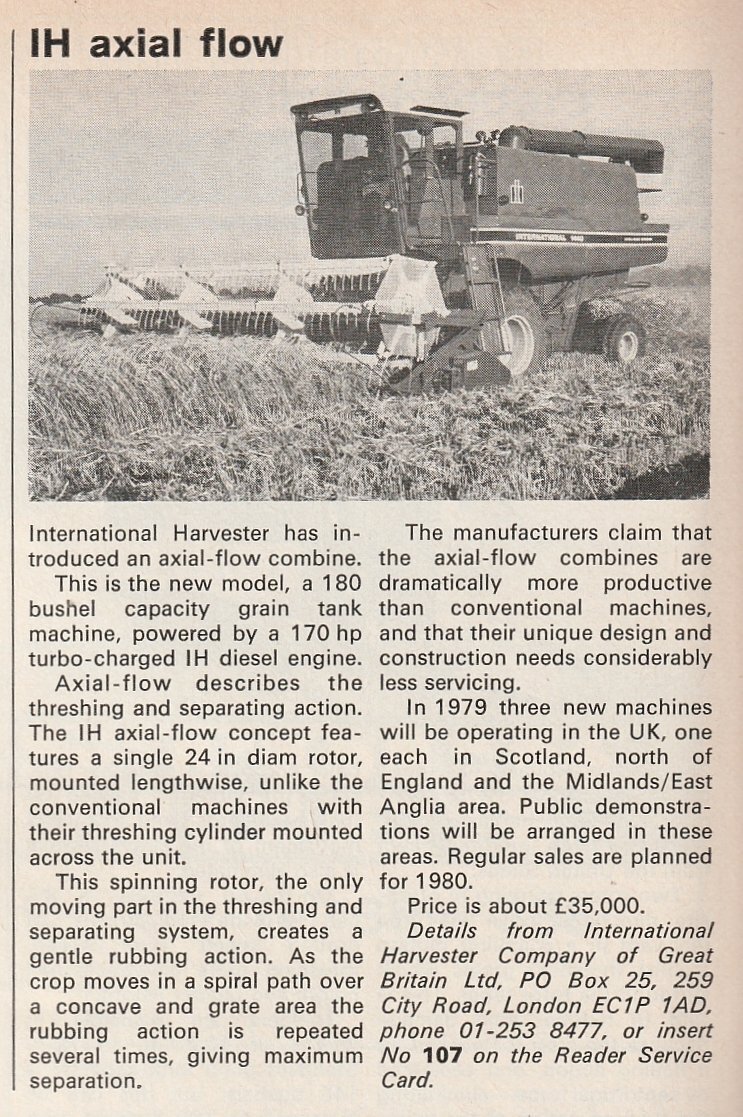
I owned two 1460s over the years. They are, in my opinion, one of the best machines ever built. I had 20' heads on both of them, and would consider that to be the perfect head size. I've cut 70 bushels soybeans, at 4.5 MPH, with no problems. There are different heads that can be mounted on 1460s. I had an 820 and a 1020 over the years, plus an 820 that was customized by John Young (Harvestmore). The Young head cut the closest to the ground of the three, but if there was a rock in the field, it picked it up. I only ran that head for two seasons. I'd recommend a 1020. Set the front feeder plate on the combine feeder house to 12 degrees, and they work well. An 820 will also work, but they are heavy and harder to make float as you need for beans.
As for the grass problem, I don't know where you are located, but a frost will be your friend. The grass has a different attitude after a frost. A 1460 can have a Standard rotor, a Specialty rotor, or the newer AFX rotor. If the bean stems are green, the Specialty or AFX will work better, but the standard will also work; you will just have to get used to the combine growling at you.
You can install a product called "Disruptors" in the grates of the machine, which would help with the grass (I'm betting this is the same product they put in the Deeres for grass). They are available from dealers or aftermarket from Shoup or Sloan...... (see Google Link Below)
One thing I'd watch. The grain heads have both a 1.5" and 3" cutter bar options (how wide the cycle sections are). The idea is that a 1.5" cut does not move the bean stem as much and stops shatter loss. But, in a weedy (grass) condition, you DO NOT WANT A 1.5" CUT"...they don't cut the grass; they just wiggle the grass back and forth.... green grass is very flexible. I had a 1.5" cut for two years and changed it over when I rebuilt the head....I was never happy with the 1.5" setup.
As for the 45-minute (or two- to three-hour) combine drive being bad on the machine. Not sure what to say; one of the dumbest things I've heard.
Are you only allowed to cut beans or run corn for a couple of hours, and then rest the machine for a while? The only wear I think will occur is on the tires, and that is no worse than on a tractor, but blacktop is hard on ag tires.
Most dealers drive the new machines if they can make the trip in a few hours; it's quicker than hauling (removing grain tank extensions and flatting a tire take time).
The only other thing I might add. The early 1460s used mechanical-cable control, and later ones had electric over hydraulic header controls... they both work, but the later ones work better.
This link is to a timeline of the Axial-Flow combines that might be helpful:
I put this together, let me know if anything is wrong or especially if you have something to add!! Axial-Flow “Heritage” Combine Timeline 1977- Introduction of the first 300 Axial-Flow Combines; · 1440: 135-Hp 436 Cid, 145 Bu. Grain Tank, 4750 sq. in. Sieve Area, 24” Rotor · 1460: 170-Hp 436 Cid,...

www.redpowermagazine.com
As I said, I owned two 1460s over the years. The last one I owned (picture) was one of the last ones built (1985 model) after the Case IH merger and the only year they said CASE on the