


I have been trying to find a good motor oil that will work goot for both summer and winter in my 47 2n because I dont use it enough to change oil every spring and fall. We tried 10w-30, but that seemed alittle thin raking hay. I bought some 10w-40 I havent put it in yet. I know that it will be more like straight 30. what you guys think?
You are using an out of date browser. It may not display this or other websites correctly.
You should upgrade or use an alternative browser.
You should upgrade or use an alternative browser.
NoNewParts
Member
like SouNdguy, I run 15w40 in everything now
got tired of all the different cans in the shop
30w,40w for tractors
20-50 for drag cars and bike
10w30 or 10w40 for winter stuff
and I was always out of the one I needed.........
got tired of all the different cans in the shop
30w,40w for tractors
20-50 for drag cars and bike
10w30 or 10w40 for winter stuff
and I was always out of the one I needed.........

TheOldHokie
Well-known Member
- Location
- Myersville, MD 21773
(quoted from post at 23:16:10 09/02/11) I have been trying to find a good motor oil that will work goot for both summer and winter in my 47 2n because I dont use it enough to change oil every spring and fall. We tried 10w-30, but that seemed alittle thin raking hay. I bought some 10w-40 I havent put it in yet. I know that it will be more like straight 30. what you guys think?
Good question and I'll try to give you a good answer. I'll keep it "short" but it may still make your eyes glaze over :roll:
SAE 10W30 [u:637e86274e]is[/u:637e86274e] SAE 30 oil. SAE 10W40 [u:637e86274e]is[/u:637e86274e] SAE 40 oil. The multi-grades and the mono-grades all have the high temperature viscosity specified by their SAE high temperature grade label and that is the same whether they are multi or mono grade oils. Conversly SAE 30 [u:637e86274e]is not[/u:637e86274e] SAE 10W oil and SAE 40 [u:637e86274e]is not[/u:637e86274e] SAE 15W oil. Neither mono-grade meets the cold weather viscosity specified by [u:637e86274e]ANY[/u:637e86274e] SAE cold temperature standard. So you see a multi-grade is simply an oil that meets BOTH a hot AND a cold grade requirement. A mono-grade is an oil that meets either a hot or a cold grade but not one of each.
When choosing a multigrade pick the cold weather grade based on the cold weather pumping performance you need. On the hot weather side choose a grade that gives you good oil pressure in your hot operating conditions. You can easily graph comparative viscosity curves for oils you might be considering using this handy dandy online viscosity graphing tool:
[u:637e86274e]Widman Oil Viscosity Curve Calculator[/u:637e86274e]
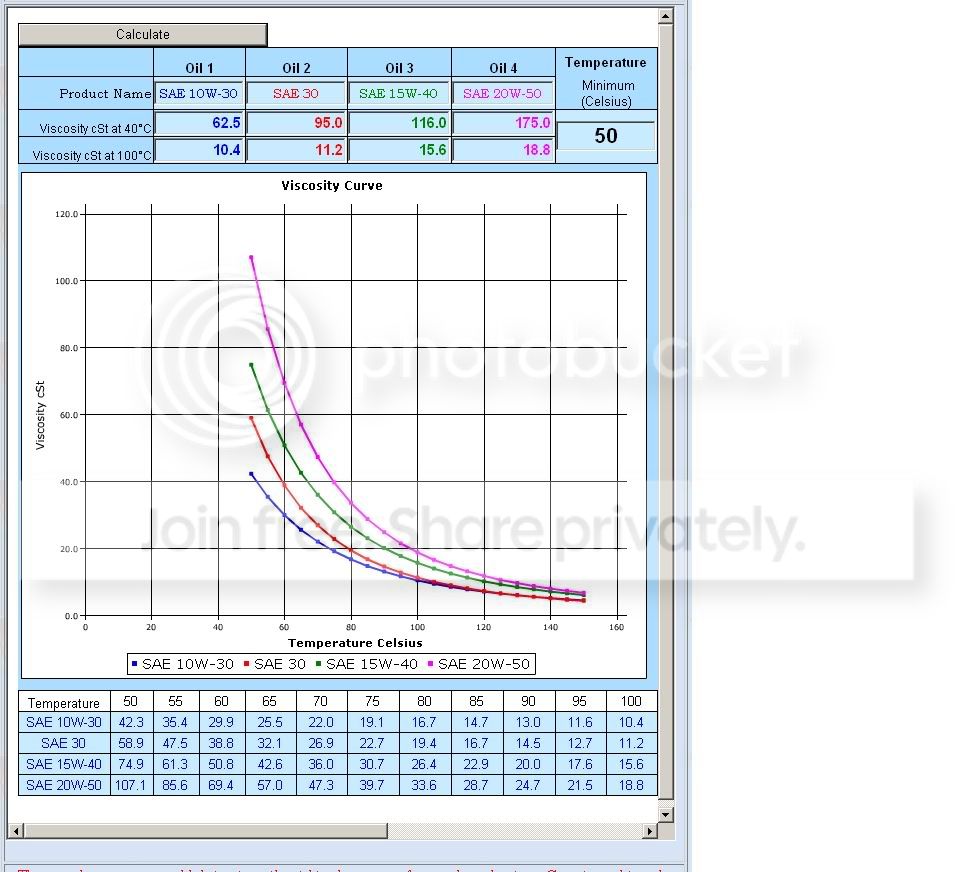
To use the tool you just need to get the actual labratory test viscosities for the oils you are considering and plug them into the calculator. Those values are measured at 40C and 100C and can be found in the product data sheets which are typically available on the manufacturer's web sites. Here is a sample comparative graph I did of a generic SAE 10W30, SAE 30, SAE 15W40,and SAE 20W50. Top graph shows the performance over a typical full operating temperature range and the second one drills in for a little closer look at the hot values. No two oils with the same grade label will be exactly the same. Product specific curves will vary somewhat based on the individual brands and formulations but they will all start and end in their designated grade ranges which you can find here:
[u:637e86274e]Viscosity Grade Table from SAE J300 Motor Oil Viscosity Standard[/u:637e86274e]
And if you want to read my really long answer try this:
[u:637e86274e]Understanding the SAE Motor Oil Viscosity Standard[/u:637e86274e]
TOH

G6 at Snook, TX
Well-known Member
15-40 here as well. I have settled on it because I like the oil pressure it consistently gives me. I use the JD brand because it is for tractors specifically, but I have no worries about Rotella T either. Both are good.
Others will disagree, but I add a little Lucas Oil stabilizer to my 8ns because I change them once a year.
Others will disagree, but I add a little Lucas Oil stabilizer to my 8ns because I change them once a year.
(quoted from post at 20:16:10 09/02/11) I have been trying to find a good motor oil that will work goot for both summer and winter in my 47 2n because I dont use it enough to change oil every spring and fall. We tried 10w-30, but that seemed alittle thin raking hay. I bought some 10w-40 I havent put it in yet. I know that it will be more like straight 30. what you guys think?
I used 30wt year round in my 2n for 20 plus years. Had good oil pressure. I tried the Rotella 15-40 last fall it was ok in the winter. It gave me better oil pressure when engine was cold but a small drop in pressure when engine ran for 3-4 hours.
When weather warmed engine had less oil pressure when cold and dropped more when warmed. I had to change back to 30 wt. It works the best.
trouttman
TheOldHokie
Well-known Member
- Location
- Myersville, MD 21773
(quoted from post at 00:12:51 09/05/11) Thanks alot for all the help guys
Lots of opinions and anecdotal observations given but not a lot of hard data. Maybe a simple look at a real product data sheet will be easier to understand than my graphs. So here are some simple comparative numbers for different grades of Valvoline All Fleet Plus Engine Oil . These numbers are very typical of other similar products but every name brand is slightly different.
The Valvoline datasheet lists 4 different viscosity measurements for each grade of oil - simple pour viscosities at 40C and 100C, high tepmperature and high shear (HTHS) viscosity at 150C, and cold cranking simulator (CCS) viscosity at temps well below freezing. There is also a Borderline Pumping test conducted at extremely cold temperatures with the oil held there for an extended time. Those tests determine what grade the oil is. After testing the oil is given a grade label telling you which tests it passed and (by omission) which tests it didn't.
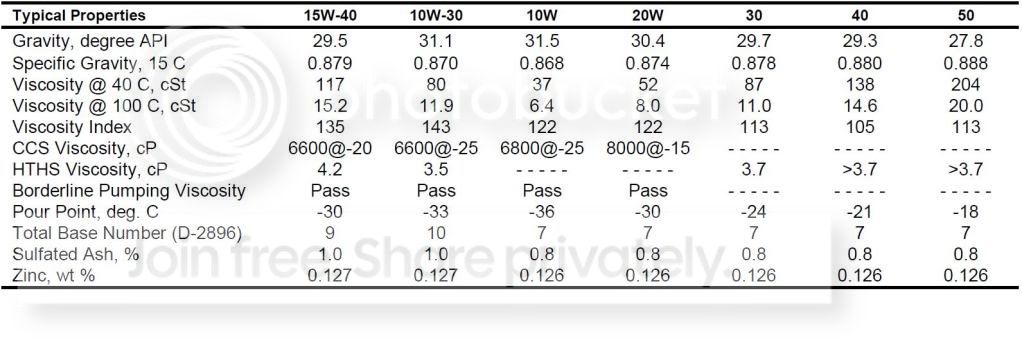
a) As you can see the SAE 15W40 has a higher viscosity than either the SAE 10W30 or the SAE 30 throughout the normal operating temrperature band (40C to 100C). That of course is what you would expect if you understand the grading scheme.
b) The SAE 10W30 has a slightly higher pour viscosity than the SAE 30 when really hot inside the bearings of a hot running engine (100C/212F) and just slightly lower viscosity sitting in your "cold" tractor sump on a hot Texas day (40C/104F). They both are near the absolute maximum pour viscosity allowed for a grade 30 oil (12.5 cSt).
(c) No Cold Cranking Simulator (CCS) viscosities are given for the summer monogrades (SAE 30, 40, and 50) becasue they get really thick when cold, wont pass the test, and aren't required to. Simialrly the winter mono-grades (SAE 10W and SAE 20W) have no High Temperature/High Shear (HTHS) viscosities given because they get really thin when hot, won't pass that test, and are not required to.
d) All of the multigrade and winter monogrades also pass the Borderline Pumping(cold gellation) test but the summer monogrades won't pass that test and are not required to
HTH,
TOH
TheOldHokie
Well-known Member
- Location
- Myersville, MD 21773
(quoted from post at 10:54:46 09/05/11) Thanks, that is really interesting. Where do you find all of these graphs?
Well I'm glad someone besides me thinks it's interesting. Useful too if you care to utilize a little science when deciding on a grade of oil for your car/truck/tractor.The viscosity data in that table I posted was taken from the All Fleet product data sheet I found on the Valvoline site. It's just a cropped screen shot of their PDF page. Most oil companies make similar data available on their web sites. The graphs were produced by feeding that data into an online viscosity graphing tool provided by Widman Oil:
http://www.widman.biz/English/Calculators/Graph.html
That tool takes the viscosities of an oil measured at 40C and 100C and uses the values to compute a full viscosity curve for the oil over a (mostly) user selectable temperature range. You can input viscosity data for four different oils and it plots the curves on the same set of axis so you can get a good clear graphical comparison. Since the curves increase exponentially as the temperature drops they converge on each other at the high temperture end. There is a user input box for the minimum oil temperture you want to graph - by setting it higher you can graphically drill down and separate the higher temperature sections of the curves. They also have a couple other interesting viscosity calculator tools.
TOH
Jerry Kirkpatrick
Member
Thanks, Hok...that's good stuff!
JK
After looking at the charts I think 15/40 and 20/50 should not be used in cold weather in worn engines.We have all seen engines that had trouble getting oil pressure after an oil change.I think this happens because the oil pump is worn and has trouble pulling the oil thru a screen.I drove an International truck that showed no oil pressure on a cold morning until I put a pint of #10 oil into the crank case.My wife had a high milage Mercury that rattled pretty bad on cold mornings.It didnt seem to be so noisy after a fresh oil change with 10/30.Since 15/40 and 20/50 have a higher cold viscosity than 30 oil the N engines may have some dry start ups in cold weather with 15/40 and 20/50.I did an oil change on my truck in late Nov with 15/40 and saw some erratic oil pressure on the gauge for a while .Never did that with 10/30.Truck has good hot oil pressure.The improved oils may be harming old engines with high viscosity on cold startup.
TheOldHokie
Well-known Member
- Location
- Myersville, MD 21773
(quoted from post at 06:02:11 09/13/11) After looking at the charts I think 15/40 and 20/50 should not be used in cold weather in worn engines.We have all seen engines that had trouble getting oil pressure after an oil change.I think this happens because the oil pump is worn and has trouble pulling the oil thru a screen.I drove an International truck that showed no oil pressure on a cold morning until I put a pint of #10 oil into the crank case.My wife had a high milage Mercury that rattled pretty bad on cold mornings.It didnt seem to be so noisy after a fresh oil change with 10/30.Since 15/40 and 20/50 have a higher cold viscosity than 30 oil the N engines may have some dry start ups in cold weather with 15/40 and 20/50.I did an oil change on my truck in late Nov with 15/40 and saw some erratic oil pressure on the gauge for a while .Never did that with 10/30.Truck has good hot oil pressure.The improved oils may be harming old engines with high viscosity on cold startup.
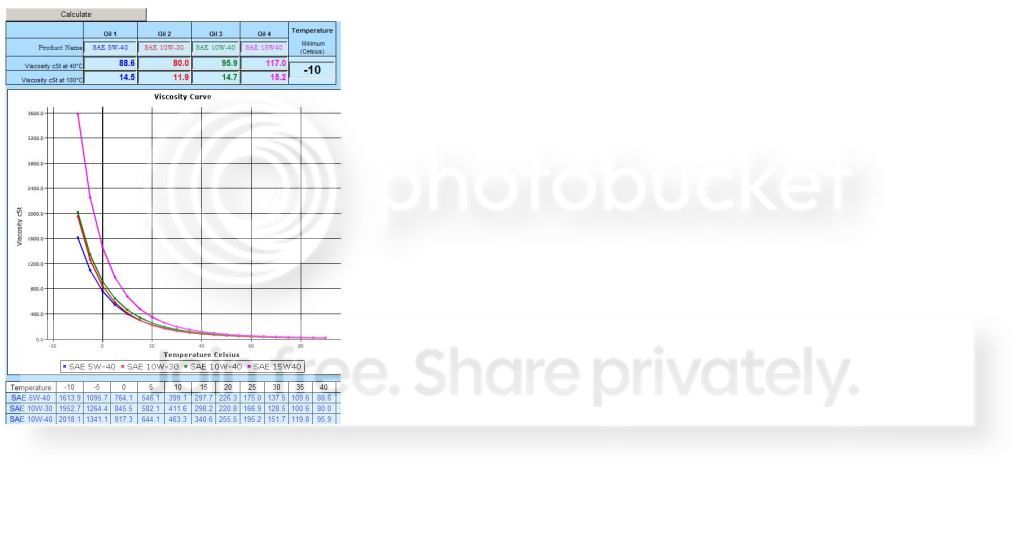
You are missing the point. Modern day oils are specifically formulated to give you lower viscosity and better pumpabilty on cold startup. That's one of the primary improvements over monograde oils. But it's up to you to understand the grading system and chose a grade that is suitable for use in your engine and your temperature band. If you think SAE 15W40 is overly thick for cold startup in your engine but you still want the hot viscosity of a grade 40 oil simply move down a grade on the winter side - e.g use SAE 5W40 or 10W40. Heck you can get oils in grades 0W40 or 0W50 if you thought that was appropriate to your situation. I don't know if it's still the case but at one time SAE 0W40 was the factory fill for new Mercedes. So as Bruce says - choose the grade based on your conditions. Using the Widman tool I plotted a comparative graph of some of those grades for you and you can see they are very nearly identical to SAE 10W30 at temps well below freezing. The analysis tools and data are there - all you have to do is use them.
TOH

We sell tractor parts! We have the parts you need to repair your tractor - the right parts. Our low prices and years of research make us your best choice when you need parts. Shop Online Today.
Copyright © 1997-2025 Yesterday's Tractor Co.
All Rights Reserved. Reproduction of any part of this website, including design and content, without written permission is strictly prohibited. Trade Marks and Trade Names contained and used in this Website are those of others, and are used in this Website in a descriptive sense to refer to the products of others. Use of this Web site constitutes acceptance of our User Agreement and Privacy Policy TRADEMARK DISCLAIMER: Tradenames and Trademarks referred to within Yesterday's Tractor Co. products and within the Yesterday's Tractor Co. websites are the property of their respective trademark holders. None of these trademark holders are affiliated with Yesterday's Tractor Co., our products, or our website nor are we sponsored by them. John Deere and its logos are the registered trademarks of the John Deere Corporation. Agco, Agco Allis, White, Massey Ferguson and their logos are the registered trademarks of AGCO Corporation. Case, Case-IH, Farmall, International Harvester, New Holland and their logos are registered trademarks of CNH Global N.V.
Yesterday's Tractors - Antique Tractor Headquarters
Website Accessibility Policy