Michael Law

New User
I have a 8N. When I turn the switch on the amp meter show neg. When running it shows charging.
Today it started ran for about a min then shut down. When I attempted to restart the amp meter showed no power, and no spark. I checked all terminals and it shows that all is getting power.
But it has no spark, and ideas on whats up?
I am just a plugger with limited knowledge on electrical.
Michael
 
We can be more helpful if you would give us a little more info about your tractor.

Troubleshooting is different depending on the model of the tractor, voltage, ignition system & distributor placement & the absence of OEM parts.

When you ask a question, it’s always important to tell us:

1. The model of your tractor (2N, 9N, 8N, NAA, etc).

2. If it is 6v or 12v.

3. If it’s an N, if the distributor is on the front or side of the engine.

4. If it has any major parts that are not OEM, such as electronic ignition, an in-line fuel filter, a Zenith carb, an 8v battery, a side coil on a front distributor, etc

5. The last time you tuned it (points, plugs, condenser, rotor, cap, set the timing & adjusted the carb).

All we know now is that you have an 8N that doesn't run.
50 Tips
 
Mike.......didja know the guttz of yer weaksister ignition switch can cumm apart inside the switch housing and guess what??? NO sparkies. (and no ammeter reading)

Howsomevers; didja know in order to make sparkies, yer POINTS haffta OPEN. Its the LAW, electro-magnetic law. Not uncommon for ignition points to slip CLOSED and guess what??? NO sparkies. (but will have about 3-5amps meter reading) Yer call

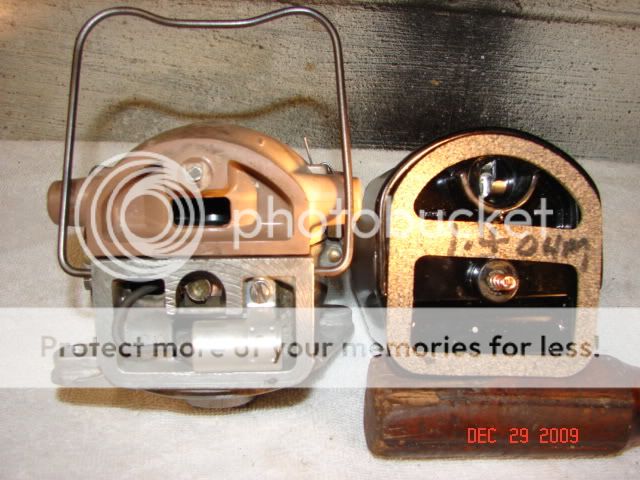
Don't matter whether ittza 5-nipple sidemount or weird 4-nipple frontmount, the sparkies all work the same. You do know ittza 2-bolt, 15-min job to remove yer 4-nipple frontmount and change and adjust the points (0.015") on the kitchen table, don't you??? Just un-snapple yer capple and letter dangle. Installation is a reversal of the removal ...except... gently start yer 2-bolts and rotate yer rotor until the OFF-SET tang slips into the camshaft OFF-SET drive slot. Then tighten yer 2-bolts and re-snapple yer capple. Simple, eh?

Remember the sparkie firing order is 1,2,4,3 CCW (#1 is next to radiator) Many neubie shadetree mechanics gitt sparkies 3&4 reversed. These N-Engines are SOOOooo GOOOoood they will start and run on just 2-cylinders but won't have enny power. .........Dell, yer self-appointed sparkie-meister
 
Points run hot and can build up an oxide film that insulates them.The ammeter should flick back and forth when cranking.When you dont see this clean the points.You will have to learn electricals or pay 90 bucks an hour to have it fixed.
 
Bruce
It's 8 N ,6volt all original.
It ran good, up untill yesterday.
When I turn the switch on it always show neg on the amp meter. then when it starts it shows charging.
It ran for about a min. then it shut down. When I tried to restart the amp meter showed nothing, and no spark I checked with a meter, I get about 6 volts from switch to generator and other connections.
I am stumped,
 
Tune ups tend to introduce new junk parts to a tractor.Tune ups were a great money maker for auto garages but a lot of good parts got thrown out.I used to save all the condensers and use them for radio noise problems.The 50s and 60s Ford condensers were oil filled and rarely gave trouble.They are marked Fomoco and have a spot of solder on the end where the oil was put in.Ford auto dealers can supply points for Ford tractors.
 
We still need to know some more info.

Is it a front or side distributor?

It takes three things for an engine to run: spark at the right time, compression, & fuel in the right mixture. For the moment, forget about compression & concentrate on narrowing the problem down to spark or fuel.


There are three very important tools you always need to have in your N tool box: a 3 inch piece of wire w/ alligator clips on each end, an old spark plug w/ the gap opened to at least 3/16” ( ¼” is better) and a 7/16 box end wrench. (see tip # 50 at the link below) And, you really do need a working ammeter on the tractor; it is a very important diagnostic tool. With these tools, you can quickly narrow down most N problems to spark or fuel.


First, check for fuel. Get a can & put it under the carb. Remove the bolt in the bottom of the carb; as long as the fuel is turned on, you should see gas flowing out of the carb. Let it run for at least 30 seconds. If it’s a dribble, or runs for 5 seconds & stops, or none at all, you have solved half the problem: it’s fuel related. If gas flows well out of the carb & only stops when you turn it off at the sediment bowl, chances are very good it’s not a fuel problem. So, next, turn the key on, crank the engine & look at the ammeter. What is the needle doing? Does it show a constant discharge, no movement at all, or does it move back & forth slightly? Next, get the old plug, ground it to a rust & paint free spot on the engine, turn the key on & crank the engine. If the spark jumps the 3/16” gap, you probably don’t have a spark problem. If it won’t jump the 3/16” gap, you have a spark problem. If the ammeter needle shows a constant discharge, or doesn’t move at all, that also tells you that you have a spark problem. Jump the ignition switch w/ your jumper wire & see what happens. If it runs, you found the problem. If it doesn’t have spark after you jump the ignition switch, post back for more info on further troubleshooting. (and do not forget to turn the ignition switch off; see tip # 38)


If it does not have gas coming out of the carb at a steady stream w/ the bolt out for at least 30 seconds, you have a fuel problem. First, remove the gas cap. Your vent could be clogged & it vacuum locked. If that doesn’t work, tap the carb bowl w/ a hammer handle in case the float is sticking closed. (don’t whack it w/ the head of the hammer; you can crack the bowl). If you still don’t see gas flowing, the N has three fuel screens; one in the brass elbow, one in the top of the sediment bowl & one on the stem of the sediment bowl in the gas tank. Check the screen in the elbow & the screen in the top of the sediment bowl. (don’t worry about the one in the tank) Both probably need to be cleaned. If you have the fuel knob turned on all the way, & 1 gallon or less in the tank, it may be trying to feed off of the reserve inlet which is probably clogged. Only open it 2 full turns. Put at least 2 gallons in the tank. (and do not forget to turn the gas off; see tip # 9)


There are ways to check for spark & fuel that work & ways that don't. For example, having gas to the carb is nice, but having it past the float is what counts! That’s why removing the 7/16” bolt in the bottom of the carb is the way to check for fuel. And, same thing w/ spark at the plugs. Some folks think that checking for spark means pulling a plug wire off & looking for one. Well, it's the distance the spark jumps at the plug that gives you the info you want. It takes about 17kv to jump a 3/16" gap & 22kv to jump ¼” in the open air. Remember, it’s 14psi outside of the engine & about 90psi at a 6:1 compression ratio in the cylinders & compressed air creates electrical resistance, so you really need the 17-22kv to fire the plugs when the engine is running. A store bought plug checker will work better than an old plug because it won’t shock the snot out of you like an old plug might!
50 Tips
 
Mike........you write......."When I turn the switch on it always show neg on the amp meter. then when it starts it shows charging"........would you believe that is the way gennys work??? Until the engine starts, yer ammeter will show NEGATIVE 'cuz of yer ignition ...and... when yer engine starts, guess what??? the GENNY charges yer battery and it shows on yer ammeter. Thats the way it works. ........Sheesh!!!

You write......."I get about 6 volts from switch to generator and other connections".......why does that supprize you??? .......ONE side of yer ignition switch is ALWAYS connected to yer battery ...and... all the other connections you mention are essentually GROUND. And guess what??? You will always read battery volts from ignition switch to ground. .......Sheesh!!! .......respectfully, Dell
 
Thank you all for the info on no spark.
Is there any simple wat to change and adjust points on a 8N 6 volt? Located up front close to the fan. Pretty tight and hard to see.
Michael
 
Bruce, your information was priceless.
I need new points, I think there burnt from what I can see.
Front mount distrbutor, on the right side. Is there an easer way to change the point on this thing. Pretty tight fit. Any tricks to it?
 
When describing the distributor placement on an N, the terms "front" & "side" are mutually exclusive. By saying it's a tight fit, I'll assume it's a front distributor, but you could get confusing replies if someone thinks you have a side distributor, which happens to be on the right side of the engine, near the front.

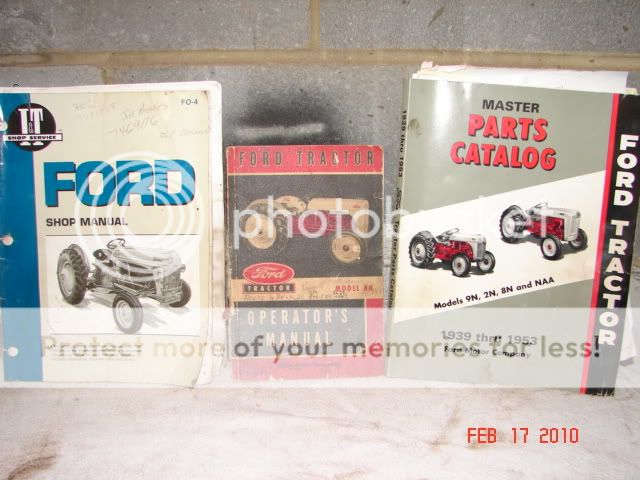
First, check out tip # 39. A good set of manuals will be a great help to you. You'll need points & a condenser (and maybe a cap & rotor) so order the manuals at the same time. Get your parts here or from nnalert's. NAPA is expensive & TSC has poor quality, expensive parts.

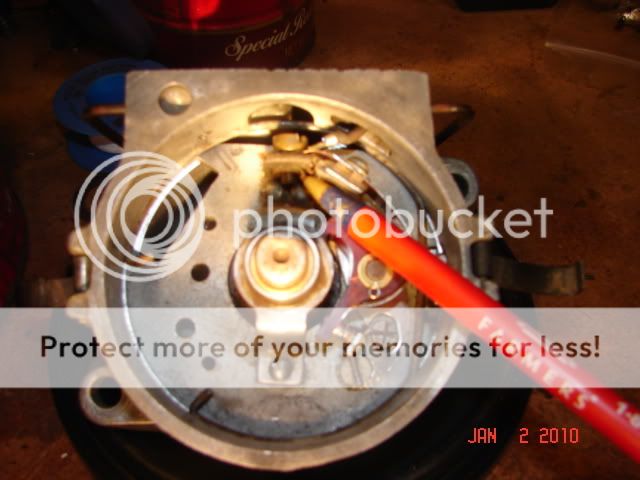
The front distributor was designed to come off of the tractor to replace/adjust the points. Remove the wire on the coil, remove the coil bail, remove the distributor cap & take the two bolts off. The base of the distributor has an offset tang & can only go back one way unless you really force it on. Look at how the points & condenser set in the distributor before you start pulling it down! Turn the tang & observe how the points open & close. If this is your first time doing it, draw a sketch!. Make sure you are using quality parts; the points should have a phenolic rubbing block & not the cheap white plastic crap. Use only Wells, Blue Streak or Echlin brand points. (* see below) Be careful not to ground the tip of the condenser wire to the body of the distributor when you replace the points. Do not break the little copper strip that goes to the points. (If you do, make another out of the old set of points) Also, make sure the condenser wire does not go through the same opening in the distributor that the coil pig tail does. The condenser wire goes the opening on the top right. Look at the old points; are they burned, pitted or mis-aligned? Check the point gap, .015 on all four lobes. Make sure the blade is at a perfect right angle to the points & you want to feel just the slightest bit of drag when you pull the blade through the points. Set the points on the highside of the cam. Make sure you have the star washers under the screws on the points. Dress the points by running a piece of card stock or brown paper bag through them. New points sometimes have an anti-corrosive dielectric coating on them & old points can corrode or pick up grease from a dirty feeler gauge or excessive cam lubricant. And, don’t forget to lube the rubbing block w/ cam lube; not Vaseline, not bearing grease, but cam lube. (** see below)

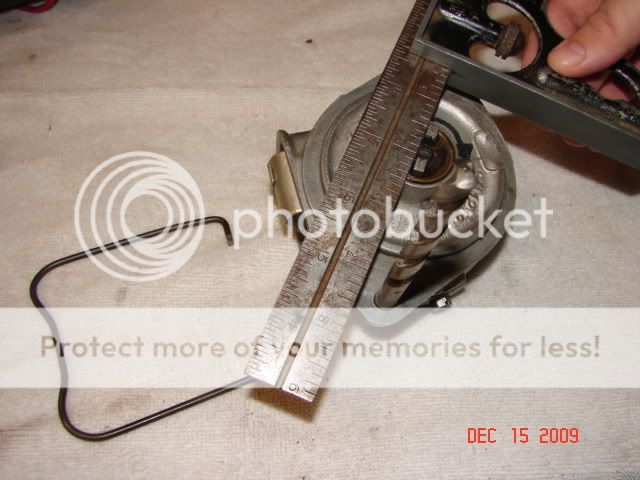
Now, set the timing. Get a meter or test light, a 21/64” drill bit & a metal straight edge. Put the distributor face down w/ the condenser on the left & the timing plate lock screw on the bottom. Look at the end of the shaft: it has a narrow side & a wide side. Make sure you can tell the difference. Now, place the drill bit in the bottom mounting hole. (this will be your reference point for measuring) . Next, place a straight edge on the wide side of the tang on shaft as shown in fig. FO83 in the I&T FO4 manual. Rotate the shaft CCW (as viewed from rotor side OR CW as viewed from back/tang side) until the straight edge is ¼" beyond the outside edge of the drill bit you stuck in the distributor mounting hole. At this distance, the distributor points should start to open. (get your meter/light out now & check) If not, loosen the timing plate lock screw and turn to advance or retard the timing. (move the plate down to advance timing, up to retard) Remember, each one of those little hash marks represents about 4* of timing. Keep adjusting until you get the proper ¼" setting. (if the plate won’t move, you might need to remove the big C clip to loosen it a bit) As you’re adjusting, eliminate backlash by turning the shaft backwards (CW as viewed from the front) and bring the shaft forwards (CCW as viewed from the front) to measure your setting. This ¼" setting will get you static timing at top dead center.

After you set the points & timing, do a continuity check before you put the distributor back on the tractor. Before you start, make sure your meter/light works (don't ask....)

With the distributor still off the tractor, follow these steps:

1. Coil off, cap off, points open. One probe on the brass screw & the other on both sides of the open points. On the side closest to the cam, you should have continuity. Not on the other side! If you do, you will also have continuity everywhere because the points are grounded.

2. Coil off, cap off, points open. One probe on the brass screw & the other anywhere on the body of the distributor. You should have no continuity! Now, rotate the tang on the distributor....as the points open & close, you have continuity (closed) and lose it when they open.

3. Put the coil on the distributor, cap off, points open. One probe on the lead on the top of the coil, the other on the cam side of the open points. You should have continuity!

4. Coil on, cap off, points open. One probe on the lead on the top of the coil, the other anywhere on the body of the distributor. You should have no continuity!

At this point, I just put the distributor, coil & cap all back on the tractor as a unit. The reason I do this is because it is real easy to get the cap or coil mis-aligned trying to put it back together one piece at a time & the result is something gets broken or you get a ‘no spark’ problem.

It's possible to put it back on wrong & break it. Look at the slot on the end of the cam shaft. What ever angle it happens to be, turn the distributor tang to match it. Make sure you can tell the wide side from the narrow side on both the cam & distributor! (close counts) Then place the distributor on the front of the engine, gently push it in place & slowly turn the distributor body until you feel the tang slip into the slot. Rotate the distributor body until the bolt holes line up. Then, hand tighten the two bolts until the distributor body is flush w/ the timing gear cover.

Post back w/ results & any other questions.


* NAPA part numbers:

· Points: FD-6769X

· Condenser: FD-71

· Rotor: FD-104

· Cap: FD-126

** Distributor cam lube: http://www.autoanything.com/fluids-manuals-63-771-1978/201A1960.aspx?kc=FFPMM
DSC03217.jpg

DSC03473.jpg

distributorinsulator.jpg

timing003.jpg

Coil1.jpg

50 Tips
 
To Bruce.
Kudos to the Yesterday Tractors and mostly to Bruce. The Parts ordered came in record to, even thru snail mail.
And Bruces instructons worked like he was here doing it himself. And when you turn the key it starts after a half revalution.
So my hat goes off to Bruce and Yesterdays Tractors. !!THANKS!!
Michael Law
 
Yesterday's Tractor Forums

We sell tractor parts! We have the parts you need to repair your tractor - the right parts. Our low prices and years of research make us your best choice when you need parts. Shop Online Today.

Back
Top