oil gage question

I have a 49 8N and I am new to the tractor world. I have gotten a lot of answers just reading the postings here and I am sure my tractor thanks you. Anyway I recently changed the oil in the tractor (it was really bad whomever owned it before must never have done it) and when I start the tractor the oil gage reads good pressure. After about an hour of mowing the gage drops to zero. I know there is plenty of oil in there. If I let the tractor sit for a few minutes and start up the gage goes back to reading fine for a while. Is it the gage or is this a sign of something worse?

Thanks
 
(quoted from post at 09:20:44 06/07/11) I have a 49 8N and I am new to the tractor world. I have gotten a lot of answers just reading the postings here and I am sure my tractor thanks you. Anyway I recently changed the oil in the tractor (it was really bad whomever owned it before must never have done it) and when I start the tractor the oil gage reads good pressure. After about an hour of mowing the gage drops to zero. I know there is plenty of oil in there. If I let the tractor sit for a few minutes and start up the gage goes back to reading fine for a while. Is it the gage or is this a sign of something worse?

Thanks

If it's really just a few minutes of sitting before it returns to a good reading it certainly sounds like something related to the gauge. What pressure is it showing when first started and warmed up good and what pressure does it show after it drops to zero, sits, and is then restarted?

TOH

TOH
 
I believe the needle stands at 20 (I am at work so I cannot look at it right now) and I know after it drops and cools for a little while it goes back to 20 (same spot)
 
Joe........dang idiot lites ennyways, eh? What you are reporting is semi-normal. As oil heats up, it thins out and makes less pressure. Its called the "viscosity factor". Many neubie shadetree mechanics use 10-30wt oil 'cuz that is what their BelchFire-V8 uses. 10-30wt is really THIN 10wt oil to start with and has heat sensitive additives that make it act like 10wt oil when hot. Its still 10wt oil.

In 1939, Ford specified 30wt detergent oil (40wt when HOT weather plowing) Todays oils are so much better, but can prove semi-disastrous 'cuz oil it also a COOLANT. In fact it takes about 1-hr to fully heat the 6-qts of engine oil. (just as you report)

Also, the N-Oil is pressure regulated at about 35psi ...but... worn engine parts (bearings and oilpump) will sometimes limit max oil pressure to less than new engine spec's. So yer 20psi oilpressure could be very reasonable for a worn engine. Remember, yer oil pressure gauge is only 20% accurate ennyways.

Iff'n it really worrys you, change yer oil to single 40wt. ......the oily Dell
 
since gauges are so cheap, for the heck of it.. I'd repalce the gauge.. you can get a sunpro for about 9$.. also.. what oil did you put in it?

soundguy
 
Joe,
My 49 8N does the same thing you talk about. I just installed a new pressure gauge and same thing. I too was running 10w30 oil but will be changing that to 30w. Del
 
do this.

change the gauge first.. see what it reads on the 10-30.. which IMHO.. is not a good N oil unless it has a rebuilt engine.

if pressur eis still low at hot idle.. switch instead to 15w40 oil.

better oil anyway.. and should give you as good a pressure, when hot thant he straight 30w and 40w oils.. yet not as much wear at cold startup.

soundguy
 
(quoted from post at 10:25:53 06/07/11) I put in 10W-30...I think I might have to switch to straight 40wt.

I am going to change the gage.

Dell is full of it. The oil you are using [u:8efab56d9a][b:8efab56d9a]has the same viscosity[/b:8efab56d9a][/u:8efab56d9a] when hot as any "straight SAE 30". It is not SAE 10 oil it is SAE 30 oil by every viscoity test defined by the SAE. SAE 10 oil doesn't even exist in todays grading system. It also happens to be SAE 10W (the W means winter grade) when tested for cold weather preformance - winter grades use different tests and are totally different grades fromthe hot weather grades. Multi-grade or mono-grade they all get the same hot (100C and 150C) viscosity tests and have the same viscosity requirements. Having the proper viscosity at those temperatures is the ONLY thing that makes an oil SAE 30. If SAE 10W30 is too thin to produce a measurable oil pressure it's going to be too thin with SAE 30 as well. And if it is too thin then your internal clearances are excessive and you can play this silly heavier weight oil game if you want but it isn't going to cure zero oil pressure. If it's that bad the real solution is fix the motor. Right now I have an 8N sitting outside with SAE 10W30 in it and I can run it all day in the summer heat mowing grass and the oil pressure at idle won't fall below 25 PSI - almost 40 PSI at 1500 RPM. Your probblem is not the grade of the oil you are using.

TOH
 
Well the only issue I have is if I turn it off and let it sit for 5 to 10 minutes the pressure goes right back. Not enough time to really cool off or anything. I am thinking now that it is probably the gage.
 
(quoted from post at 10:00:53 06/07/11) Joe........dang idiot lites ennyways, eh? What you are reporting is semi-normal. As oil heats up, it thins out and makes less pressure. Its called the "viscosity factor". Many neubie shadetree mechanics use 10-30wt oil 'cuz that is what their BelchFire-V8 uses. 10-30wt is really THIN 10wt oil to start with and has heat sensitive additives that make it act like 10wt oil when hot. Its still 10wt oil.

In 1939, Ford specified 30wt detergent oil (40wt when HOT weather plowing) Todays oils are so much better, but can prove semi-disastrous 'cuz oil it also a COOLANT. In fact it takes about 1-hr to fully heat the 6-qts of engine oil. (just as you report)

Also, the N-Oil is pressure regulated at about 35psi ...but... worn engine parts (bearings and oilpump) will sometimes limit max oil pressure to less than new engine spec's. So yer 20psi oilpressure could be very reasonable for a worn engine. Remember, yer oil pressure gauge is only 20% accurate ennyways.

Iff'n it really worrys you, change yer oil to single 40wt. ......the oily Dell

I think you intended to say, "10-30wt is really THIN 10wt oil to start with and has heat sensitive additives that make it act like [b:f63ccdc08c][u:f63ccdc08c][color=red:f63ccdc08c](30wt)[/color:f63ccdc08c][/u:f63ccdc08c][/b:f63ccdc08c] 10wt oil when hot. Its still 10wt oil. "
 
Mine has been doing the exact same thing for almost 20 years now. I"m using 40 weight with double the normal about of Lucas oil treatment. I"ve wanted to rebuild my engine for a long time, but around here I bet you couldn"t do it for less than about $2,000. I don"t want to put that much money into the tractor since it still starts and runs fine.
 
(quoted from post at 11:27:06 06/07/11) Well the only issue I have is if I turn it off and let it sit for 5 to 10 minutes the pressure goes right back. Not enough time to really cool off or anything. I am thinking now that it is probably the gage.

Exactly why in my initial response I focused on the length of time you let it sit to fix the problem. The oil isn't going to cool appreciably in 5 minutes. If that 5-10 minute hiatus produces a 20 PSI bump on the gauge you likely have a gauge or pump issue. I'd make darn sure I actually had oil pressure before running the tractor with the gauge sitting on zero.

TOH
 
I take it that engine is either oem with low hours, or at some time has had a rebuild that addressed pump, and bearings, and perhaps the cam bore in the block.

I know you know this.. but that machine is the exc3eption rather than the rule.

the overwhelming average N seen here is lucky to make 40 psi cold.. or anywhere near that when hot, no matter what oil is used, unless it falls into one of the previous catagories I stated.

On the other hand.. I routinely see it with the OHV series.. having good oil pressure even when worn seems to be much easier for them..

soundguy
 
The oil viscosity decreases with oil temperture. When you start up, the oil has a high viscosity realtive to the viscosity it has at operating temperature. Also your internal bearing clearances vary with material temperture. The oil pump output is a function of the oil viscsity and the clearances. The there is an oil pressure relief valve in the lube system that helps to keep the oil pressure from getting too high.

There are at least three possibilities to what you are observing.
The first possibility is that your oil pump is worn and as the oil temperature increases, the oil pump clearnances open up and the oil viscosity is reduced causing the oil pressure delivered by the pump to drop.

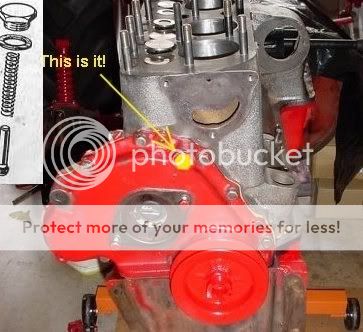
The second possibiliy is that the oil pressure relief valve is stuck open and as the oil warms up, flow is constantly diverted tthrough the relief valve back to the crankcase or pump inlet, thus reduing the flow available to the bearings.
The third possibility is that the bearings are worn and as the oil viscosity drops due to increasing temperature and the clearances in he bearings open us, so does the pressure in the lube system.
All possible combinations of these efects can be occuring at the same.

Check the oil pump first an replace it if it is worn. If it"s within specs then check the oil pressure relief valve to make sure that it operates freely and that the spring is not damaged or has the wrong spring constant. If this doesn"t cure the problem, then the bearings are worn and need replacement.
 
(quoted from post at 01:41:44 06/08/11) The oil viscosity decreases with oil temperture. When you start up, the oil has a high viscosity realtive to the viscosity it has at operating temperature. Also your internal bearing clearances vary with material temperture. The oil pump output is a function of the oil viscsity and the clearances. The there is an oil pressure relief valve in the lube system that helps to keep the oil pressure from getting too high.

There are at least three possibilities to what you are observing.
The first possibility is that your oil pump is worn and as the oil temperature increases, the oil pump clearnances open up and the oil viscosity is reduced causing the oil pressure delivered by the pump to drop.

The second possibiliy is that the oil pressure relief valve is stuck open and as the oil warms up, flow is constantly diverted tthrough the relief valve back to the crankcase or pump inlet, thus reduing the flow available to the bearings.
The third possibility is that the bearings are worn and as the oil viscosity drops due to increasing temperature and the clearances in he bearings open us, so does the pressure in the lube system.
All possible combinations of these efects can be occuring at the same.

Check the oil pump first an replace it if it is worn. If it"s within specs then check the oil pressure relief valve to make sure that it operates freely and that the spring is not damaged or has the wrong spring constant. If this doesn"t cure the problem, then the bearings are worn and need replacement.

I do believe that I would check the pressure relief valve before I went to the trouble of removing the pan and checking the pump. I like to check the easy cheep thing first.
 
Jerry I guess I am confused. How long does it take oil to cool? If I shut the tractor off for 5 minutes and re-start the pressure goes right back. In all your scenarios the issues all happen when the oil is hot. If true then should it continue until the oil does cool down?

I am going to change the gage first and see. Then the pump and so on (I guess least money to more money/time).
 
If the gauge does not change it, I would take out the pressure relief valve and spring and take a look at it. It is real simple, but it is easy to check.
 
(quoted from post at 12:04:00 06/07/11) I take it that engine is either oem with low hours, or at some time has had a rebuild that addressed pump, and bearings, and perhaps the cam bore in the block.

I know you know this.. but that machine is the exc3eption rather than the rule.

the overwhelming average N seen here is lucky to make 40 psi cold.. or anywhere near that when hot, no matter what oil is used, unless it falls into one of the previous catagories I stated.

On the other hand.. I routinely see it with the OHV series.. having good oil pressure even when worn seems to be much easier for them..

soundguy

I believe you are responding to me? Yes - I agree - the oil pump in the N is anemic and even moderate wear produces a very noticeable drop in operational oil pressure - probably a big reason they increased the displacement by 50% on later models. I have two N's and both made great oil pressure (20+ at idle - 30+ at RPM) when I bought them using the exact same SAE 10W30 I pour into my "Belch-Fire V8". That is also the oil pressure I remember from Grandad's 8N back on the farm in the 60's and is the sum total of my personal experience. I rebuilt my 9N not because of low oil pressure but because the PO had allowed it to freeze and Bondo'ed the big crack in the block to hide it from an unwitting buyer (me). It had clearly been rebuilt in the very recent past - probably by the Bondo Bandit. The 8N is a total unknown but the original proofmeter had stopped working at what appeared to be something in excess of 1000 hours. I bought it from the widow of the second owner and from what she told me about it's history I beleive it had seen little hard work - I suspect the motor is factory original.

I'm sure there are also many N's that do not make anything close to that sort of oil pressure on any grade of oil. And that is my point - low oil presure with SAE 10W30, SAE 30, SAE 15W40, or any other grade is an indication of wear. There is absolutely nothing inherent in the N motor that makes it unique to the rest of the automotive world with regard to oil viscosity and the "SAE 30 one size fits all" rule still applies. If the internal clearances are reasonably close to Ford specification then any motor oil that meets their original SAE 30 recommendation will work acceptably.

And that includes multigrades like SAE 10W30, SAE 5W30, or even SAE 0W30. They ALL have the viscosity defined as SAE 30 when the motor is warmed up. This idea that a SAE xxW30 is somehow "thinner" than monograde SAE 30 is just simply wrong. Saying they are "really" a thinner grade and "act like" SAE 30 implies there is something lacking. There is not - it's pure horse puckey. The viscosity modifiers (and many synthetics actually have none) chemically alter the physical viscosity of the oil just like ethylene glycol chemically alters the physical freezing point of water. They make the oil perform better over a wider temperature range. This is not a deficiency - it is a plus that you want and need even in an N.


Bruce's 50 points offers great guidance - choose a grade of oil that produces appropriate oil pressure. Using an excessivley heavy grade buys you nothing and costs you in cold weather. I have no quibble with your preference for SAE 15W40 - decent cold weather grade and on the high end of what Ford recommended for hot weather. Fine oil for year round use in the vast majority of climates and may give you a little pressure bump on a worn motor. My experience with many worn motors over the years is that the bump is short lived and with continued usage the drop becomes increasingly greater requiring even heavier grades to maintain. And the degradation proceeds at a faster pace especially in cold climates where the heavier grades produce more and more wear at cold startup.

YMMV,

TOH
 
(quoted from post at 14:20:44 06/07/11) I have a 49 8N and I am new to the tractor world. I have gotten a lot of answers just reading the postings here and I am sure my tractor thanks you. Anyway I recently changed the oil in the tractor (it was really bad whomever owned it before must never have done it) and when I start the tractor the oil gage reads good pressure. After about an hour of mowing the gage drops to zero. I know there is plenty of oil in there. If I let the tractor sit for a few minutes and start up the gage goes back to reading fine for a while. Is it the gage or is this a sign of something worse?

Thanks

Joe, when your tractor is warmed up and your gauge shows 0psi is that when your engine is idling or is it revved up some? If your engine is warm and you rev it up to half throttle does the gauge show higher pressure?
 
What does the oil pressure gauge really tell you? A. The oil pump is working. B. Part of the oil is being directed through the oil filter. C. Rod and Main bearings are relatively snug. Rule of thumb (whom ever Mr Thumb is) is 10 psi per 1000 rpms is sufficient. Even for race cars. Low oil pressure could be one bearing with sloppy clearance and the rest of the system is starved for oil. I had an old Mercury with oil pressure problems. With 50 weight oil and three cans of STP, I drove it all summer without a problem and 10 psi most of the time. Sooner or later you will have to bite the bullet and tear it down to take a peek.
 
mine had problems kinda like yours. I would take the oil line to the gage loose and shoot carb cleaner in and blow it out first, 2 try new gage, 3 try 40 weight oil...do one thing at a time.... If your oil was really that bad the oil line may be getting plugged.
 
yep.. the message order is weird.

I agree with you completely.

needing say.. 50-60w oil to keep positive pressure is just a bandaid waiting for a rebuild or worse. I know some people have to do it.. but it's far from ideal. and as you say.. when cold it must be jike jello in there.

I like the 15w40 for florida as it gets reasonably warm.. easilly to the high 90's, plus add the work you are doing...

I used to shop round for different oils for different machines and got tired of playing that game... since my diesels all use 15w40, and it's a decent oil with respect to addatives, especially as far as a gasser is concerned.. I simply buy it in quantity now and run it in all my machines.

my 2n likely has the lowest oil pressures.. 18 cold and about 10 hot at mid idle. I have ran her all day before and actually gotten her down to 8 psi at a very low 400 rpm idle after about 8 hrs of run time on 30w oil. the 15w40 keeps it in double digits no matter how long it runs.. so that's a plus. she eventually might need a rebuild.. but I almost never run her now that I discovered the OHV series :)

I do have a clappe dout 850 that on 15w40 runs fom about 38-25 cold to hot idle.. but that's about the lowest I've seen on any of my OHV engines.. IE.. the 25. most of em start at 50 and go to 40 or so..

soundguy
 
I guess I missed the 5 minute scenario in your original post. Given that, I would suspect your problem is a weak spring in the relief valve. The valve closes on shutdown and even with hot oil, takes a bit of time to open again. Could be the bore of the relief valve is dirty also causing it to relieve slowly.
I doubt the gauge would be the cause of your problem. It"s a simple Bourdon mechanical gauge and they usualy work or don"t work or they are damaged and read inaccurately (like 10 psi when the engine is shut off and the pressure is zero)..
 
I agree with you. I forgot the N"s have a pressure relief valve remote from the pump. Most other tractors have them integral to the pump.
 
(quoted from post at 23:27:11 06/07/11) I guess I missed the 5 minute scenario in your original post. Given that, I would suspect your problem is a weak spring in the relief valve. The valve closes on shutdown and even with hot oil, takes a bit of time to open again. Could be the bore of the relief valve is dirty also causing it to relieve slowly.
I doubt the gauge would be the cause of your problem. It"s a simple Bourdon mechanical gauge and they usualy work or don"t work or they are damaged and read inaccurately (like 10 psi when the engine is shut off and the pressure is zero)..
ot much contact surface here to stick & un-stick after 5 minutes.
8nOilPressRelief2.jpg

oil_press_relief-1.jpg

I would verify the gauge first.
 
(quoted from post at 00:46:54 06/08/11)
(quoted from post at 23:27:11 06/07/11) I guess I missed the 5 minute scenario in your original post. Given that, I would suspect your problem is a weak spring in the relief valve. The valve closes on shutdown and even with hot oil, takes a bit of time to open again. Could be the bore of the relief valve is dirty also causing it to relieve slowly.
I doubt the gauge would be the cause of your problem. It"s a simple Bourdon mechanical gauge and they usualy work or don"t work or they are damaged and read inaccurately (like 10 psi when the engine is shut off and the pressure is zero)..
ot much contact surface here to stick & un-stick after 5 minutes.
I would verify the gauge first.

I'm suspicious of some sort of intermittent blockage. I think I might consider purging the line to the gauge and cleaning the pickup screen on the pump.

TOH
 
Joe, the cheapest way to check out your problem is likely 1- check it again with another gauge 2- Take Dells advice and use a single-weight, heavier oil like SAE 40 or SAE 50 even.
Hell..it's SUMMER and you don't need a multiwt oil in a Ford tractor any time of year at all, anyway.

The Old Hokie means well. But he's wrong to jump on Dell so personally and so critically. Dell is correct. The Old Hokie wants to confuse everyone with his superior techie-talk about oil which does NOT APPLY to this matter. He wants Dell, me, and you to admire his tidbit of speshul knowlege about multi-weight oil...but overlook his stoopid use of the word "motor" when he means ENGINE. If he want's everyone to be so perfect about oil he should at least be consistent about being picky on himself too.

NO PERSONAL ATTACKS ARE MERITED HERE, in my opinion.

JOe..there's one more possibility that may be overlooked. YOur oil pump pickup may be defective. If your pump produces oil pressure when the oil is cold, but not when it's hot... it may be due to worn engine parts and may be helped (and the repairs deferred) by using a heavy weight single grade oil. I do that myself on my tractor, and it starts out at 35 psi cold and when hot has dropped to 20 psi at higher rpms while working and 5 psi at idle. Been that way for years and years with no harm and no big money out of my pocket rebuilding the engine, which continues to do good, hard work regularly. Cheap fix. SAE 50 aircraft engine oil, year roujnd, hot Texas summers and cold seventeen-degree TX winters. Multiweight sucked and failed to hold pressure and lubricate. Dell's simple answer works (regardless of what "scientists" say.)

That other possibility might be related to your oil pump pickup tube. If it's loose, as the oil warms it may allow more air to enter the pump until it cavitates. The fix will be to remove your sump drain, and see if you can "wiggle" your oil pump pickup tube. It's up above the big drain plug/screen, and leads to the pump body. (Get yourself an IT FO-4 manual from Tractor Supply or this website if you don't have one. It's your very best tool, ever.) If the pickup tube is loose.. then you'll have to remove the sump and braze/solder the tube to the pump. It's a bit more trouble but not expensive.

 
(quoted from post at 06:35:49 06/08/11) Joe, the cheapest way to check out your problem is likely 1- check it again with another gauge 2- Take Dells advice and use a single-weight, heavier oil like SAE 40 or SAE 50 even.
Hell..it's SUMMER and you don't need a multiwt oil in a Ford tractor any time of year at all, anyway.

The Old Hokie means well. But he's wrong to jump on Dell so personally and so critically. Dell is correct. The Old Hokie wants to confuse everyone with his superior techie-talk about oil which does NOT APPLY to this matter. He wants Dell, me, and you to admire his tidbit of speshul knowlege about multi-weight oil...but overlook his stoopid use of the word "motor" when he means ENGINE. If he want's everyone to be so perfect about oil he should at least be consistent about being picky on himself too.

NO PERSONAL ATTACKS ARE MERITED HERE, in my opinion.

JOe..there's one more possibility that may be overlooked. YOur oil pump pickup may be defective. If your pump produces oil pressure when the oil is cold, but not when it's hot... it may be due to worn engine parts and may be helped (and the repairs deferred) by using a heavy weight single grade oil. I do that myself on my tractor, and it starts out at 35 psi cold and when hot has dropped to 20 psi at higher rpms while working and 5 psi at idle. Been that way for years and years with no harm and no big money out of my pocket rebuilding the engine, which continues to do good, hard work regularly. Cheap fix. SAE 50 aircraft engine oil, year roujnd, hot Texas summers and cold seventeen-degree TX winters. Multiweight sucked and failed to hold pressure and lubricate. Dell's simple answer works (regardless of what "scientists" say.)

That other possibility might be related to your oil pump pickup tube. If it's loose, as the oil warms it may allow more air to enter the pump until it cavitates. The fix will be to remove your sump drain, and see if you can "wiggle" your oil pump pickup tube. If it's loose.. then you'll have to remove the sump and braze/solder the tube to the pump. It's a bit more trouble but not expensive.


I have no desire to confuse anybody. The facts are simple - SAE 10W30 has the same viscosity as SAE 30 when hot. Depending on the individual brand and formulation ALL grade 30 oils have a viscosity somewhere in the range 9.3 to 12.6 cSt @ 100C. That is what the SAE viscosity standard requires and monograde or multigrade any and all [u:807ef6e201][b:807ef6e201]motor[/b:807ef6e201][/u:807ef6e201] oils with a grade 30 stamp on the label are in that range at that temperature. No special knowledge required - grade 30 is grade 30 in all it's different formulations - is that so hard to understand?

And I see absolutely nothing in the symptoms of this problem that indicate it is caused by a loss of viscosity due to heat. Ever tried changing the oil on a hot motor 5 minutes after shutting it off? Be careful you don't scald yourself.

TOH
 
(quoted from post at 06:35:49 06/08/11) Joe, the cheapest way to check out your problem is likely 1- check it again with another gauge 2- Take Dells advice and use a single-weight, heavier oil like SAE 40 or SAE 50 even.
Hell..it's SUMMER and you don't need a multiwt oil in a Ford tractor any time of year at all, anyway.

The Old Hokie means well. But he's wrong to jump on Dell so personally and so critically. Dell is correct. The Old Hokie wants to confuse everyone with his superior techie-talk about oil which does NOT APPLY to this matter. He wants Dell, me, and you to admire his tidbit of speshul knowlege about multi-weight oil...but overlook his stoopid use of the word "motor" when he means ENGINE. If he want's everyone to be so perfect about oil he should at least be consistent about being picky on himself too.

NO PERSONAL ATTACKS ARE MERITED HERE, in my opinion.

JOe..there's one more possibility that may be overlooked. YOur oil pump pickup may be defective. If your pump produces oil pressure when the oil is cold, but not when it's hot... it may be due to worn engine parts and may be helped (and the repairs deferred) by using a heavy weight single grade oil. I do that myself on my tractor, and it starts out at 35 psi cold and when hot has dropped to 20 psi at higher rpms while working and 5 psi at idle. Been that way for years and years with no harm and no big money out of my pocket rebuilding the engine, which continues to do good, hard work regularly. Cheap fix. SAE 50 aircraft engine oil, year roujnd, hot Texas summers and cold seventeen-degree TX winters. Multiweight sucked and failed to hold pressure and lubricate. Dell's simple answer works (regardless of what "scientists" say.)

That other possibility might be related to your oil pump pickup tube. If it's loose, as the oil warms it may allow more air to enter the pump until it cavitates. The fix will be to remove your sump drain, and see if you can "wiggle" your oil pump pickup tube. It's up above the big drain plug/screen, and leads to the pump body. (Get yourself an IT FO-4 manual from Tractor Supply or this website if you don't have one. It's your very best tool, ever.) If the pickup tube is loose.. then you'll have to remove the sump and braze/solder the tube to the pump. It's a bit more trouble but not expensive.
HY stop at 40 or 50? Don't mess around. A little good...more is better thinking! Take the weight thing to the limit, maybe 90wt GL-1 or 140wt?? :twisted:

On a more serious note, if it is worn out to point of too low or zero pressure, it will require 'hard' parts, not something from a can or bottle to fix it. That is just the way it is!
 
(quoted from post at 09:02:00 06/08/11)
(quoted from post at 06:35:49 06/08/11) Joe, the cheapest way to check out your problem is likely 1- check it again with another gauge 2- Take Dells advice and use a single-weight, heavier oil like SAE 40 or SAE 50 even.
Hell..it's SUMMER and you don't need a multiwt oil in a Ford tractor any time of year at all, anyway.

The Old Hokie means well. But he's wrong to jump on Dell so personally and so critically. Dell is correct. The Old Hokie wants to confuse everyone with his superior techie-talk about oil which does NOT APPLY to this matter. He wants Dell, me, and you to admire his tidbit of speshul knowlege about multi-weight oil...but overlook his stoopid use of the word "motor" when he means ENGINE. If he want's everyone to be so perfect about oil he should at least be consistent about being picky on himself too.

NO PERSONAL ATTACKS ARE MERITED HERE, in my opinion.

JOe..there's one more possibility that may be overlooked. YOur oil pump pickup may be defective. If your pump produces oil pressure when the oil is cold, but not when it's hot... it may be due to worn engine parts and may be helped (and the repairs deferred) by using a heavy weight single grade oil. I do that myself on my tractor, and it starts out at 35 psi cold and when hot has dropped to 20 psi at higher rpms while working and 5 psi at idle. Been that way for years and years with no harm and no big money out of my pocket rebuilding the engine, which continues to do good, hard work regularly. Cheap fix. SAE 50 aircraft engine oil, year roujnd, hot Texas summers and cold seventeen-degree TX winters. Multiweight sucked and failed to hold pressure and lubricate. Dell's simple answer works (regardless of what "scientists" say.)

That other possibility might be related to your oil pump pickup tube. If it's loose, as the oil warms it may allow more air to enter the pump until it cavitates. The fix will be to remove your sump drain, and see if you can "wiggle" your oil pump pickup tube. It's up above the big drain plug/screen, and leads to the pump body. (Get yourself an IT FO-4 manual from Tractor Supply or this website if you don't have one. It's your very best tool, ever.) If the pickup tube is loose.. then you'll have to remove the sump and braze/solder the tube to the pump. It's a bit more trouble but not expensive.
HY stop at 40 or 50? Don't mess around. A little good...more is better thinking! Take the weight thing to the limit, maybe 90wt GL-1 or 140wt?? :twisted:

Ahhh - the beauty of the SAE viscosity grading standards.

SAE 50 motor oil is is 15.3-21.9 cSt
SAE 60 motor oil is 21.9 - 26.1 cSt
SAE 90 gear oil is 13.5 - 18.5 cSt
SAE 110 gearoil is 18.5 - 24.0
SAE 140 gear oil is 24.0 - 32.5 cSt

Gonna have to be the SAE 60 or SAE 140 if it gets any looser :roll:

TOH
 
(quoted from post at 09:10:08 06/08/11)
(quoted from post at 09:02:00 06/08/11)
(quoted from post at 06:35:49 06/08/11) Joe, the cheapest way to check out your problem is likely 1- check it again with another gauge 2- Take Dells advice and use a single-weight, heavier oil like SAE 40 or SAE 50 even.
Hell..it's SUMMER and you don't need a multiwt oil in a Ford tractor any time of year at all, anyway.

The Old Hokie means well. But he's wrong to jump on Dell so personally and so critically. Dell is correct. The Old Hokie wants to confuse everyone with his superior techie-talk about oil which does NOT APPLY to this matter. He wants Dell, me, and you to admire his tidbit of speshul knowlege about multi-weight oil...but overlook his stoopid use of the word "motor" when he means ENGINE. If he want's everyone to be so perfect about oil he should at least be consistent about being picky on himself too.

NO PERSONAL ATTACKS ARE MERITED HERE, in my opinion.

JOe..there's one more possibility that may be overlooked. YOur oil pump pickup may be defective. If your pump produces oil pressure when the oil is cold, but not when it's hot... it may be due to worn engine parts and may be helped (and the repairs deferred) by using a heavy weight single grade oil. I do that myself on my tractor, and it starts out at 35 psi cold and when hot has dropped to 20 psi at higher rpms while working and 5 psi at idle. Been that way for years and years with no harm and no big money out of my pocket rebuilding the engine, which continues to do good, hard work regularly. Cheap fix. SAE 50 aircraft engine oil, year roujnd, hot Texas summers and cold seventeen-degree TX winters. Multiweight sucked and failed to hold pressure and lubricate. Dell's simple answer works (regardless of what "scientists" say.)

That other possibility might be related to your oil pump pickup tube. If it's loose, as the oil warms it may allow more air to enter the pump until it cavitates. The fix will be to remove your sump drain, and see if you can "wiggle" your oil pump pickup tube. It's up above the big drain plug/screen, and leads to the pump body. (Get yourself an IT FO-4 manual from Tractor Supply or this website if you don't have one. It's your very best tool, ever.) If the pickup tube is loose.. then you'll have to remove the sump and braze/solder the tube to the pump. It's a bit more trouble but not expensive.
HY stop at 40 or 50? Don't mess around. A little good...more is better thinking! Take the weight thing to the limit, maybe 90wt GL-1 or 140wt?? :twisted:

Ahhh - the beauty of the SAE viscosity grading standards.

SAE 50 motor oil is is 15.3-21.9 cSt
SAE 60 motor oil is 21.9 - 26.1 cSt
SAE 90 gear oil is 13.5 - 18.5 cSt
SAE 110 gearoil is 18.5 - 24.0
SAE 140 gear oil is 24.0 - 32.5 cSt

Gonna have to be the SAE 60 or SAE 140 if it gets any looser :roll:

TOH
would not have pulled it out of the dark, back crevices of the gray matter had you not pointed it out, but I do now have some remembrance of 'motor' oil versus gear oil not having the same viscosity to 'wt' correlations........probably from one of your earlier oil educational/informational posts. I like learning.
 
(quoted from post at 17:23:19 06/08/11)
(quoted from post at 09:39:36 06/08/11) I like learning.

I have it on good authority it is way over rated and a waste of time.

TOH
o I have noticed. By the way since you put up those cSt numbers, what is same for 134 hyd oil?
 
(quoted from post at 17:32:13 06/08/11)
(quoted from post at 17:23:19 06/08/11)
(quoted from post at 09:39:36 06/08/11) I like learning.

I have it on good authority it is way over rated and a waste of time.

TOH
o I have noticed. By the way since you put up those cSt numbers, what is same for 134 hyd oil?

It varies somewhat by brand but 9-11 cSt @100C is typical. Viscosity Oil company makes the Ambra 134 product under contract from New Holland and according to their tech support people the viscosity is 9.4 cSt @100C with a viscosity index of 136. That puts it smack dab in the middle of the SAE 80 gear oil range but with a much higher VI than a conventional gear oil - hence it's better cold weather performance as a hydraulic oil. I initially asked for a full product data sheet and I was told New Holland had a policy against releasing such a document. Tech support could and did however provide answers to my specific questions but not a comprehensive list of properties.....

TOH
 
Yesterday's Tractor Forums

We sell tractor parts! We have the parts you need to repair your tractor - the right parts. Our low prices and years of research make us your best choice when you need parts. Shop Online Today.

Back
Top