

You should upgrade or use an alternative browser.


Janicholson
Well-known Member
- Location
- Central MN St. Cloud
Janicholson
Well-known Member
- Location
- Central MN St. Cloud
john in la
Well-known Member
OR
Momentarily touch Bat to Fld.
What one is correct?
Your guess is as good as mine.
As you did not tell us what kind of tractor you have.
So we have no idea if you have a A or B circuit generator.
ust make it simple. BATT to ARM will polarize the fields of either "A" or "B" circuit.(quoted from post at 19:59:52 04/14/15) Momentarily touch Bat to Arm.
OR
Momentarily touch Bat to Fld.
What one is correct?
Your guess is as good as mine.
As you did not tell us what kind of tractor you have.
So we have no idea if you have a A or B circuit generator.
john in la
Well-known Member
Fords b-circuit system was bat to field
But thanks for setting me straight.
Janicholson
Well-known Member
- Location
- Central MN St. Cloud
Janicholson
Well-known Member
- Location
- Central MN St. Cloud
1) To Polarize you pass current through the field windings and creation of the electromagnetic field that is then generated imparts a degree of residual permanent type (NOT electromagnetic) magnetism into the soft iron field poles, ie you're magnetizing the iron when current flows through the field windings.
2) You polarize an A circuit (most tractors other then some Fords and some Masseys and a few others) by jumping off the VR or cutout relays BAT terminal over to the A terminal so hot battery voltage present on BAT causes current to flow through the field windings (on a 2 brush A genny the fields begin at the A post and end at the external F post) since the gennys external F terminal is grounded via the voltage regulator which gives F its ground path.
3) You polarize a B circuit (some Fords and Masseys and a few others) by applying hot battery voltage (such as present on a VR's BAT A terminal) to the external F terminal so current flows through the fields to ground as the other end of the fields is internally grounded. NOTE on a B circuit if you apply voltage to the A terminal, current flows through the armature to ground but NOT through the field windings IE NO POLARIZATION!!! The fields on a TWO BRUSH B start at the external F terminal then to the internal ground with no connection to A other then the armature as well as one end of the fields are both grounded.
DISCLAIMER I did this in a hurry I may be incorrect, but as I recall on a two brush genny on a B system the fields are between the external insulated F post and an internal ground with no connection to the armature circuit, the B armature circuit is between the hot ungrounded brush which wires to the external A post and the other brush which is grounded so applying voltage from BAT to A DOES NOT cause field current to flow (like it would on an A system) which is necessary to polarize the soft iron field poles. ISNT THAT CORRECT PROFESSOR JIM??????????????????????????????????????????????
Jim already posted my Troubleshooting Procedure but its ONLY for a Class A system NOT a B
I think the above is correct and Im stickin to until proven otherwise
SUMMARY Polarize an A system by jumping from BAT to A (current flows through fields then to ground via the VR)
Polarize a B system by jumping from BAT to F (current flows through fields which are between F and internal gnd)
What say other sparkies??????????????????????????????????????
Janicholson
Well-known Member
- Location
- Central MN St. Cloud
(quoted from post at 22:29:21 04/14/15) Yall, we need to get back to engineering basics of what Polarization is and how its accomplished:
1) To Polarize you pass current through the field windings and creation of the electromagnetic field that is then generated imparts a degree of residual permanent type (NOT electromagnetic) magnetism into the soft iron field poles, ie you're magnetizing the iron when current flows through the field windings.
2) You polarize an A circuit (most tractors other then some Fords and some Masseys and a few others) by jumping off the VR or cutout relays BAT terminal over to the A terminal so hot battery voltage present on BAT causes current to flow through the field windings (on a 2 brush A genny the fields begin at the A post and end at the external F post) since the gennys external F terminal is grounded via the voltage regulator which gives F its ground path.
3) You polarize a B circuit (some Fords and Masseys and a few others) by applying hot battery voltage (such as present on a VR's BAT A terminal) to the external F terminal so current flows through the fields to ground as the other end of the fields is internally grounded. NOTE on a B circuit if you apply voltage to the A terminal, current flows through the armature to ground but NOT through the field windings IE NO POLARIZATION!!! The fields on a TWO BRUSH B start at the external F terminal then to the internal ground with no connection to A other then the armature as well as one end of the fields are both grounded.
DISCLAIMER I did this in a hurry I may be incorrect, but as I recall on a two brush genny on a B system the fields are between the external insulated F post and an internal ground with no connection to the armature circuit, the B armature circuit is between the hot ungrounded brush which wires to the external A post and the other brush which is grounded so applying voltage from BAT to A DOES NOT cause field current to flow (like it would on an A system) which is necessary to polarize the soft iron field poles. ISNT THAT CORRECT PROFESSOR JIM??????????????????????????????????????????????
Jim already posted my Troubleshooting Procedure but its ONLY for a Class A system NOT a B
I think the above is correct and Im stickin to until proven otherwise
SUMMARY Polarize an A system by jumping from BAT to A (current flows through fields then to ground via the VR)
Polarize a B system by jumping from BAT to F (current flows through fields which are between F and internal gnd)
What say other sparkies??????????????????????????????????????
Yes, you are right about the , "I may be incorrect part".
{NOTE on a B circuit if you apply voltage to the A terminal, current flows through the armature to ground but NOT through the field windings IE NO POLARIZATION!!! The fields on a TWO BRUSH B start at the external F terminal then to the internal ground with no connection to A other then the armature as well as one end of the fields are both grounded.
DISCLAIMER I did this in a hurry I may be incorrect,....}
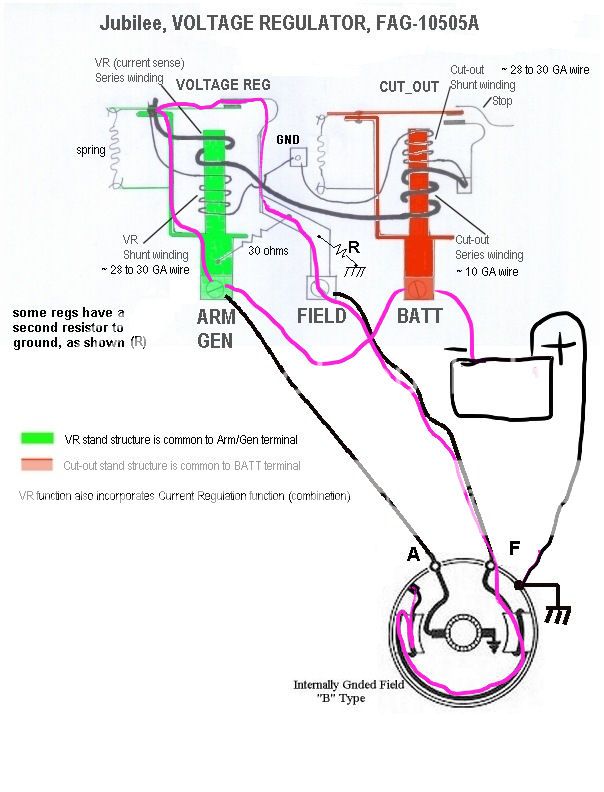
See the current path through the field coils in violet when Batt is applied to ARM in a "B" circuit system. As I said, both "A" & "B" can both be polarized by BATT to ARM.

The same procedure for both is wonderful to know!!(quoted from post at 05:20:09 04/15/15)(quoted from post at 22:29:21 04/14/15) Yall, we need to get back to engineering basics of what Polarization is and how its accomplished:
1) To Polarize you pass current through the field windings and creation of the electromagnetic field that is then generated imparts a degree of residual permanent type (NOT electromagnetic) magnetism into the soft iron field poles, ie you're magnetizing the iron when current flows through the field windings.
2) You polarize an A circuit (most tractors other then some Fords and some Masseys and a few others) by jumping off the VR or cutout relays BAT terminal over to the A terminal so hot battery voltage present on BAT causes current to flow through the field windings (on a 2 brush A genny the fields begin at the A post and end at the external F post) since the gennys external F terminal is grounded via the voltage regulator which gives F its ground path.
3) You polarize a B circuit (some Fords and Masseys and a few others) by applying hot battery voltage (such as present on a VR's BAT A terminal) to the external F terminal so current flows through the fields to ground as the other end of the fields is internally grounded. NOTE on a B circuit if you apply voltage to the A terminal, current flows through the armature to ground but NOT through the field windings IE NO POLARIZATION!!! The fields on a TWO BRUSH B start at the external F terminal then to the internal ground with no connection to A other then the armature as well as one end of the fields are both grounded.
DISCLAIMER I did this in a hurry I may be incorrect, but as I recall on a two brush genny on a B system the fields are between the external insulated F post and an internal ground with no connection to the armature circuit, the B armature circuit is between the hot ungrounded brush which wires to the external A post and the other brush which is grounded so applying voltage from BAT to A DOES NOT cause field current to flow (like it would on an A system) which is necessary to polarize the soft iron field poles. ISNT THAT CORRECT PROFESSOR JIM??????????????????????????????????????????????
Jim already posted my Troubleshooting Procedure but its ONLY for a Class A system NOT a B
I think the above is correct and Im stickin to until proven otherwise
SUMMARY Polarize an A system by jumping from BAT to A (current flows through fields then to ground via the VR)
Polarize a B system by jumping from BAT to F (current flows through fields which are between F and internal gnd)
What say other sparkies??????????????????????????????????????
Yes, you are right about the , "I may be incorrect part".
{NOTE on a B circuit if you apply voltage to the A terminal, current flows through the armature to ground but NOT through the field windings IE NO POLARIZATION!!! The fields on a TWO BRUSH B start at the external F terminal then to the internal ground with no connection to A other then the armature as well as one end of the fields are both grounded.
DISCLAIMER I did this in a hurry I may be incorrect,....}
See the current path through the field coils in violet when Batt is applied to ARM in a "B" circuit system. As I said, both "A" & "B" can both be polarized by BATT to ARM.
Thank you for your long needed simplification! Why is the "A"/"B" polarization been made to look complicated for so long when it could have been so simple all these years? Thank you for presenting with such clarity.

We sell tractor parts! We have the parts you need to repair your tractor - the right parts. Our low prices and years of research make us your best choice when you need parts. Shop Online Today.
Copyright © 1997-2025 Yesterday's Tractor Co.
All Rights Reserved. Reproduction of any part of this website, including design and content, without written permission is strictly prohibited. Trade Marks and Trade Names contained and used in this Website are those of others, and are used in this Website in a descriptive sense to refer to the products of others. Use of this Web site constitutes acceptance of our User Agreement and Privacy Policy TRADEMARK DISCLAIMER: Tradenames and Trademarks referred to within Yesterday's Tractor Co. products and within the Yesterday's Tractor Co. websites are the property of their respective trademark holders. None of these trademark holders are affiliated with Yesterday's Tractor Co., our products, or our website nor are we sponsored by them. John Deere and its logos are the registered trademarks of the John Deere Corporation. Agco, Agco Allis, White, Massey Ferguson and their logos are the registered trademarks of AGCO Corporation. Case, Case-IH, Farmall, International Harvester, New Holland and their logos are registered trademarks of CNH Global N.V.
Yesterday's Tractors - Antique Tractor Headquarters
Website Accessibility Policy