

Steve in PA

New User
I know this topic has been covered many times but after going through the archives I am still confused. I have a 49 8N with front mount coil that has been converted to 12 Volt. I had to redo the wiring since it was so messed up. I believe it has a new "12 volt" square can coil, though I am not totally certain. I used the infamous ballast resistor in series with Dell"s 0.5 ohm 20 watt combo (which I still found at Radio Shack). Was I supposed to use both the original ballast resistor and Dell"s resistor? It has seemed to run OK for a year, but I am now having some stall outs (though I think it is a fuel problem now- I have poor flow at carb).
 
Yes, you must always use the OEM ballast resistor because it is a ballast resistor, not a fixed resistor. Rather than guess at the coil resistance, measure it & see what it is.

Technology & materials being what they were in the 30's, that square coil would melt if it ran on much more than 4 amps for any length of time. (see tip # 38 for an example). In order to get a hot spark at the same time the starter was drawing max current from the battery, a ballast resistor was added in the ignition circuit. What that did was add about .3 ohms of resistance in the circuit, added to the 1.5 ohms of the coil. That got you 3.5 amps or so at start up. As the voltage increased when the engine was running to about 7.5 volts, the resistor heated up, adding more resistance in the circuit. 1.0 ohms hot, plus 1.5 ohms of the coil got you down to 3 amps or so to keep from melting the coil. The same rule (actually, Ohm's Law) applies to a 12v circuit. I= E/R. Current equals voltage divided by resistance.

It used to be before the "Land of Almost Right" started making coils that you could count on a 12v frontmount coil as having 3 ohms of internal resistance & the 6v coils as having 1.5 ohms or less. Thus, thanks to Ohm's Law, you could calculate what additional resistance you needed in the circuit to limit coil current to 3.5 amps. So, you will need to measure the internal resistance of that alleged 12v coil & see what it is. A digital multi-meter has two probes & a switch. Set the switch on resistance. Put one probe on the top of the coil & the other on the pigtail at the bottom. It will give you a reading in ohms. Lets just say it reads 3.0 ohms. Your OEM ballast resistor (which you must use) is about 1 ohm hot. A coil a 3.0 ohms, plus the ballast resistor at 1 ohm (hot) gives you 4.0 ohms resistance in the circuit. Your 12 volt alternator puts out 14.5 volts. You need to determine current (amps). 14.5 v divided by 4.0 ohms gets you 3.6 amps; that's ok. But, and this is the problem......what if the coil is only 2 ohms? Do the math. 14.5 volts divided by 3.0 ohms gets you 4.8 amps! Not good! And, if the coil is less than 2 ohms (and some are) it will fry quickly. So, to get it to 3.5 amps, you need another resistor in the circuit. Either that, or keep spare $30 coil around.

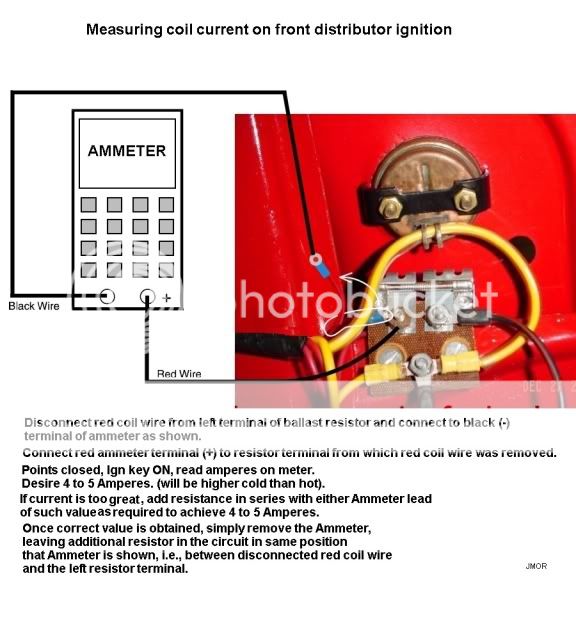
Or, you can not worry about measuring the resistance; just use an ammeter per the other picture & directions that JMOR put together.
measuring_coil_current.jpg

50 Tips
 
If you have a fuel issue ,why would you think the resistors are a problem? fix the fuel first and then check the coil and see how much resistance is in the coil,1.5-6v:2.5-12v.---lha
 
Steve.......ALWAYS use the "infamous ballast resistor" with either 6v -or- 12v squarecan ignition coil. NO ARGUE!!! You can also use my secret 0.5-ohm 20watt resistor with the 12v squarecan coil iff'n you want.

Iff'n you use the original 6v squarecan coil you will need a 12v-to-6v converting resistor of 2.5-ohms and 50-watts.

Unfortunately, neither the 6v -or- 12v squarecan ignition coil is marked so you haffta verify its design volts the hard way with an ohm meter. Or you can believe the box.

Ohm-meters are NOT very accurate at low ohms readings, but even the most inaccurate can differentiate between about 1-ohm (6v) and about 2.5-ohm (12v) How hard can that be??? Can be a $10 el-cheapo hardware store analog or digital multi-meter or $600 lab grade meter. .......Dell
 
(quoted from post at 18:07:32 05/31/10) I know this topic has been covered many times but after going through the archives I am still confused. I have a 49 8N with front mount coil that has been converted to 12 Volt. I had to redo the wiring since it was so messed up. I believe it has a new "12 volt" square can coil, though I am not totally certain. I used the infamous ballast resistor in series with Dell"s 0.5 ohm 20 watt combo (which I still found at Radio Shack). Was I supposed to use both the original ballast resistor and Dell"s resistor? It has seemed to run OK for a year, but I am now having some stall outs (though I think it is a fuel problem now- I have poor flow at carb).


"..but after going through the archives I am still confused."

Well, my friend, that is no wonder at all! There is so much conflicting "info" out here, sometimes from the same poster, that I do empathize with you.
The 'end point' you are looking for is, as Bruce posted, is 4 to 5 amps......whatever resistance that requires with whatever coil you have.
 
(quoted from post at 18:30:34 05/31/10) If you have a fuel issue ,why would you think the resistors are a problem? fix the fuel first and then check the coil and see how much resistance is in the coil,1.5-6v:2.5-12v.---lha
.......and if my coil is 0.47 ohms, what do I have?
 
Yesterday's Tractor Forums

We sell tractor parts! We have the parts you need to repair your tractor - the right parts. Our low prices and years of research make us your best choice when you need parts. Shop Online Today.

Back
Top