Have trouble starting Ford 9n. I converted from 6 to 12 volts. When I remove the online ballast resistor(3 ohms) it starts fine. Should I go with bypassing ballast resistor, use a resistor with less ohms, or something else?

 
Coils costs about $35. If you don't mind buying a new one every few months, then skip the resistors.

I doubt you have a ballast resistor at 3 ohms. It's probably a fixed resistor.

Look at the picture. The OEM ballast resistor is on top of the terminal block.

It's all a matter of math. The total resistance in the circuit needs to be sufficient to reduce the operating current at the coil to less than 4 amps. 3.5a is ideal.

Technology & materials being what they were in the 30's, that square coil would melt if it ran on much more than 4 amps for any length of time. (see tip # 38 for an example). In order to get a hot spark at the same time the starter was drawing max current from the battery, a ballast resistor was added in the ignition circuit. What that did was add about .3 ohms of resistance in the circuit, added to the 1.5 ohms of the coil. That got you 3.5 amps or so at start up. As the voltage increased when the engine was running to about 7.5 volts, the resistor heated up, adding more resistance in the circuit. 1.0 ohms hot, plus 1.5 ohms of the coil got you down to 3 amps or so to keep from melting the coil. The same rule (actually, Ohm's Law) applies to a 12v circuit. I= E/R. Current equals voltage divided by resistance.

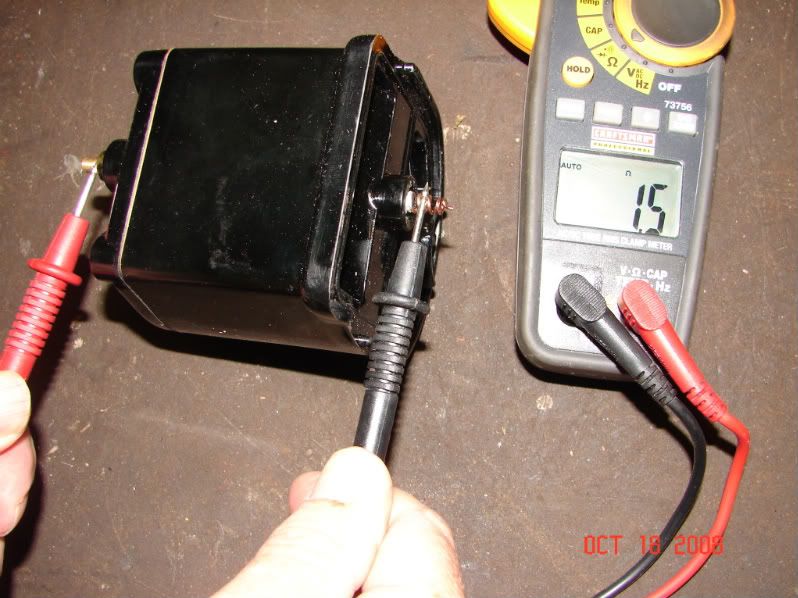
It used to be before the "Land of Almost Right" started making coils that you could count on a 12v frontmount coil as having 3 ohms of internal resistance & the 6v coils as having 1.5 ohms or less. Thus, thanks to Ohm's Law, you could calculate what additional resistance you needed in the circuit to limit coil current to 3.5 amps. So, you will need to measure the internal resistance of your coil & see what it is. A digital multi-meter has two probes & a switch. Set the switch on resistance. Put one probe on the top of the coil & the other on the pigtail at the bottom. It will give you a reading in ohms. Lets just say it reads 3.0 ohms. Your OEM ballast resistor (which you must use) is about 1 ohm hot. A coil a 3.0 ohms, plus the ballast resistor at 1 ohm (hot) gives you 4.0 ohms resistance in the circuit. Your 12 volt alternator puts out 14.5 volts. You need to determine current (amps). 14.5 v divided by 4.0 ohms gets you 3.6 amps; that's ok. But, and this is the problem......what if the coil is only 2 ohms? Do the math. 14.5 volts divided by 3.0 ohms gets you 4.8 amps! Not good! And, if the coil is less than 2 ohms (and some are) it will fry quickly. So, to get it to 3.5 amps, you need another resistor in the circuit. Either that, or keep spare $35 coil around.

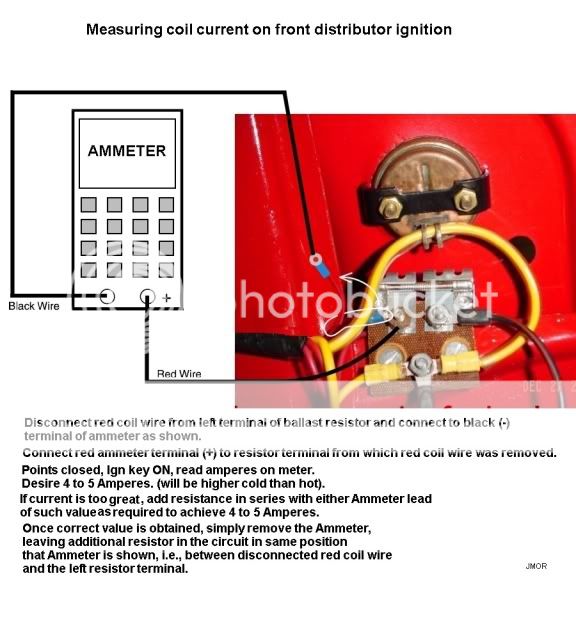
Or, you can not worry about measuring the resistance; just use an ammeter per the other picture & directions that JMOR put together.

Or, you can just forget all of this & get a 3 ohm coil & use the OEM ballast resistor.
Coil.jpg

measuring_coil_current.jpg

50 Tips
 
Bruce, thank you. Very helpful. I think my question confused the ballast resistor with the online resistor. Your response answers the question.

Herman
 
Yesterday's Tractor Forums

We sell tractor parts! We have the parts you need to repair your tractor - the right parts. Our low prices and years of research make us your best choice when you need parts. Shop Online Today.

Back
Top