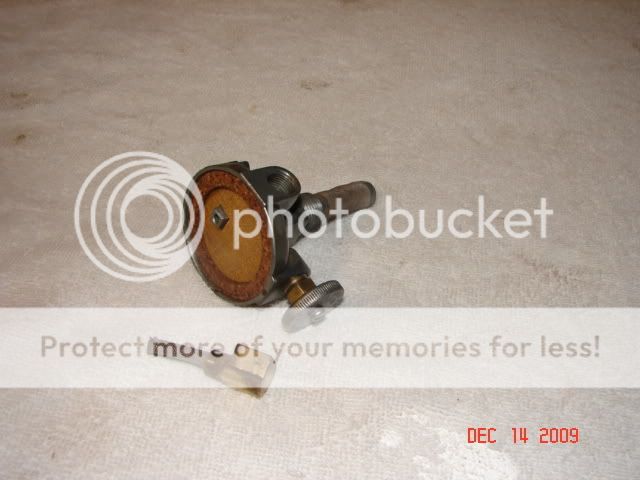
" what could cause this and are these problems related"
They could be related. Especially if, as flembo suggested, you let that gas sit in the tank all winter w/o adding fuel stabilizer.
Start by draining out the old gas & adding at least two gallons of fresh gas. W/ a fuel stabilizer in it.
If that doesn't work, there are easily a half dozen causes of the problem. Rather than guess, I've always found the best approach is to take a step-by-step approach to solving the problem, working from most likely to least likely. The trick to fixing these tractors (or trouble shooting any piece of equipment) is to be systematic about it. You need to isolate the problem step by step and work from most likely to least likely.
It is important for you to tell us if your tractor has a 6 volt or 12 volt electrical system. The troubleshooting is different based upon the configuration of your engine.
It takes three things for an engine to run: spark at the right time, compression, & fuel in the right mixture. For the moment, forget about compression & concentrate on narrowing the problem down to spark or fuel.
There are three very important tools you always need to have in your N tool box: a 3 inch piece of wire w/ alligator clips on each end, an old spark plug w/ the gap opened to at least 3/16” ( ¼” is better) and a 7/16 box end wrench. (see tip # 50 at the link below) And, you really do need a working ammeter on the tractor; it is a very important diagnostic tool. With these tools, you can quickly narrow down most N problems to spark or fuel.
First, charge the battery. You need a strong battery to:
Spin the starter
Engage the bendix
Provide voltage to the coil.
As the battery gets weaker, the first thing to fail is your spark.
In addition to charging the battery, you may need new cables as well (tip # 41). And, don't forget to clean all the grounds, to include the mating area between the starter & the block.
The more current you use to spin the starter, the less you have for the ignition.
Next time it stops, check quickly for fuel then spark. When I say quickly, I mean get off the seat, grab the tools & do it right then. Do not wait a minute or two. First, check for fuel. Get a can & put it under the carb. Remove the bolt in the bottom of the carb; as long as the fuel is turned on, you should see gas flowing out of the carb. Let it run for at least 30 seconds. If it’s a dribble, or runs for 5 seconds & stops, or none at all, you have solved half the problem: it’s fuel related. If gas flows well out of the carb & only stops when you turn it off at the sediment bowl, chances are very good it’s not a fuel problem. So, next, turn the key on, crank the engine & look at the ammeter. What is the needle doing? Does it show a constant discharge, no movement at all, or does it move back & forth slightly? Next, get the old plug, ground it to a rust & paint free spot on the engine, turn the key on & crank the engine. If the spark jumps the 3/16” gap, you probably don’t have a spark problem. If it won’t jump the 3/16” gap, you have a spark problem. If the ammeter needle shows a constant discharge, or doesn’t move at all, that also tells you that you have a spark problem. Jump the ignition switch w/ your jumper wire & see what happens. If it runs, you found the problem. If it doesn’t have spark after you jump the ignition switch, post back for more info on further troubleshooting. (and do not forget to turn the ignition switch off; see tip # 38)
If it does not have gas coming out of the carb at a steady stream w/ the bolt out for at least 30 seconds, you have a fuel problem. First, remove the gas cap. Your vent could be clogged & it vacuum locked. If that doesn’t work, tap the carb bowl w/ a hammer handle in case the float is sticking closed. (don’t whack it w/ the head of the hammer; you can crack the bowl). If you still don’t see gas flowing, the N has three fuel screens; one in the brass elbow, one in the top of the sediment bowl & one on the stem of the sediment bowl in the gas tank. Check the screen in the elbow & the screen in the top of the sediment bowl. (don’t worry about the one in the tank) Both probably need to be cleaned. If you have the fuel knob turned on all the way, & 1 gallon or less in the tank, it may be trying to feed off of the reserve inlet which is probably clogged. Only open it 2 full turns. Put at least 2 gallons in the tank. (and do not forget to turn the gas off; see tip # 9)
There are ways to check for spark & fuel that work & ways that don't. For example, having gas to the carb is nice, but having it past the float is what counts! That’s why removing the 7/16” bolt in the bottom of the carb is the way to check for fuel. And, same thing w/ spark at the plugs. Some folks think that checking for spark means pulling a plug wire off & looking for one. Well, it's the distance the spark jumps at the plug that gives you the info you want. It takes about 17kv to jump a 3/16" gap & 22kv to jump ¼” in the open air. Remember, it’s 14psi outside of the engine & about 90psi at a 6:1 compression ratio in the cylinders & compressed air creates electrical resistance, so you really need the 17-22kv to fire the plugs when the engine is running. A store bought plug checker will work better than an old plug because it won’t shock the snot out of you like an old plug might!
After you find out why it won't restart and after you add new gas, you can move on to adjusting the carb. (which is not your problem, BTW)
Make sure the tractor is at operating temp; that usually takes 10 – 15 minutes at idle depending on ambient temp.
Both Ford and Marvel/Schebler (assuming you have a M/S carb ) say to set both the side-pointing idlemix and the down-pointing mainjet to 1-turn as a starting point. I set the down-pointing mainjet to 1-1/2 turns and don't fool w/ it until the final step.
Then adjust the side-pointing idlemix for fastest idle; not the smoothest idle. Next, adjust the behind the carb idle-speed set-screw for very slow 400-rpms idle. Do that idlemix adjust for maximum idle at least 3-times. Make sure that you turn the screws slowly, like 1/8 of a turn at a time & wait a second or two for the engine to catch up. Take your time!
Do it like this:
1. Adjust idle mix jet until RPM increases
2. Adjust idle-mix set screw until the engine nearly stops (as slow as you can get it unless you have a tach that tells you 400 rpm)
Repeat steps 1 - 3 three times.
Remember the side-pointing idlemix is out for lean, in for rich.
If you do not have any problems inside the carb, it is easy to get the idle down to 350 - 400 rpms.
Your last step is to go back to the main jet. Remember, in for lean, out for rich. If you end up turning it OUT more than ½ turn for max power (remember, you already had it 1 ½ turns out) then stop right there because you have a dirty carb or a fuel problem.
75 Tips