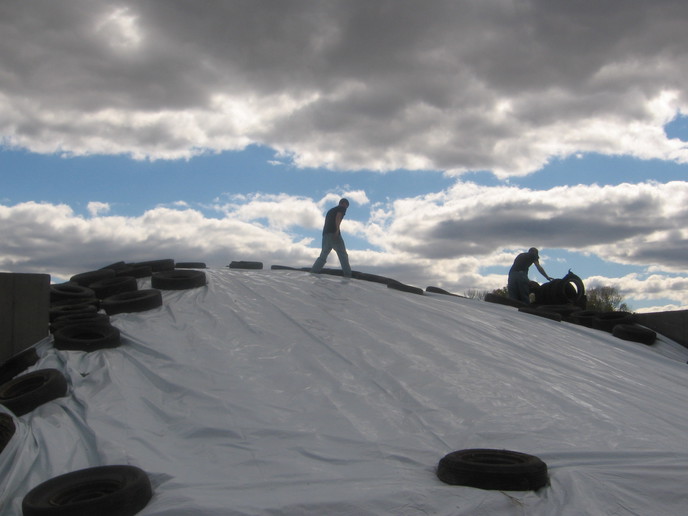
Silage bunker???

I'm about to chop silage for the first time for myself in a few weeks. I have one thing that I'm a little unsure about right now before I start. I don't have a nice concrete bunker to store in. I've got a level pad built a few years ago for a shop to be built on in the future. It has grass and bare dirt in places. I'm going to line rolls of hay up along the sides and one end and use that as walls. My question is should I line the bottom of the bunker with plastic? I have seen pits in the past in the side of a hill and there was no plastic under them. I'm not sure that was correct or not but it worked for that person. Trying to do whatever I need in order to have the least amount of spoilage. One other thing. Does anyone have a place they would recommend buying the plastic from to cover the bunker with and to line the bottom if need be. Thanks Chris
 
I think with hay on the sides you will just have rotten hay and silage. We made stacks all the time on dirt. Make sure it's well packed and drained so you don't end up with mud and you will be fine. Lot of folks use plastic on top but I'm not sure you save enough to pay for the plastic. It depends some on how long your stack will last. The important part of making a stack is to pack it well, especially when done to get it sealed well.
 
No plastic on the bottom. You will want drainage from any "juices" from the silage. On a concrete bunker they are tapered slightly so the juices just run out the front.

For covering we use roll plastic over wintering "film" sold by Griffen greenhouse supply. It's a roll of white plastic that is used for protecting poly greenhouses over the winter. It comes in different widths and thickness. We have had good luck with that and it's relatively not expensive.

Good luck
 
I expect you will receive many replies to this post. And I don't think there really is one answer . Much depends on how much tolerance you have to spoilage. Some will just flip out and tell you that you are wasting too much with and spoilage. Tower silo fans get some spoiled silage to from stave silos, but as the unloaders chew it up and spit the silage down the shoot , it all gets mixed in , and you can't see it.
Now more the the point of your question, I have put up silage in a cement floor - earth side pit silo , that is cut into the side of a hill , for the last 14 years. I don't put plastic down on the floor , or up the sides. I do cover with plastic. Just don't believe the silage loss would worth the frustration of trying to fill and pack the corn , without destroying the plastic in the process. We get some spoilage , but very little. Cutting the corn at the right moisture, and doing a good job packing is more important.
I the situation you describe , with a flat pad of concrete, and no sides , not so sure that I would bother with the bales rowed up to make sides. The reason is , you will not be able to pack tight against the bales without the bales moving. And if you use round bales the round sides will add to the packing problem. I would just forget sides , and then you can drive your packing tractor right up the side, as well as end to end. I would also not worry much about going wider than the cement pad when doing this type of pile , as the total volume of silage not on the pad is minimal compared to the extra depth of silage that you can get packed on the pad. Only thing I will say to watch for is , be sure water will not run on to or in to your silage pile . Best of luck, Bruce
 
I'd read that with haylage some folks were having great luck with putting plastic down,then wrapping it up over so it was totally sealed,but with corn silage,you won't need to.
Just be darned careful using round bales for walls. I was at an auction one time where they had an AgBagger. I was talking to the guy who bought it. He said he'd used bales as walls and one rolled away while he was packing. He said he tipped the tractor over. His wife sent him to the sale to buy the bagger before he managed to kill himself.
a168379.jpg

a168380.jpg
 
Google "drive over silage pile." You won't need walls, and probably do a better job without them. Along the wall is where the spoilage is.... especially if is a half A@#$ed wall that you can't pack safely against.

Good luck and be safe.
 
Agreed on the no plastic on the bottom.

We never covered the top either, just mounded up in the center and the water drained off to the sides. You'll get a layer of spoilage on the top but not too bad if you use it in a season. Just don't let anyone walk across it once its packed in place. Every step they take breaking through the crust will make a "staff" of spoilage right to the bottom of the pile.
 
How many acres do you have to chop? When you start feeding can you feed it fast enough to keep the face from spoiling? I think you will get a lot of spoilage where the bales meet the silage. Are the bales wrapped, that will help a little bit. Any time I have seen silage piles there seems to be almost as much spoilage as there is edible. When you think you have it packed enough pack it again Think about renting a bagger if you have enough tractors
 
Just a pile like has been said is all that is needed, preferably on a concrete pad so when digging out in the winter and spring you are not dealing with mud and frozen ruts!
 
David has a point... how many head are you feeding? If a small number, it is a lot easier to keep the face fresh on a bag, especially in warm weather.
 
We found the best results with a drive over pile cover it soon as your finished chopping. Use clay shale whatever you have to hold the plastic down singing stretched tight. If you have air pockets you WILL get rott and lots of it. Than use old truck tires completely covering the surface. Get it covered quickly very tightly all the way around and lots and lots of tires you'll be happy. Also it needs to be wet enough to make your tires shiny when packing and pack every load untill the next one arrives. If it's too dry not packed enough or air tight you will get lots and lots of spoilage.
 
i would agree. concrete walls or no walls. round Hay bales will be a mess to keep air out and keep the bales from buckling/moving/rolling out of place and making a bigger mess and more spoilage.

best bet is to hire/rent a bagger for the day. spoilage would pay for itself. plastic to cover a pile isn't free either.

best bunker i'd seen for spoilage was a concrete floor and dirt walls (BIG dirt walls) up in MN. not sure what they did to get it to work but it worked.

also saw a cool idea in WI where a guy had a 3 sided concrete bunk built into the side of a hill with a flat pad up on top. he'd run the regular self unloading silage wagons from the top pad into the bunk below and then move and pack it down. when it was full he would cover it with rejected chocolate from a local choc company and the sun would melt it in place and seal the bunker. no plastic to remove or blow away. he just scooped up the silage and chocolate and put it all in the TMR.
 
Thank you to everyone for your input. I will look at the drive over piles a little more. I had not wanted to go this route due to the extra space I figure it will take. I know concrete walls would be better but there is no budget for that right now. The bagger option is out as there is no dealer around me who has anything in stock or rents them. Plus the tractor to run it is a problem. Anyone have a place that they recommend to get the plastic covering for the top?
 
No one else mentioned this,but I know someone who sows wheat on top of their pile and no other cover.The wheat roots seal it.Mark
 
Anything designed for covering silage is good usually. We've had great luck with megaplast. Good plastics is usually white (outside) and black against the pile. Like others have said narrow depending how many animals your feeding. We're feeding 65 dairy cows half grass half corn. Our piles are 40' wide plastic and in summer we can barely keep ahead of heating. We go 2 dump truck widths at a time leaving a couple feet between the piles to start the pile and build it from there. Have to leave some leeway on your piles too. Ex. If your using a 40' wide cover keep measuring your pile as you go and stop adding to that section once it reaches 35-37' across including the sidewalls. Using bales as walls will end up in a lot of spoilage. Another thing we do if for whatever reason we're not going to start to finish a pile in 2 days well temporarily cover completed sections of a pile till it's finished. Extra work yes but big pay offs. You really have to treat it as round bale silage. You wouldn't bale silage today and leave it out to wrap in a weeks time or put the wrap on loose and expect it to keep well. All silage is the same,need all the air out and sealed quickly for good results. Im no expert but I've learned the hard way how not to do it. If you can cover it soon as it's done and if you use dirt start covering the edge along one side being careful not to pull the plastic than when you get to the other side pour the dirt that it slides down the sides and it will pull the plastic super snug. Keeping that air out is the key. Than the tires will keep it from flapping during windy days or when your feeding out of it. You can make ag bag silo quality silage with a pack pile IF it's covered very well and you will be very pleased. I've made poorly sealed piles in the past and I bet we had minimum 30% spoilage on the top and sides.
 
I tried exactly what you want to do. Way to much waste,not only silage,but also the round bales.You can't pack it tight enough along the bales.Just drive over it from all sides.
 
If bagging isn't an option... just make a heap, pack it well... and cover it with 8 mil plastic. I don't think I'd wreck the pad you have for your shop either unless you've given up on the shop. Put it somewhere else reasonably dry and drained...

Rod
 
Thanks phillip d. The more that I think about. You can probably get more silage in less space as far as width goes not using the bales for sides. Putting silage in that space. Let me ask this also. You say to cover the finished parts of the pile if I'm not going to finish in a couple days. Should I cover it and then come uncover it when I go back to chopping again? Also, I've got some corn that will be ready soon. Then I've got some that will not be ready until probably a month after that. Would you uncover the first pile and add to it when I start chopping the second batch or make a second pile?
 
I've done it a couple different ways depending on the situation. If we're chopping today and the pile won't be finished and there's several days of heavy rain on the way we will pull the plastic over it and hold it down usually with some bales just to keep all the water off it than pull it off and go chopping again. Heavy rain on the fresh uncovered pile will do damage to the nutrients as well. It won't be air tight but will protect it from rain till the weather clears. If were doing a pile and for whatever circumstances its going to be a bunch of days to complete say half way finishing a pile we'll roll the plastic out and stop close to where the face that is still in progress ends and use clay and tires on the completed section. As far as chopping a month apart if it was me I'd cover it airtight as best you can whatever size the pile you complete first will be and leave it be till you start to feed it. These piles to be done with very minimal spoilage seem to require lots of attention to detail to get the best results. We've tried sprinkling barley over piles, taking 2 weeks to make a huge pile than covering it when finished, using bales to hold down plastic basically just sitting on top and rows of bales as a starting wall. All of those resulted in huge amounts of spoilage. Anything we've found here is it cant sit open to air more than a couple of days and the plastic has to be put on tight as an underarmour t-shirt that's 2 sizes too small and stay tight until after you take it off.
 
Very well said,I wish we had a decent hill close enough to the barn to use a pit bunker too.I know of others that do it that way and love it. Some meetings we've been at in recent years are suggesting a well done pile on a surface you won't get stuck on has less spoilage than a concrete bunker. I can't afford to build a nice bunker and after seeing some pictures of big pie shaped rot formations on the top corners all the way down the sides due to water running off the plastic down the wall and into the silage I'm more than happy using our poor mans bunker.
 
Thanks a lot philip d. This is why I asked this question on this site. I knew there were people who had done this before and would have good advice about it. I'll try to post some pictures of the chopping and piling with old equipment.
 
Your quite welcome and would love to see the pictures. Anyone else on here who has experience had the same points as well. Best of luck and happy chopping!
 
Yesterday's Tractor Forums

We sell tractor parts! We have the parts you need to repair your tractor - the right parts. Our low prices and years of research make us your best choice when you need parts. Shop Online Today.

Back
Top