

Stumped by 8N

I have a 1952 8N that was working, quit on me one day, and I have not been able to get it started again. I have checked and found that all the plugs have spark (and they"re new). I just put in a new carburetor, there is definitely fuel reaching it and so far as I can tell everything is working there. The battery is also new this year. The starter usually turns it over, except that there are a few missing teeth on the flywheel so occasionally it doesn"t catch - that happens a bit more often than I would expect given the number of missing teeth I can see, so I wonder if there could be an issue with the starter itself. Anyway, though it will turn over it will not get going. One thing to note is that the previous owner gave it a squirt of ether (QuickStart) often when starting it, and had put an air intake pipe on it with a little screw-top port to squirt the ether through - the rubber part of this wore out and I replaced it with a standard one, putting in the new plugs, a new rotor and then the new carb in hopes of making it start without the ether. I"m checking over the wiring now, but since it has spark I have doubts that is the explanation. Any suggestions much appreciated.
 
You say all the plugs have spark but is the spark as good as it needs to be?? You need a spark that is blue/white and will jump a 1/4 inch gap or more. Weak spark means no go. Also things like low compression can cause your problem and starting fluid will help one start that has low compression since it burns easier then gas does and once started it runs on gas
 
Takes 3 things to make it go - fuel, compression, and spark at the right time. If there is suction when you hold your hand over the carb air inlet, then there is probably enough compression. Spark should be able to jump a 3/16" gap on a grounded plug. Spark should be bluewhite, not yellow. Unless you messed with the dist, the timing should be OK, but I would recheck the firing order - 1243. Fuel should flow steadily thru the carb when you remove the pipe plug in the bottom of the bowl. Your job is to determine which one of those 3 is at fault.
 
Any suggestions much appreciated.

You need fire (got it ) fuel ( got it ) compression (? )

If the motor is tired a 6volt starter may no spin it fast enough to build enough compression to start .

You can jump the starter with 12 volt as long as you keep it isolated from the 6 volt side .
 
There are 3 filters in the fuel system to check. Could be some flecks of rust or sediment knocked loose when you replaced your carb. A quick compression check- ignition off- take out plug, hold thumb tightly over sparkie hole and hit starter. If it can push your thumb off a bit compression's probably OK. Could be fuel on sparkplugs too.
 
I would try two things that are missed a lot.

Emery cloth both contacts on the plug and check the gaps, going a bit tight on the gap might compensate for weak fire. If any plug has been exposed to excess gas (flooding) it may have a coating from the additives that will impede or cool the spark.

Change out the coil wire and spark plug wires, especially if they are over 5 years old. Even new plug wires can fail or give faulty spark.

I contend that most 12 volt conversions are not needed if a tractor has a good carb, wires, plugs, points, condenser, coil, and timing.

As an experienced small engine person, I know an engine needs work of some sort if it takes more than one or two pulles to get it to run, usually a spark plug cleaning and fresh gas does it. It is the same with these old low compression engines.
Good luck.
 
Ether[starter fluid] is not good for any motor,on any regular basis.It will do a lot of harm[holes in pistons]if overused.I would use it only as a last resort.---lha
 
" I have a 1952 8N that was working, quit on me one day, and I have not been able to get it started again. "

I doubt it lost compression in one day. While it wouldn't hurt a bit to do a compression check, you have a fuel problem or a spark problem.

There are ways to check for spark & fuel that work & ways that don't. For example, having gas to the carb is nice, but having it past the float is what counts! That’s why removing the bolt in the bottom of the carb is the way to do it. And, same thing w/ spark at the plugs. Some folks think that checking for spark means pulling a plug wire off & looking for one. Well, it's the distance the spark jumps at the plug that gives you the info you want. It takes about 17kv to jump a 3/16" gap & 22kv to jump ¼” in the open air, so that's why you need to use a spark plug. Or, a store bought plug checker. Remember, it’s 14psi outside of the engine & about 90psi at a 6:1 compression ratio in the cylinders & compressed air creates electrical resistance, so you really need the 17-22kv to fire the plugs when the engine is running.

Check for spark & fuel as suggested & post back w/ the results.
50 Tips
 
I did in fact check the gas by loosening the bolt in the bottom of the carb, and the spark using a spark plug. Spark is blue-white.
 
Nobody has mentioned drift starting it. You would have the maximum battery power available to the ignition system because there would be no starter drain on it.
Also, check your timing between the cam shaft and the crankshaft. If it has jumped a tooth there it may throw things out of whack enough to mess up your engine. Even though you got spark and fuel, if it isn't happening at the right time it ain"t gonna run. Even if it did jump a tooth at the crank, it may still run but it won"t have any power.
 
I've been wondering about that possibility. I drained and refilled the tank in the spring, and put fuel stabilizer in it when I did so. So I'm not sure if it's old enough to be a problem, but maybe it would be smart to drain it again and put in fresh gas?
 
May need to try a jumper wire and carefully jump out the ignition switch and then the dash mounted resistor just to make sure they are not failing when under a load.
 
May need to try a jumper wire and carefully jump out the ignition switch and then the dash mounted resistor just to make sure they are not failing when under a load.
 
Grant........ennytime you have "starting issues", change yer sparkies to NEW CLEAN DRY AutoLite 437"s gapped 0.025". NO ARGUE!!! Don"t throw the FLOODED sparkies away, just clean"n"dry them, one-atta-time in HOT running engine and save"um fer the next time. (and there will be a next time)

As fer yer starter motor; that is one of the reasons to convert to 12-volts. 12V onnna 6V starter motor really spins the engine for faster starts. Specially helpful on worn-out low compression engine. And NO, 12V on 6V starter motor does NOT hurt the starter or the solenoid.

You really do need to do the dreaded compression test. Ford specs: 90psi min (dry) Iff"n they don"t meet the spec; do a WET test with about 1-oz squirt of oil down the sparkie hole and testter again. Write all the numbers down and then consult with us.

Based on yer complaint; my guess you have LOW compression and maybe BURNED exhaust valves from using ether quick start. Ether can also burn holes in the top of yer pistons. That is why the "wet-test". It will seal the piston iff"n leaking.

As fer yer flywheel ring gear tooth wear, surprizingly enuff, 4-cylinder engines seem to always stop at the same point on the flywheel. Thus worn teeth at just one spot. New flwheel ring. $20 (cheap) spliting the tractor, time consuming. Me? I just roll them BIG ag-bar tire a foot with tractor in 3rd-gear and present NEW teeth to the starter motor Bendix drive. Simple, eh? ......HTH, Dell yer self-appointed sparkie-meister
 
Thought this might be useful information to somebody starting up an enigine that has been sitting for a long period of time.
I have a John Deere LUC two cylinder power unit that powers my Meadows grist mill that had been sitting at least a year since last started. I wanted to start it to crack 50 pounds of corn to feed to my big 4 chicken flock. After cleaning the plugs and digging into the high speed jet on the carburetor it started with the help of some starting fluid and ran good. I poured the 50 pounds of corn into the hopper and in about 10 minutes the corn was all cracked so I decided to let it run a few more minutes to clear out the grist mill. After about two minutes it began to sputter and puff smoke out around the intake of the carburetor where I had not tightened it up after working on the carburetor. It got down to hitting once in a while on one cylinder and finally quit. I tried restarting it with starting fluid etc and it would backfire and puff that intake smoke. Had absolutely no compression. Took the tapped cover off and found both intake valves stuck open. Thought it would be a simple thing to just pry the valves down. Nothing doing! I finally pulled the head and found both intake valves standing wide open. Could not push them down with my hand so got out my trusty air impact hammer chisel with a blunt tool and put it on top of the valve in the middle so as not to bend the valve. Got the valves to close but hard to move really. Turned the crank and they stuck again hard. I finally got them closed again and just continued to hammer and vibrate then with the impact and spray in WD40 till I could finally turn the crank and they would come up and go back down on their own.

I am thinking that there had to be some rust inside the intake manifold that came loose when the engine first began to run and got pulled up around the valve stems and finally locked them up.

I am going to take the manifold off today and sand blast it inside to make sure there is no more rust if in fact that is what happened???? I suspect that the alchol in our fuel caused the rust in the intake to form after sitting for some time. This is something that has never happened to any engine I owned in my 60 or so years of mechanic experiance????? Only thing I can think of to blame it on. Anybody have any other ideas of why this happened?????

Zane
 
Thanks Mr.Zane--good info. Makes sense to me. I"m interested in knowing what you find inside the manifold.
 
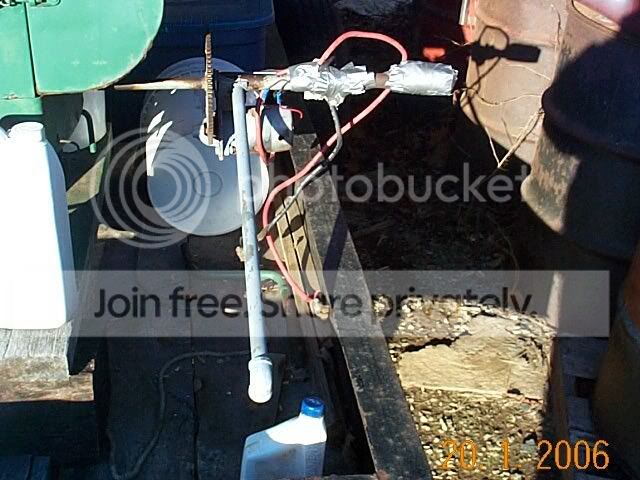
The inside of the intake was pretty scaled up and my theory could have been right about the rust turning loose???? Jury is still out! I did sand blast it all away and reinstalled the manifold etc and started it up and ran it for about 30 minutes and it did OK. I did put a few ounces of Marvel Mystery oil in the gas. Just hope it doesn't do it again!!!!! I need to go out and start it more often too I guess. It's hand cranked and that is a problem for a 75 year old mechanic! I do have a home made electric starter thingy that I made just for it.

See the picture.

Zane
HANDCRANK.jpg
 
"... that powers my Meadows grist mill ... "
See the picture.


HANDCRANK.jpg

Zane , a mill for chicken feed ???

You do put that chinken feed in a kettle with a long copper tube running out of it do ya , he he ???
 
I don"t know about 8M carbs but some time on my NAA and 601 the floats hang and will not start, I tap on the side of the carb and free the floats and the engine will start.
 
Yesterday's Tractor Forums

We sell tractor parts! We have the parts you need to repair your tractor - the right parts. Our low prices and years of research make us your best choice when you need parts. Shop Online Today.

Back
Top
