


The All Powerful Megger

farmersamm

Well-known Member
A megger is used to test whether there's an insulation breakdown between adjacent wires. It puts out huge current, compared to a regular ohm meter, often found in your multimeter. It's an ohm meter on steroids.

I recently had a well problem. The breaker would trip sometimes. Never a regular trip.

My well runs on a regular circuit breaker.........the ones that need a dead short to trip. I have about 300' of UF between the breaker box, and the well. IT WAS MY INTUITION THAT I HAD A INTERMITTENT SHORT. Great detective work, huh:rolleyes: Doesn't take an Einstein.

You have two scenarios. Either you have rodent damage, or the UF has aged out, and the insulation is breaking down. The UF in question has been buried for over 30yrs............about the lifespan of UF.

I trotted out, and bought a megger off of FleaBay.....................never knew they existed. I'd been bouncing around the internet, and discovered them.

61tIGclvrHL._AC_SL1000_.jpg


You can test until the cows come home with a multimeter................and it will usually give you a "good" reading. They simply don't have enough power to isolate a fault.


So...................now I know I have a fault....................BUT WHERE IS IT????? I'm not gonna dig up 300' of wire.


Ignoring the erroneous readings I had with some temporary splices, I knew that there was an actual short somewhere along the line.

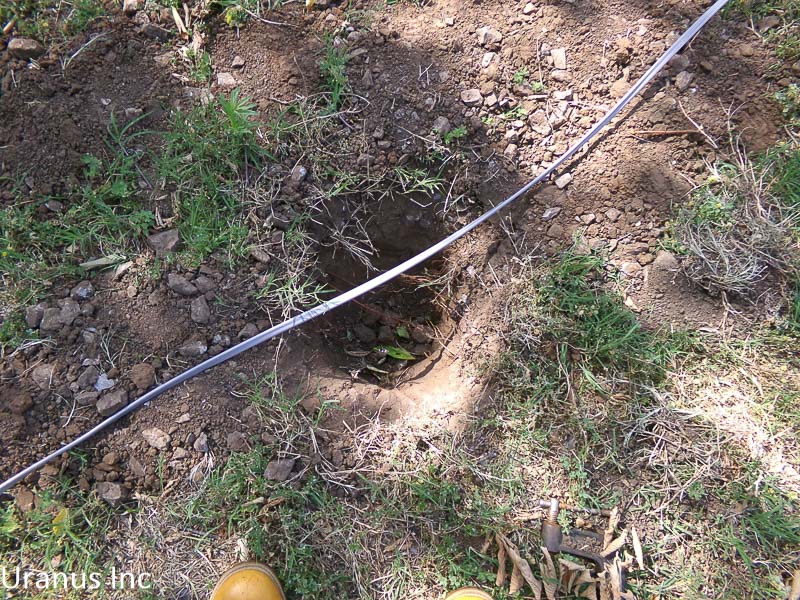
The wire was traced along its entire length................................................AND THE LINE WAS SPLIT INTO SECTIONS. Digging it up, and testing short runs. Small precise holes to reach the wire to cut it, and test it.
well18.jpg

well19.jpg


I found a section of UF that was bad. Not the precise location, but within a given section of the wire. That's all I need to know. I now know what section of wire has to be replaced.

Replaced the bad section.................THEN TESTED GOOD WIRE FOR A BASELINE. You need to know how good UF meggs out, to establish what a healthy system looks like..........then the next time, you're not stumbling around in the dark.


The "standard" use for a megger is to test insulation for breakdown. The megger also has the ability to find short circuits.
 
Bear in mind, this was not a willy nilly blind taste test. THE PUMP WAS TESTED FIRST.

Knowing the trip curve on the breaker..........................

trip curve1.jpg


And the locked rotor amp draw on the pump..........................

Screenshot_4-5-2026_155917_.jpeg.jpg


You can use an inrush current meter to see what the motor is drawing on startup......................

surge tester.jpg


All of this beats flailing around replacing stuff willy nilly. You're on solid ground...............good diagnostics.
 
Now you tell me. I spent close to $5000 over the winter replacing literally everything to do with my well shy of the casing. Turned out to be a wire under the house. It would go a month or more without tripping, then wouldn't go more than half an hour. We did that from November to March before we finally got it. We had already replaced the wire from right next to the house out to the well. It worked for a month. Last thing we did was the wire under the house because there wasn't anything else left to do.
 
Now you tell me. I spent close to $5000 over the winter replacing literally everything to do with my well shy of the casing. Turned out to be a wire under the house. It would go a month or more without tripping, then wouldn't go more than half an hour. We did that from November to March before we finally got it. We had already replaced the wire from right next to the house out to the well. It worked for a month. Last thing we did was the wire under the house because there wasn't anything else left to do.
It's Karma man...................you did me a good turn.............so maybe I repaid the favor.
tkqe4fh-smiley-two-thumbs-up175028_285604.gif
 
A megger is used to test whether there's an insulation breakdown between adjacent wires. It puts out huge current, compared to a regular ohm meter, often found in your multimeter. It's an ohm meter on steroids.

I recently had a well problem. The breaker would trip sometimes. Never a regular trip.

My well runs on a regular circuit breaker.........the ones that need a dead short to trip. I have about 300' of UF between the breaker box, and the well. IT WAS MY INTUITION THAT I HAD A INTERMITTENT SHORT. Great detective work, huh:rolleyes: Doesn't take an Einstein.

You have two scenarios. Either you have rodent damage, or the UF has aged out, and the insulation is breaking down. The UF in question has been buried for over 30yrs............about the lifespan of UF.

I trotted out, and bought a megger off of FleaBay.....................never knew they existed. I'd been bouncing around the internet, and discovered them.

View attachment 161300

You can test until the cows come home with a multimeter................and it will usually give you a "good" reading. They simply don't have enough power to isolate a fault.


So...................now I know I have a fault....................BUT WHERE IS IT????? I'm not gonna dig up 300' of wire.


Ignoring the erroneous readings I had with some temporary splices, I knew that there was an actual short somewhere along the line.

The wire was traced along its entire length................................................AND THE LINE WAS SPLIT INTO SECTIONS. Digging it up, and testing short runs. Small precise holes to reach the wire to cut it, and test it.

View attachment 161303
View attachment 161304

I found a section of UF that was bad. Not the precise location, but within a given section of the wire. That's all I need to know. I now know what section of wire has to be replaced.

Replaced the bad section.................THEN TESTED GOOD WIRE FOR A BASELINE. You need to know how good UF meggs out, to establish what a healthy system looks like..........then the next time, you're not stumbling around in the dark.


The "standard" use for a megger is to test insulation for breakdown. The megger also has the ability to find short circuits.
If you haven't discovered it yet, that thing will bite the heck out of you. We went to using meggers back in the late 70"s or early 80's and had a lot of fun for a while lighting up coworkers or anyone else that came nosing around wanting to know what we were doing. I got bit quite a few times myself not paying attention to what I was doing. Caused quite a bit of cussing!!
 
I see a possible flaw in your process: You said 30 years was about the expected lifespan of UF. Instead of splicing a piece in (ignoring for the moment the potential problems with an underground splice) you're just kicking the can down the road. If one section failed, the rest is likely not far behind.

I'd have bit the bullet and replaced the entire run. Cry once...
 
I see a possible flaw in your process: You said 30 years was about the expected lifespan of UF. Instead of splicing a piece in (ignoring for the moment the potential problems with an underground splice) you're just kicking the can down the road. If one section failed, the rest is likely not far behind.

I'd have bit the bullet and replaced the entire run. Cry once...
I would be concerned about all the cuts and splices. A splice is a logical place for a problem to occur. I am not to sure what you mean by UF but if it has a lifespan I would get rid of it.
 
Having the high voltage test ranges with a common meg-ohmmeter is useful, get one which also has a high-current, low resistance range and you will be grinning later for the time and trouble you save.
Fluke1520.jpg
 
I would be concerned about all the cuts and splices. A splice is a logical place for a problem to occur. I am not to sure what you mean by UF but if it has a lifespan I would get rid of it.
I selected these kind of splices, made for underground work.

well17.jpg


I've since shrink sleeved them. They were only left without waterproofing for final testing. I hope they hold up well.


The splice locations are marked with steel plate anchored with a longish piece of round stock pushed into the ground. Sorta like a survey marker that shows boundaries. The flat plate allows me to mow over the markers without fear of messing the mower up. If things go wrong again, I can easily locate the splices for testing purposes.
 
I see a possible flaw in your process: You said 30 years was about the expected lifespan of UF. Instead of splicing a piece in (ignoring for the moment the potential problems with an underground splice) you're just kicking the can down the road. If one section failed, the rest is likely not far behind.

I'd have bit the bullet and replaced the entire run. Cry once...
We really didn't feel that we had it in us to dig up a gravel driveway to replace the furthest section of cable before it enters the well house. I tested that segment, and it tested useable.................... for now
unsure.gif


But ya know...............we're gonna be even older when that section eventually goes bad. Probably just put the stupid wire in a section of pipe across the gravel.......just dug in deep enough to drive across.
 
We really didn't feel that we had it in us to dig up a gravel driveway to replace the furthest section of cable before it enters the well house. I tested that segment, and it tested useable.................... for nowView attachment 161395

But ya know...............we're gonna be even older when that section eventually goes bad. Probably just put the stupid wire in a section of pipe across the gravel.......just dug in deep enough to drive across.
I totally get that, I'm 75 and shovels don't fit my hand any more.
 
Yesterday's Tractor Forums

We sell tractor parts! We have the parts you need to repair your tractor - the right parts. Our low prices and years of research make us your best choice when you need parts. Shop Online Today.

Back
Top
