


farmersamm
Well-known Member
A megger is used to test whether there's an insulation breakdown between adjacent wires. It puts out huge current, compared to a regular ohm meter, often found in your multimeter. It's an ohm meter on steroids.
I recently had a well problem. The breaker would trip sometimes. Never a regular trip.
My well runs on a regular circuit breaker.........the ones that need a dead short to trip. I have about 300' of UF between the breaker box, and the well. IT WAS MY INTUITION THAT I HAD A INTERMITTENT SHORT. Great detective work, huh Doesn't take an Einstein.
You have two scenarios. Either you have rodent damage, or the UF has aged out, and the insulation is breaking down. The UF in question has been buried for over 30yrs............about the lifespan of UF.
I trotted out, and bought a megger off of FleaBay.....................never knew they existed. I'd been bouncing around the internet, and discovered them.

You can test until the cows come home with a multimeter................and it will usually give you a "good" reading. They simply don't have enough power to isolate a fault.
So...................now I know I have a fault....................BUT WHERE IS IT????? I'm not gonna dig up 300' of wire.
Ignoring the erroneous readings I had with some temporary splices, I knew that there was an actual short somewhere along the line.
The wire was traced along its entire length................................................AND THE LINE WAS SPLIT INTO SECTIONS. Digging it up, and testing short runs. Small precise holes to reach the wire to cut it, and test it.
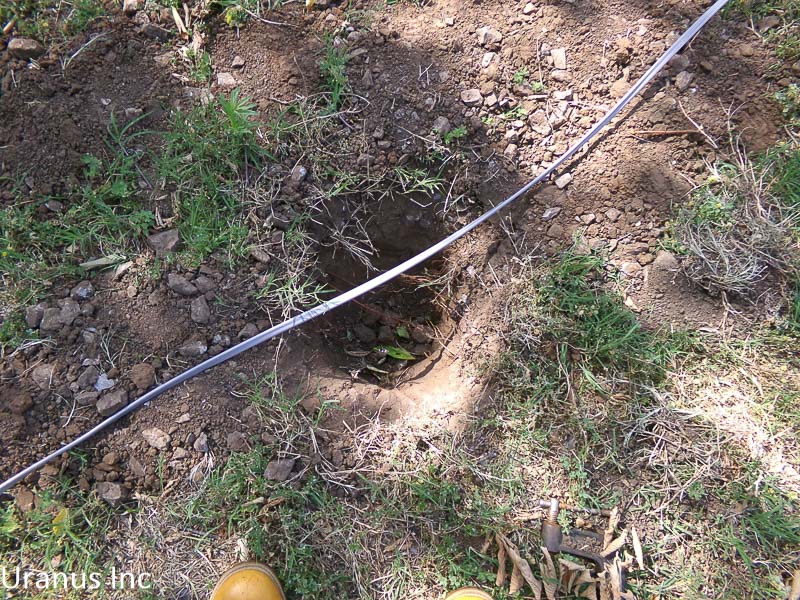

I found a section of UF that was bad. Not the precise location, but within a given section of the wire. That's all I need to know. I now know what section of wire has to be replaced.
Replaced the bad section.................THEN TESTED GOOD WIRE FOR A BASELINE. You need to know how good UF meggs out, to establish what a healthy system looks like..........then the next time, you're not stumbling around in the dark.
The "standard" use for a megger is to test insulation for breakdown. The megger also has the ability to find short circuits.
I recently had a well problem. The breaker would trip sometimes. Never a regular trip.
My well runs on a regular circuit breaker.........the ones that need a dead short to trip. I have about 300' of UF between the breaker box, and the well. IT WAS MY INTUITION THAT I HAD A INTERMITTENT SHORT. Great detective work, huh
Doesn't take an Einstein.You have two scenarios. Either you have rodent damage, or the UF has aged out, and the insulation is breaking down. The UF in question has been buried for over 30yrs............about the lifespan of UF.
I trotted out, and bought a megger off of FleaBay.....................never knew they existed. I'd been bouncing around the internet, and discovered them.
You can test until the cows come home with a multimeter................and it will usually give you a "good" reading. They simply don't have enough power to isolate a fault.
So...................now I know I have a fault....................BUT WHERE IS IT????? I'm not gonna dig up 300' of wire.
Ignoring the erroneous readings I had with some temporary splices, I knew that there was an actual short somewhere along the line.
The wire was traced along its entire length................................................AND THE LINE WAS SPLIT INTO SECTIONS. Digging it up, and testing short runs. Small precise holes to reach the wire to cut it, and test it.
I found a section of UF that was bad. Not the precise location, but within a given section of the wire. That's all I need to know. I now know what section of wire has to be replaced.
Replaced the bad section.................THEN TESTED GOOD WIRE FOR A BASELINE. You need to know how good UF meggs out, to establish what a healthy system looks like..........then the next time, you're not stumbling around in the dark.
The "standard" use for a megger is to test insulation for breakdown. The megger also has the ability to find short circuits.


