Having difficult time installing a new thermostat in the upper radiator hose on my 8N. Is there a way to do it without damaging the new thermostat. Thank you all
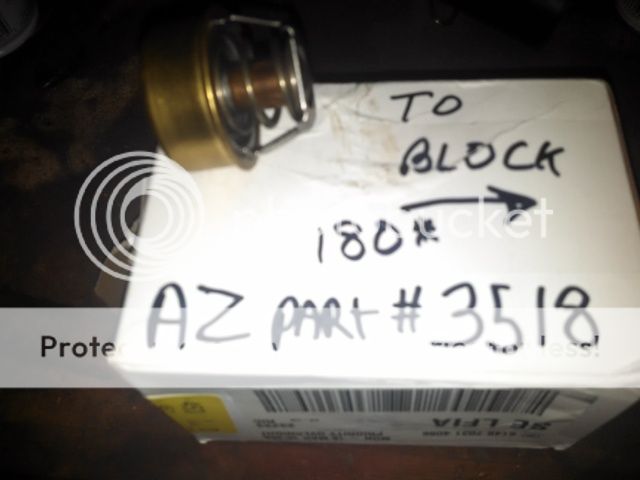
 
160* or 180* t-stat?

The 180's are a PITA to install.

Heat the hose in hot water. Just use a little dish soap to lube one end. Once you get it started, tap it in w/ a socket.
75 Tips
 
Pics are of a 180* t-stat & OEM t-stat & hose.
IMG_20140214_131446_737_zps536345ad.jpg

75 Tips
 

Bruce, what makes it harder to install the 180 degree thermostats? All I have installed is the 160 degree ones.
 
Not really any need for a 180. The 160 has been the standard on the N's for over 60 years. There is a 180 listed for the N's but it was only used in the distillate burning NAN's as their fuel vaporizes better at 180 temp.

 
Automotive engineers recognized the benefits of a hotter running engine more than 60 years ago. Ford added thermostats to engines in 1933 or 34. Problem was the methanol based antifreeze in the non-pressurized cooling systems would boil off if the operating temperature of the engine got much above 180*. Hence a 160* t-stat.
Untitled URL Link
 
(quoted from post at 06:52:52 01/27/17) Not really any need for a 180. The 160 has been the standard on the N's for over 60 years. There is a 180 listed for the N's but it was only used in the distillate burning NAN's as their fuel vaporizes better at 180 temp.

A fully open thermostat does not control the temp anyway air flow across the radiator does plus how efficient the rad is on a healthy system. . A 160 would normally not be fully open till 180 Every N I have installed a temp gauge on with a functional 160 stat had no problem hitting the 180 mark and higher.

No temp gauge you don't know but it sounds good to those that don't know.

You modern car/truck with a 195 stat cold will hit 210 before the stat is fully open if all is well will drop to 190 and stabilize at highway speeds. Part of my diagnostic routine is to jump in it cold and at the 2 1/3 to 3 mile mark see the temp gauge go a little higher than normal and fall back to normal all is well I can ship it.

Folks say you don't need a temp gauge if you don't know then you don't need one. A chit load of info can be learned from one if you pay attention to its pattern.

A little more on engine temp. About all you can diagnose on a piece of equipment that shows up at your door overheating is to confirm its overheating (check temp and confirm the complaint) check air flow any other time spent is wasted. To diagnosis a overheating complaint you start with a bone cold engine.

Y'all chew on that the next time you throw a book of pattern answers at a overheating condition.
 
I installed one of the Renault thermostats from Rock Auto. The tractor quickly boiled over each time I started it. Upon investigation, there was no "bleed" hole in the thermostat, so I guessed that it could not sense the temperature due to an air lock in the hose. I drilled a 3/32" hole in the frame of the thermostat and it works perfectly now.

The thermostat is open when the discharge neck of the head reads 160* with a temperature gun. The head reads 170* at the #2 cylinder, 180* at the #3 cylinder, and 200* at #4. If a 180* thermostat raised all these temperatures by 20*, it would boil plain water at #4 without a pressure cap. I would not use a 180* thermostat without 50/50 antifreeze.

The Renault thermostats are larger in diameter than the original ones, but the hose seems to take them without a problem. They are harder to install/remove. I found that 1-1/4" electrical conduit is slightly less than 1-1/2" outside diameter, and is useful for pushing the thermostat in/out. Use a lubricant and rinse it out before installing the hose on the tractor. I use WD40 for lubricant.
 
Sometimes it's easier to diagnose automatic transmission problems than diagnose overheating issues. I try to categorize them into coolant flow issues or airflow issues and then you still find crossovers. The best help, and cheaper repair at times, is full disclosure of the problem written on the work order. Telling me your car overheats doesn't cut it. I want to know when (highway,city) how long does it take to overheat, is it consistently doing it "etc", and to make matters more complicated I've seen people put thermostats in backwards or not put the spring back in the lower hoses or even break off the lower plastic scoop that directs air into the radiator. I need to stop and get my blood pressure medicine.
 
I recall that sort of boiling off. First learned about it when I was working our 9N one early warm spring. It was cooled by mostly alcohol and not much water as we had a cold winter, Hit the boiling point and looked like an explosion. We could not get permanent as it all went to the war effort so in the changing seasons you used a lot of alcohol. If the 160 degree thermostat was designed for alcohol use only then why did Ford Tractor build gas engine tractors with 160's well into the 50's and even 60's?
 
" If the 160 degree thermostat was designed for alcohol use only then why did Ford Tractor build gas engine tractors with 160's well into the 50's and even 60's?"

Beats me.

Probably the same reason that Ford didn't install any t-stat at all until 1933 or 34. The Model T didn't even have a water pump.

I guess at some point Ford's engineers finally convinced the bean counters that a hotter running engine performed better and the t-stat was worth the expense.

No doubt the design of the engine and materials used, as well as lubricants, has a lot to do with the optimum operating temp. IIRC, most engines these days run much hotter.
 

If you ever get bored boil a stat play with the temps hi/low and watch it do its thang. What I have played with have a 30 deg operating range lets say a 195. Once opened fully at 210 it will start to close at 190 and still be opened somewhat open at 180.

Thru the years I have read and played with different ways to get some kind of regulation from a thermo that does not want to play fair. A thermo is a variable device it has to be are the temps would fluctuate all over the place.

I have drilled my fair share of holes in them BUT always down the road the real issue showed up. It would show up with a leaking head gasket that I could not condemn at the time, a radiator issue are some odd ball circulation problem. All I did was take the regulator effect out of it till the real issue showed its tail.

Its time consuming every one that gets a hold of a intermittent problem child job is a loooooser.
 
Yesterday's Tractor Forums

We sell tractor parts! We have the parts you need to repair your tractor - the right parts. Our low prices and years of research make us your best choice when you need parts. Shop Online Today.

Back
Top