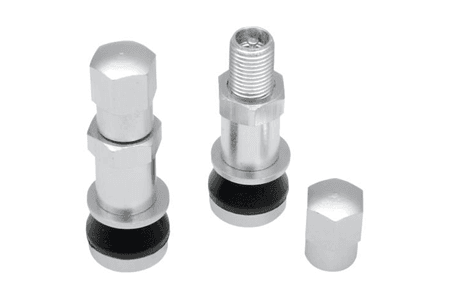
Valve stem help please

xtal_01

New User
OK ... this is not really a tractor question but I am stuck and the farmer next door said he had a valve stem like this on one of his tractors years ago. I am hoping someone know what the heck this is and where to get it.

This is on a 20 year old Ferris zero turn.

The valve stem is a small (about .3" dia) hole.

It is not a normal stem.

It looks like it has a nut holding it in and a seal on the back side.

I see lots of them but they are all for the "normal" size (.453 or .625). On mine the diameter of the stem is the dia of the hole. the nut has the same threads as the cap.

Any suggestions where to get this ???

Local dealer and tire shops don't have this.

Thanks!
 

Attachments

  • IMG_2082.JPEG
    IMG_2082.JPEG
    545.9 KB · Views: 79
OK ... this is not really a tractor question but I am stuck and the farmer next door said he had a valve stem like this on one of his tractors years ago. I am hoping someone know what the heck this is and where to get it.

This is on a 20 year old Ferris zero turn.

The valve stem is a small (about .3" dia) hole.

It is not a normal stem.

It looks like it has a nut holding it in and a seal on the back side.

I see lots of them but they are all for the "normal" size (.453 or .625). On mine the diameter of the stem is the dia of the hole. the nut has the same threads as the cap.

Any suggestions where to get this ???

Local dealer and tire shops don't have this.

Thanks!
Needed on last year, ended up buying a package of 10 to get one. Try searching motorcycle valve stem. Drilling out to common size might be easier than finding one.
 
If it’s .30
WOW .... I think that is it! I looked on a dozen motorcycle places (I just had a feeling that is what it might be) and Amazon and nothing came up. Thanks so much !!!
 
WOW .... I think that is it! I looked on a dozen motorcycle places (I just had a feeling that is what it might be) and Amazon and nothing came up. Thanks so much !!!
I’ve used Drag Specialties parts many times over the years but I know nothing about the company that I posted.
They seem legit but check with DS themselves and see if they sell direct.
 
Thanks so much everyone!

Now that I know what I am looking for, I found several sets out there ... even a set of stainless ones ... $13 a pair and free shipping. I really appreciate all the help finding these. I looked online ... when to the dealer ... stopped at a tire shop ... I think they all thought I had lost my mind when I explained what I was looking for.

I have the tires coming in later this week. When I take them off, I will know for sure what I have.

I will let you guys know how I make out.

Thanks so much again!
 
While they make that kind of threaded stem for tubeless stems and for tubes, from the looks of that stem, I'd bet dollars to buttons that's a tube with a threaded stem (either a TR4 or TR6). Pretty common on smaller equipment tubes.

Whether it currently is or isn't a tube, based off the condition of the stem-area of that rim, I'd want a tube in there. And if you go to a tube, it won't really matter if the new stem is threaded or not. I never had any patience for tubeless tires in farm or lawn equipment. Mind you, you need to have someone that knows how to install a tube properly. Which (in my experience) no tire shop in the last 30 years knows how to do properly.
1777484779023.png

1777484979278.png
 
Last edited:
That is nothing more than a threaded valve stem found on ATV tubes. Bet that when you remove the nut. The hole will be nearly as big as the nut itself.
Ferris mowers came from the factory with tubeless tires and short rubber valve stems.
 
Mind you, you need to have someone that knows how to install a tube properly. Which (in my experience) no tire shop in the last 30 years knows how to do properly.

Enlighten us with the proper way a tube should be installed in a tire.
I have been installing tubes in everything from bicycles to 100 ton rock trucks for over 50 years. And I have never had a problem. Yes I have pinched a few over the years. But who hasn't?
Does the blue line found on most tubes today go up or down? What happens if it put in wrong?
 
If you've been doing it for 50 years I'm sure your better than me at it. And maybe it's just the tire shops around me that are bad. The biggest issue I find is tire shops all seem to want to prove how fast they can break a tire down and get it back on. Which may be fine for tubeless, but not for tubes. They break it down, give the rims a quick scraping on the changer, throw the tire/tube on, inflate, and send you out the door. Before I got fed up and we went back to doing tubes ourselves, the ones done at shops may have held up for a week, a month, or a couple years, but sooner or later (usually sooner) those I've had tubes done by shops always seem to wear through - especially if used on higher-speed tires. Though admittedly it wasn't just my frustration with their work that caused me to go back to doing all our own tire work. I'm particularly bad for buying cheap/old equipment that always has pooched tires when I get it. Add those to all the old hay and (especially) log wagons we have between the two farms and how many hawthorns and honey locusts are around that it'd cost me a fortune if I took all the tires we do to a shop. I buy 15", and 16" tubes in 10-packs from Cantin and always keep a couple good used tires in 14" through 16" on hand.

Anyhow, I'm sure I don't need to tell my methods on here, as I suspect anyone who's into antique tractor forums already knows how to mount a tube (probably knows better than me). But here's my method/thoughts: Any traces of rust/roughness removed - even if light surface rust - especially for any road-going equipment that sees higher wheel speeds - else the tube will rub against that rough spot and wear through. At the minimum, a thorough cleaning with a wire cup on an angle grinder is required. And if putting a tube in a used tire (which is most of what I do - for all wagons and implements I get used truck tires from the scrapyard around the corner) the tires need a proper checking. Rim and tire need to be uber-clean and smooth so that the tube can slide to its happy home upon inflation. I do admittedly cheat on my coatings and often give the inside of my rims a coat with that spray-on 'cold galvanizing compound'. Definitely not the best paint/coating, but I like it because it fully cures in 5-10 minutes so you can get the tire back together quickly. Once all clean, a light J-cloth rubbed lightly over the rim and inside of the tire - Anything it catches on even slightly needs to be checked/cleaned. It's amazing what a really light j-cloth will catch on that you won't feel by hand or see by eye.

One thing that bugs me is that all tubes until about 15 years ago used to be pre-powdered - they'd come with that light, talc (or whatever it was) dry powder lubricant already on them to let the tube slide into its proper/happy place upon inflation. But any tubes I've bought more recently no longer come powdered - they're just bare rubber. So I give my tubes and the inside of the tire a good coating with baby/talcum powder. Which is proper practice regardless. The old guy I used to work with had a tube of 'tire talc' I can still picture in my mind - the tub must have been 60 years old and had a peeling orange and cream label - always reminded me of Allis colouring, which I thought ironic as he was a die-hard Farmall guy to the core. Mount tube & tire (stem centred and on correct side, of course, and making sure you have a radial tube for a radial tire). Inflate enough to seat bead making sure you're not pinching, completely deflate to let the tube relax into position (something tire shops around here also don't bother doing), and reinflate to full pressure. And make sure you use a stem grommet if you're putting a narrow stem in a TR15-sized hole - which always seems to be the case for me because I'm always putting newer radial tubes in implement rims.

I'd like to say that I've never had any of my own tubes fail, but that'd definitely be a lie. Hawthorne and honey locust take their toll around here, and just last summer a tube I put in an All-Crop failed travelling between farms. When I broke it down I saw I had clearly goofed and pinched it. And I've certainly pinched a few when mounting - especially those I do at the Southern Farm where I don't have a changer and just use spoons. But I've had pretty good luck apart from that. Tires on my float, one of my utility trailers, and my tool trailer all have tubes I put in years ago, and they get hauled all over at highway speeds. Not that that's enough of a sample size to mean much. But all our hay, log, and grain wagons, plus many other implements also have tubes I put in. And apart from the All-crop, I can't recall any that failed after install that wasn't because of a thorn/nail. Back in that period where we were taking everything to tire shops, we certainly didn't have anywhere near that success rate. Especially on our log wagons that travelled the roads a lot at higher speeds. We were constantly bringing those tires back in. Shops were always telling us to go tubeless, but because the log wagons get the holy-heck beat out of them on narrow bush trails with stumps/rocks everywhere that would push a heavily-loaded tire off the bead, tubeless were always terrible for us.
 
Last edited:
Yesterday's Tractor Forums

We sell tractor parts! We have the parts you need to repair your tractor - the right parts. Our low prices and years of research make us your best choice when you need parts. Shop Online Today.

Back
Top