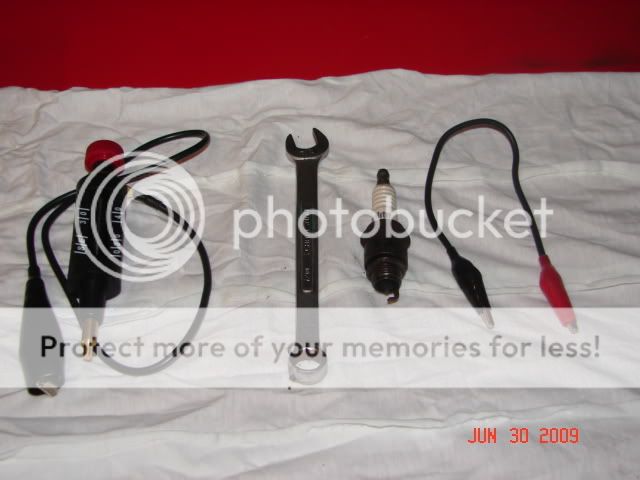
" so if there is something more likely at fault than the coil, please provide suggestions. "
I'd bet your coil is fine because it's a 6v round coil. I'd also be surprised if any parts are faulty. What's needed instead of parts is some diagnostic work. Maybe something is broke, but I doubt it.
In the 45+ years I’ve been trying to keep old cars & tractors running, I’ve tried a number of different methods to get a non-running car/truck/tractor to start. One way was to just start replacing every part I could get to until it started or I ran out of money. (Remove the radiator cap & drive a new tractor under it) Another way was to take the good intentioned advice of my non-mechanic friends who would tell me that when their vehicle had the same symptoms, it was the whatever that was broke or needed adjusting. I’d then try that, usually w/o getting it to run. But, when I was occasionally successful, from that point on, every time the vehicle had those symptoms, I was confident that the same fix as before would work again. It usually didn’t. Unfortunately for me, this approach was reinforced by watching real mechanics take 10 minutes to fix a problem that I couldn’t fix in 10 hours. It took a while before I figured out that my experience of working on one or two different vehicles 8 or 10 hours a month just wasn’t the same as working on 10 or 20 different makes/models of vehicles 40 hours a week. The one way that I did find the best results with is to take a systematic, step-by-step approach to solving the problem, working from most likely to least likely. The trick to fixing these tractors (or trouble shooting any piece of equipment) is to be systematic about it. You need to isolate the problem step by step and work from most likely to least likely. Jumping ahead to 'so-and-so said it could be whatever' or just replacing parts usually just wastes your time and your money. I know it did for me. Remember, it takes three things for an engine to run: spark at the right time, compression, & fuel in the right mixture. For the moment, forget about compression & concentrate on narrowing the problem to fuel or spark. If you don’t do that, you are going to end up chasing your tail around that tractor & spending a boatload of money to fix what could easily be a loose wire or failure to turn the fuel on. I offer this advice from personal experience because I am not a mechanic. I do not have the ability learned after 30 years of working on an N tractor to simply diagnose the problem & go right to the fix. So, whenever my tractors stop, it's 'check spark, check fuel' and then go from there. You can also think of it in these terms:
First -- Check the free stuff
Second -- Check the cheap stuff
Third -- Check the expensive stuff
I might not be capable of telling you why your tractor isn’t running, but I sure can tell you how to figure it out for yourself.
There are three very important tools you always need to have in your N tool box: a 3 inch piece of wire w/ alligator clips on each end, an old spark plug w/ the gap opened to at least 3/16” ( ¼” is better) and a 7/16 box end wrench. (see tip # 50 at the link below) And, you really do need a working ammeter on the tractor; it is a very important diagnostic tool. With these tools, you can quickly narrow down most N problems to spark or fuel.
First, check for fuel. Get a can & put it under the carb. Remove the bolt in the bottom of the carb; as long as the fuel is turned on, you should see gas flowing out of the carb. Let it run for at least 30 seconds. If it’s a dribble, or runs for 5 seconds & stops, or none at all, you have solved half the problem: it’s fuel related. If gas flows well out of the carb & only stops when you turn it off at the sediment bowl, chances are very good it’s not a fuel problem. So, next, turn the key on, crank the engine & look at the ammeter. What is the needle doing? Does it show a constant discharge, no movement at all, or does it move back & forth slightly? Next, get the old plug, ground it to a rust & paint free spot on the engine, turn the key on & crank the engine. If the spark jumps the 3/16” gap, you probably don’t have a spark problem. If it won’t jump the 3/16” gap, you have a spark problem. If the ammeter needle shows a constant discharge, or doesn’t move at all, that also tells you that you have a spark problem. Jump the ignition switch w/ your jumper wire & see what happens. If it runs, you found the problem. If it doesn’t have spark after you jump the ignition switch, check the voltage across the points when they are open. (it should be about 6.35v) Verify the gap on the points at .025. Then, run a piece of brown paper bag or card stock trough them. New points sometimes have a residue & old points can corrode, or get grease from the distributor cam on them. Or, you could have used a dirty feeler gauge. (I always spray mine off w/ contact cleaner.) Make sure you have voltage across the points, as in past the insulator on the side of the distributor. That is a very common failure point on sidemounts & often hard to find because it is usually an intermittent short. (If you find the short there, the Master Parts catalog lists everything you need on page 154. You can make the strip and you could also make the insulators as well. But, somethings are just easier & in the long run cheaper to buy. Get the strip, 12209, screw 350032-S, 12233 bushing & 12234 insulator & just replace it all.)If you just replaced the rotor & lost spark, put the old one back in. Check continuity on the secondary coil wire. Make sure it is firmly seated in both the cap & the coil. In fact, replace it temporarily w/ a plug wire.
If that doesn't work, post back for more info on further troubleshooting. (and do not forget to turn the ignition switch off; see tip # 38)
If it does not have gas coming out of the carb at a steady stream w/ the bolt out for at least 30 seconds, you have a fuel problem. First, remove the gas cap. Your vent could be clogged & it vacuum locked. If that doesn’t work, tap the carb bowl w/ a hammer handle in case the float is sticking closed. (don’t whack it w/ the head of the hammer; you can crack the bowl). If you still don’t see gas flowing, the N has three fuel screens; one in the brass elbow, one in the top of the sediment bowl & one on the stem of the sediment bowl in the gas tank. Check the screen in the elbow & the screen in the top of the sediment bowl. (don’t worry about the one in the tank) Both probably need to be cleaned. If you have the fuel knob turned on all the way, & 1 gallon or less in the tank, it may be trying to feed off of the reserve inlet which is probably clogged. Only open it 2 full turns. Put at least 2 gallons in the tank. (and do not forget to turn the gas off; see tip # 9)
There are ways to check for spark & fuel that work & ways that don't. For example, having gas to the carb is nice, but having it past the float is what counts! That’s why removing the bolt in the bottom of the carb is the way to do it. And, same thing w/ spark at the plugs. Some folks think that checking for spark means pulling a plug wire off & looking for one. Well, it's the distance the spark jumps at the plug that gives you the info you want. It takes about 17kv to jump a 3/16" gap & 22kv to jump ¼” in the open air, so that's why you need to use a spark plug. Or, a store bought plug checker (on the left in the picture). Remember, it’s 14psi outside of the engine & about 90psi at a 6:1 compression ratio in the cylinders & compressed air creates electrical resistance, so you really need the 17-22kv to fire the plugs when the engine is running.
Post back w/ results; I'll be interested in what the problem was.
50 Tips