

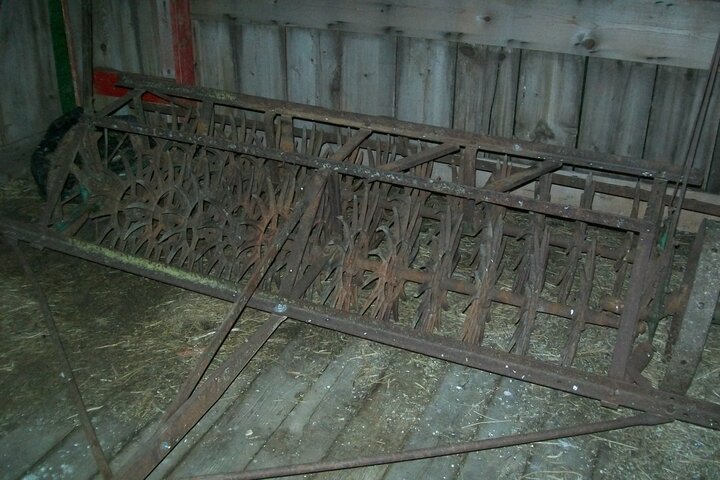
What is it?

mvphoto68792.jpg

Wifes out antique shopping today. The shop has several of these hanging on the wall. Im assuming its a cultivator/planter wheel?
 

Yes, they were mounted in gangs at an angle to cultivate row crops. I have a couple here, that looks like a great idea to get rid of them.
 
Looks like a John Deere rotary hoe wheel. No bearing, just turns on the shaft. They were/are used on
emerging crops to kill weeds as they germinate and relieve crusting problems. If you can see the
weeds, it's too late to do any good.
 
(quoted from post at 09:58:43 01/23/21) I've never seen a rotary hoe with the
gangs mounted at an angle.

I never said mine were from a rotary hoe. Mine are from a cultivator, they replaced the shovels.
 
Lilliston made them adjustable for width of rows as well as adjustable angle so when you cultivated you could throw dirt around the plant to slow any weeds. Now they are popular here at dirt race tracks where the mount them very close together and use to break up a crust or rubbered up surface during intermission and then lightly water the track and pack it in. Improves the racing for the features by allowing 2or 3 grooves to develop instead of 1 lane and no passing. The firsst time our promoter pulled on the track our comment was "oh crap what is he trying to do now?" but it works quite well.
 
(quoted from post at 10:22:43 01/23/21) Lilliston made them adjustable for width of rows as well as adjustable angle so when you cultivated you could throw dirt around the plant to slow any weeds. Now they are popular here at dirt race tracks where the mount them very close together and use to break up a crust or rubbered up surface during intermission and then lightly water the track and pack it in. Improves the racing for the features by allowing 2or 3 grooves to develop instead of 1 lane and no passing. The firsst time our promoter pulled on the track our comment was "oh crap what is he trying to do now?" but it works quite well.

Thanks, I had forgotten the brand name.
mvphoto68793.jpg
 
The one I have doesn't look like that at all. Te one I have has 4 sets of 10 wheel that have 2 setting side by side up front then another 2 sets behind sort of like a lot of disk are set up
 
That would be called a rolling cultivate here. It has cast iron teeth that are
curved and the unit with 4 such wheels can be angled. The flat metal steel fingers
in the original photos are used on what is called a rotary hoe in this area, and
are on separate suspensions for each wheel and run in a straight line only. . Two
different machines two different uses.

Ben
 
I dont know what they are but i have some growing in our flower bed. Round up doesnt even phase them.
 
If you laid them out side by side you will really see the difference between the hoe tines and the high speed cultivator tines. If I remember the cultivators were just a little bit slower than the rotary hoe, and a lot faster than the walking speed of shovel cultivators.
 
Liliston rolling cultivator I think it is repainted, they were red and white. You could angle the gangs in or out to cut away or hill up as you cultivated. The faster you went the better they worked.
 
They are also used here extensively to break the crust on heavy soils after a rainfall, to help the bean cotyledon emerge.

Ben
 
This jogged my memory a bit. When I was a kid, a neighbor of the guy I worked for said he would pull
his rotary hoe backwards across the wheat in the spring to help it stool more. For several years I
pulled a Minnie Mo rotary hoe across 300 acres 2 twice each year, as soon as I got done the first
time, I'd start across it again using an 1936 Oliver Hart Parr 70 in 5th gear. Then help put the 4
row cultivators on the M and the U Minnie and we would usually cultivate corn and beans 3 times.
 
Rotary hoe wheel. They have a ‘spoon’ or wider point on the end, when they wear down the tool becomes much less effective. Replacing them is expensive, end up
with a stack of them in a pile of the shed then.

You drive right over the corn with them, drive fast. The little spoon drip out very tiny weeds, and doesn’t hurt the bigger corn (much - it looks roughed up for a day!)

The other cultivator pictured below, the Liliston, has much tougher cast iron wheels, they are shaped differently and scratch at an angle, they dig harder and deeper
between rows to rip out a little bigger weed. The wheels are quite different.

Both types of weeders are still used and manufactured, Lilliston is popular with organic growers, the rotary hoe is as well and also is used by some with cover crops and
to bust up crusting ground on soybeans and other crops.

Paul
 

Dad always called it a rotary hoe. Those wheels go for a precious price at flea markets around me since they are popular with yard art welders. My neighbor has about 8 of them painted like sunflowers in her front flower garden.
 
Yesterday's Tractor Forums

We sell tractor parts! We have the parts you need to repair your tractor - the right parts. Our low prices and years of research make us your best choice when you need parts. Shop Online Today.

Back
Top
