

2N wiring Specs

bocomo

New User
I don't usually hang out here as I have a TO-20 Ferguson, but I have a friend that inherited a 2N that has sat for about 5 years. He has drained and cleaned the tank and sediment bowl and is going to clean and put a kit in the carburetor. He tried turning it over with a spark plug grounded to the block and got no spark. He is going to put in new points, condensor, and plugs. However, as usual, this tractor has had a half-buttock conversion to 12 v. It doesn't have the original push button starter switch and I fear they didn't use the right resistor for dropping voltage for the front mount coil. What is the correct resistor to use and what should the voltage be going to the front mount coil. Also, if you were going to convert to 12 V what is the best way. Is the non-single wire alternator a better choice than using a diode or indicator light. Thanks for any help you can provide.
 
(quoted from post at 17:14:36 04/14/09) I don't usually hang out here as I have a TO-20 Ferguson, but I have a friend that inherited a 2N that has sat for about 5 years. He has drained and cleaned the tank and sediment bowl and is going to clean and put a kit in the carburetor. He tried turning it over with a spark plug grounded to the block and got no spark. He is going to put in new points, condensor, and plugs. However, as usual, this tractor has had a half-buttock conversion to 12 v. It doesn't have the original push button starter switch and I fear they didn't use the right resistor for dropping voltage for the front mount coil. What is the correct resistor to use and what should the voltage be going to the front mount coil. Also, if you were going to convert to 12 V what is the best way. Is the non-single wire alternator a better choice than using a diode or indicator light. Thanks for any help you can provide.
Since none of us know the specific characteristics of your coil (there are several varieties floating about) none of us can be sure what resistor you need. However, I can tell you to select resistor that will yield 4 amps coil current, fully charged battery, points closed (stalled engine). What voltage will that be at the coil primary? It doesn't matter, just as long as current is 4 amps.
Most would recommend restoring the safety/neutral start switch for safety reasons like not running over yourself.
I as well as many others recommend the 3-wire Delco GM 10-SI alternator for ease of use, availability, and cost. 3-wire vs 1-wire because it will start charging just above idle, where as you may have to rev engine quite high to kick off the 1-wire unit.

9N_2N_12v_conv_no_lts.jpg
 
bocomo........the correct value of a 12v-to-6v converting resistor for the original squarecan ignition coil is 2.5-ohms, 50-watt. You MUST ALSO USE the "infamous ballast resistor" with yer squarecan ignition coil. Its the LAW; Ohms Law.

Correct voltage at the top of the 6v squarecan ignition coil is about 3-volts with the points closed, battery volts with the points open. Its the LAW; Kirchhoff's Law.

The 3-wire Delco alternator with idiot-lite (or diode) is recommended over the seemingly desirable 1-wire 'cuz you don't haffta jazz yer cold engine over 1800rpms to kick the 3-wire into charging at 600rpms.

You need the idiot-lite to beable to STOP yer engine when you turn the ignition switch OFF. Theres lottza wiring diagrams but JMOR's is good. .......Dell, a 12v advocate for the right reason
 
Since you're thinking on 12 volts... be sure your alternator has the proper (wide) pulley to fit the belt..

V-belts aren't made to run in the bottom of the groove.... in case there is a NARROW belt on there... the best solution by far is the standard width belt (5/8") and a wide pulley on the alternator.

Good luck and feel free to ask if you have trouble with stuff... lots of good help here.

duey
 
(quoted from post at 20:23:17 04/14/09) the 9n2n coil is for 4 volts, so you need a 2 ohm resistor for 12 v
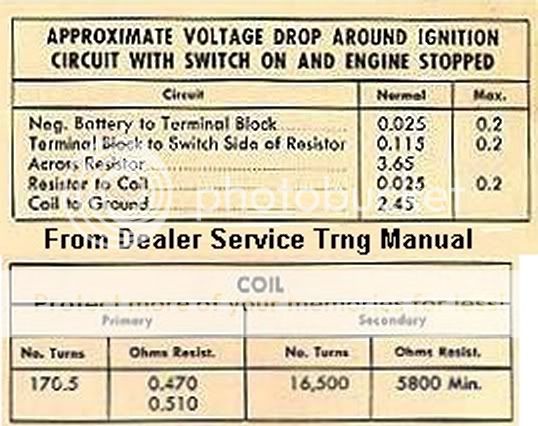
ron8, everybody & his brother out there has a number, but there are few original Ford books or manuals giving a number. Here is one.

For myself, I like to adjust the resistance for 4 amps (the value that matters) and then regardless of whether the coil is 0.5, 0.7, 0.8, 1.0, 1.5, 2.5 ohms (all of which I personally have measured) or any other value, I have the correct current.

As an aside, you will note that depending on which of the coil resistances quoted above exist, the coil voltage will respectively, be 2.0, 2.8, 3.2, 4.0, 6.0, 10.0 volts at 4 amps. So, I don't set coil voltage.

ron8 is setting 4amps for a 1 ohm coil, 2 ohm resistor, at 12volts. This will be 4.8amps when alternator has battery at 14.4v

Dell said "original" coil, which I remember from an older post of his, as 1.2 to 1.4 ohms, so he is setting up for a bit lower current @ ~3amps with the 'extra 2.5 ohm' value. Dependent to some degree on the operating resistance value of the current & temperature dependent 12250 ballast resistor {some where between 0.35 ohms in ice to 1.7 ohms red (literally) hot}.
My point being that I don't feel comfortable relying on the fact that any square can coil I come across is "original" and even if it were "original" there is far from a consensus as to what that coil resistance value is/was.
I am not saying any of these are wrong, just different and will result in different spark energy (spark heat) and coil power dissipation (heat).
So, I choose to set current, independent of the coils resistance.
My choice. You make your own choices.
8nspecs1elect_coil1.jpg
 
Yesterday's Tractor Forums

We sell tractor parts! We have the parts you need to repair your tractor - the right parts. Our low prices and years of research make us your best choice when you need parts. Shop Online Today.

Back
Top
