3 wheel tractor

Anonymous-0

Well-known Member
I need some "edumacation"!!I was watching an antique tractor show the other day and they had a whole slew of tractors. Had some N's and a lot of olderstuff. There was all kinds of the 3 wheeled tractors.I know they are used out in the flatland farming states. Here in southern WV you wouldnt last 15 minutes with one. With that being said what is the reason for that design. Does it have something to do with rows and spacing? I have never operated one but they look like it would be real awkward to run. There must be a reason for the design.
 
I have a single wheel 951.. I don't find it awkward at all ( I live on pancake flat land ).. I find it to be SUPER nimble. I can literally cut the wheel straight over, step on one break pedal, and drive in a closed circle with one tire rotating in place.. Makes it real easy for me to load up my loader bucket with animal feed and then maneuver in REAL close to my animal pens that i would not have dared to with my wide front loader ford tractors.

Soundguy
 
WV8N........in the before days of better farming thru chemistry, weed control was brute force mechanical control. (shovels) Tall tricycles with more horsepower (read John Deere and Farmall) were able to straddle 2-rows of corn or cotton or veggies with center wheel between the rows and were sharper turning. Dangerous on mountainsides. While grain crops didn't see much mechanical weed control, the higher horsepower of alotta trikes allowed pulling bigger 4-bottom plows and wider discs.

Yer 26hp 8N has adjustable width axles that can be widened out to 72-in in 2-in increments and can therefore straddle 2-rows too ...but... is still considered too low for some crops for weeding altho there were dealer installed "stilts" kits available.........Dell
 
The main reason for the row crop tractor tricycle tractor was cultivating. The cultivator was mounted ahead of the rear wheels and you were able to see the rows and tell what you were doing. Small corn was easy to cover up, so fenders were used to potect it from getting covered by the moving dirt. This gave the operator better vision of what was happening than the rear mounts cultivators that came along later. Also a lot of corn was planted with a wire check planter back in the 30's and 40's. This gave rows crossways as well as the direction the planter planted. These cross checks were not a perfect line up of cross rows so the operator had to constantly steer the tractor to avoid cultivating out corn plants. This happened every 2 rows if planted with a 2 row planter. (loved those 4 row planters when they got more popular!) The newer row crop tractors mount the cultivator on the back hitch and a guide rod is used on the front axle to staddle the row and hopefully the cultivator will follow. It was easy for vines to get wrapped between the shanks that staddled the row and wipe out a row of corn until you physically stopped and cut the vines off. This was a big drawback of the rear cultivator. If you turn around to see if it was plowing out a row, you drifted off the row and then you plowed out more. The only safe way was to stop, turn around and check the cultivator then turn around a go again. The old cross cultivate died out in the 50's, mostly because of the introduction of weed spray and that is when the wide front ends started getting more popular. Our beloved "Ns" were a little ahead of their time, but served as both row crop and utility tractors. Farmers loved them for being so handy for the small chores. Proof of that is just looking at how many are still out there!!
 
There were three wheeled (tricycle) tractors, and 4 wheel narrow front (many JD, and Farmall, as well as some other assorted Allis, and Olivers. I have a narrow front Farmall (primary for row cropping and cultivating), but as others said it is very nimble. I can litterally lock one rear wheel at speed, and spin the tractor on a dime (litterally). Many feel they are dangerous, but common sense is the key. I am not afraid to drive mine on a hill at all, however I would not spin it around on the side of a hill. Then again, I would not attempt spinning my 8N on the side of a hill either. They are much safer than people give them credit for, but they were built back when kids rode in the back windows (package tray)of cars too, and no one thought anything of it.
 
Primary purpose for the single wheel front is for very narrow row spacing. Often tomatos, green beans, peas, celery, asparagus carrots etc. In our area they usually had narrower rear tires also. In short for narrow spaced row crops.
 
(quoted from post at 09:45:53 06/09/08) I need some "edumacation"!!I was watching an antique tractor show the other day and they had a whole slew of tractors. Had some N's and a lot of olderstuff. There was all kinds of the 3 wheeled tractors.I know they are used out in the flatland farming states. Here in southern WV you wouldnt last 15 minutes with one. With that being said what is the reason for that design. Does it have something to do with rows and spacing? I have never operated one but they look like it would be real awkward to run. There must be a reason for the design.

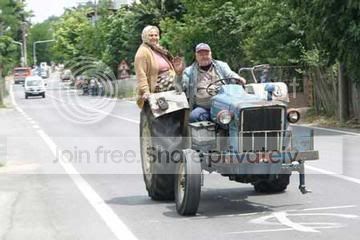
Jack-Illinois gave us a real nice bit of history & I for one appreciate that. However as the photo illustrates, the real reason for the 3 wheel tractor was to give the wife a purpose in life...if she was big enough for the job!


3wheeltractor.jpg
 
"Dangerous on mountain sides", man you got that right, my tricycle Model '60 JD (5300#) and I were plowing snow (so I could drive 25 mi. , then get in a "crummy" and drive another 40 mi. to go loggin')on my driveway at the old farm, when the rear-mount blade hit a 'nubbins' and pushed TWO wheels over the edge (this is a NARROW road with an approx. 60 degree downslope) I had a problem (first was a change of haberdashery) Took me 2 days with a chain block and chains and ropes and anything I could find to 'rock' up a little at the front, then go to the back etc. I forgot to mention, I was getting on the tractor, starting it, putting it in gear, letting in the clutch to gain a foot or so per time. Younger then & no neighbors or help.
 
Yesterday's Tractor Forums

We sell tractor parts! We have the parts you need to repair your tractor - the right parts. Our low prices and years of research make us your best choice when you need parts. Shop Online Today.

Back
Top