Engine Rotation

Anonymous-0

Well-known Member
Some things I just don't pay attention to. The answer's probably obvious, but....

What direction do internal combustian engines usually turn? What is the reason for turning that direction?


Thanks,
Glenn F.
 
(quoted from post at 18:16:45 10/24/11) Some things I just don't pay attention to. The answer's probably obvious, but....

What direction do internal combustian engines usually turn? What is the reason for turning that direction?


Thanks,
Glenn F.
ll do not rotate the same direction. Most auto/truck/tractor engines rotate CW when viewed from front of machine looking toward rear.
Most aircraft, just the opposite (CCW), but some with multiple engines had both CW & CCW on same airplane. Boats with automotive based engines can be found with either rotation. There were a few planes whose crankshaft didn't rotate at all...it was stationary......the propeller was mounted to the engine block and both prop & block rotated. Man's imagination! :roll:
 
Not trying to be a smart A...., but putting it into persective since the propellor also serves as a "flywheel" an aircraft engine turns the same direction relative to its environment as other engines. (I used to play with airboats and snowplanes and some of them used Corvair and VW engines. Prop rotation is the same.)

Areo
 
Hello Gleen F,
Like JMOR said, clock wise looking at the engine front towards the bell housing.
I guess it got started that way and it stayed standard with the rest of the engines.
Also you will find many engines,gas or diesel, with the same firing order Like the 6 cylinders which mostly have 153624 firing order.
Guido.
 
Nearly all automotive engines rotate CW when viewed from the "front" end (end opposite the flywheel).

An old timer once explained CW rotation was chosen in the early days strictly for the convenience of right handed operators while hand-cranking autos, trucks and tractors. Don't know whether this is true - but it does make some sense.

CW rotation continued after the electric self-starter came along, probably because there's no compelling reason to change it.
 
The small Yanmar Diesel engines will run in either direction that you start them. When you order them, you can specify which rotation you want and they install a starter that will spin the engine in the direction that you want.
 
(quoted from post at 18:39:25 10/24/11) Not trying to be a smart A...., but putting it into persective since the propellor also serves as a "flywheel" an aircraft engine turns the same direction relative to its environment as other engines. (I used to play with airboats and snowplanes and some of them used Corvair and VW engines. Prop rotation is the same.)

Areo
ot trying to be a smart a$$, but I did qualify MY answer just in case there was a nit-picker out there.
"...when viewed from front of machine looking toward rear. "
:lol:
 
As JMOR said - A lot of boats with 2 engines will run CW and CCW I was told by an old timmer that it was to reduce vibration. Most older engines could be set up to run CCW.
I have no idea about the newer ones.
 
Round and round. A little bird told me. Sorry, first thing popped into my head. CW looking at front of engine from cranking handle. Dave
 
Jim - Counter rotating props are also used to cancel the torque reaction of twin propellers. Otherwise the torque of a pair of props rotating the same direction can cause boat to list, especially at higher power settings.
 
I remember my neighbor telling me that the big towboats would shut off the engine, then restart them for opposite rotation of the prop. Was supposed to be a minimum "dead time" before restarting, but in a frenzy the dead time was optional. His boat days were 30 years ago, and times change.

I remember a good sized Merc outboard that was also reversed by killing the engine and restarting in the opposite rotation.

And the little antique Briggs engine on my homemade wooden framed go-cart would run either direction, and I still don't see how. I'd wind the rope backwards as a joke when someone wanted to ride it. . .

Paul
 
I had a 80 Merc that was made that way. was called a Direct Reverse Engine. I liked it because I used it water skiing and you could just pull the shift lever in to the engine off position as you went around a someone in the water you were picking up. Worked real well if it was a good running engine. The engine used one starter motor and 2 solenoids like some 12 volt winches do.
 
The engines that have opposed rotation on boats usually have two or more engines that turn the same direction, and use the gear reducer/transmission/outdrive, to reverse direction. They also use a lefthanded prop. This reduces cavitations. Check it out, however, some old ships have reversable engines.
 
(quoted from post at 23:04:04 10/24/11) The engines that have opposed rotation on boats usually have two or more engines that turn the same direction, and use the gear reducer/transmission/outdrive, to reverse direction. They also use a lefthanded prop. This reduces cavitations. Check it out, however, some old ships have reversable engines.
everal Chevy & Ford engines have cams for reverse rotation for use in boats.......depends on drive gear needs.
 
A small block Chrysler and a 327 Chevy have the same firing order, just different rotation on the distributer cap 18436572. Not saying the motor turns the other way
 
I belive the tug diesels had two camshafts. They would disengage one and engage the reverse camshaft.
I don't see how a Briggs engine could run backwards. That's one I would have to see to believe, but I have been wrong before. Same with the Lister diesel, unless they made a two stroke.
 
After thinking about this some more, I think a diesel COULD run backwards, but the exhaust manifold would become the intake manifold and the intake the exhaust manifold. I still don't think a gasoline engine would run backwards. The carburetor would have to be placed on the exhaust manifold.
Like I said, I've been wrong before! ha
I knew a guy that I worked with, he would always say "I was only wrong one time, I thought I was wrong, but it turned out I was right."
 
Any old type 2-cycle engine should be able to run CW or CCW. A Car Talk story/puzzle mentioned there was a ?Saab? that had a 2-cycle engine. The story was to have a reverse race. The guy with the saab somehow bump started it backward. That gave him the full range of "forward" gears in reverse....
 
(quoted from post at 00:05:18 10/25/11) A small block Chrysler and a 327 Chevy have the same firing order, just different rotation on the distributer cap 18436572. Not saying the motor turns the other way

Most FordV8s also had the same firing order, just the cylinders were numbered different.
 
My former company was called in because a self propelled oil platform could not be countroled. They had launched it and it could not do anything but go in circles regardless of what you did with the rudder. It turned out our trouble shooter found that both props were turning the same direction. Reconfigured one engine to reverse rotation, solved the problem.

This is a bigger issue than it would seem.

Cliff(VA)
 
Saab made three cylinder 2 cycle automobiles until the late 1960s.

Back in the days of full service gas stations, I occasionally filled such cars after pouring a can of two cycle oil into the fuel tank.

Dean
 
Rip, I agree with you on the mysterious Briggs engine - I have laid in bed at night thinking about how it could possibly run in reverse rotation. I can't explain it, but I know that I could spin it one rotation and the cart would go forward. Spin it the other way, it would fire right up and the cart would go backward. We discovered it by accident - one of my neighborhood buddies wrapped the rope the wrong way and the engine started. He got on, tightened the belt drive, and it took off backwards. I don't blame you for not believing it would work - nobody else does either, except for the neighborhood kids (now grown) that rode the thing. I wish somebody smart would explain to me how it could run backwards.

Paul
 
(quoted from post at 11:39:45 10/25/11) Rip, I agree with you on the mysterious Briggs engine - I have laid in bed at night thinking about how it could possibly run in reverse rotation. I can't explain it, but I know that I could spin it one rotation and the cart would go forward. Spin it the other way, it would fire right up and the cart would go backward. We discovered it by accident - one of my neighborhood buddies wrapped the rope the wrong way and the engine started. He got on, tightened the belt drive, and it took off backwards. I don't blame you for not believing it would work - nobody else does either, except for the neighborhood kids (now grown) that rode the thing. I wish somebody smart would explain to me how it could run backwards.

Paul
aul, perhaps that little cart engine was a 2 stroke.??
 
"I think a diesel COULD run backwards,"

If you've ever watched a John Deere 2-cylinder diesel get stalled and fire on the rebound, all the while puking the air cleaner oil UP through the intake stack and onto the hood you'd KNOW a diesel can run backwards!
 
More interesting than backwards run!
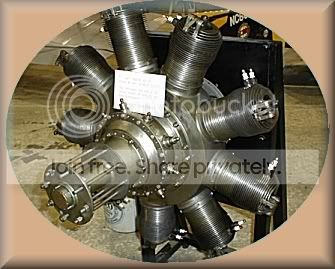
gnome9.jpg


The crankshaft of this type of engine is stationary, with a long and hollow tail shaft of large diameter. The entire radial engine rotates around the crankshaft on four sets of ball bearings. Attaching the engine to the fuselage is accomplished by running the long tail end of the crankshaft through two bulkheads and securing with mounting plates. This engine is a four cycle or four stroke type. The propeller and its hub are mounted solidly to the front cover.

Gasoline and part of the air for combustion is supplied to the engine through the hollow crankshaft. Gnome engines use a spray nozzle to atomize the fuel instead of a carburetor. Then the air and fuel enters the crankcase of the engine where it is thoroughly mixed and blended with the lubricating oil.
 
That is interesting. I wonder if they had trouble keeping the sparkplug wires on, and where would the exhaust pipes hook to? Can you imagine how much time and effort it took to design and build that? A crazy idea, in my opinion. I bet that it had no cooling problem though!
 
You know, it may have been a two stroke, I just assumed that it had normal valves, and I'm fairly certain it was a real early Briggs engine. It had an oil sump in the crankcase, and used straight gasoline for fuel. In my mind I've tried to sort out the mechanical configuration that might allow it to run backwards, and I get horribly confused, then when I dwell on the electrical needs, I just have to give up. I always hesitate to tell anyone that it would run backwards - they never believe me, but I just accept it and go on. I wish I still had the engine. It was primitive - it had a tiny carb with only one plate in it, and it was meant to be a choke (I think) but us kids used it to slow down. Our steering was spooky (clothsline rope wrapped around a broom handle), and high speed was not a priority.
 
I have, in my younger days, sailed on an ex Grimsby [UK] trawler.

This had one diesel engine which drove single propeller to move the vessel forward.

To go in reverse, the engine was stopped, air pressure lifted the push rods and moved the camshaft to enable the push rods to be dropped on the reverse camshaft. The engine was then air started and ran in reverse.
Exciting times when docking!
 
Just lug it down hard enough and it'll turn around and run backwards. Happened in the oil fields a lot back in the day. I think B model Cats are capable of it too. Ran one last summer that if I didn't slip the clutch just right taking off it would knock and have no power til I shut it down and restarted it.

My grandfather used to tell stories about converting marine diesels to use in trucks.
 
Model airplane engines accidentlly start backwards all the time. Sometimes if you idle too low it will stop and restart backwards. Piston will get almost to the top and compression will push it back down, and it will keep running the other way.
 
Early "rotary" engines didn"t have spark plug wires as such- the spark plug end touched a connector buss/flap as the cylinder rotated by the base mounting plate. Exhaust piping?-they just had stub pipe on cylinder and single exhaust valve. Intake valving was a flap valve on top of piston- down stroke of cylinder with closed exhaust meant flap opened and fuel/air/some oil mix from crankcase entered cylinder, mixed with some leftover exhaust and fresh air from reverse flow of open exhaust valve at times. High flywheel affect but rotating cylinders did cool themselves a lot at low speeds and takeoff. throttle control minimal- a start/short idle and full power were main settings and spark kill switch was secondary engine speed control. Fires on runway common at start. Anzani engine as used by Bleriet on first channel crossing had base of cylinder exhaust ports- sort of like inverted linear flow Detroit 2 stroke and spit a bit of oil mix. One point of oil mix- Castor Oil was commonly used and pilots were often wearing what we would consider now a "adult diaper". Pictures of WW1 pilots often have them wearing full hipped calvary pants- big enough for 2 sets underware and a extra pad or "nappy". Engine design may seem wierd - but at the time it was relatively light for the power produced and was servicable, important for early aviation efforts. RN
 
Yesterday's Tractor Forums

We sell tractor parts! We have the parts you need to repair your tractor - the right parts. Our low prices and years of research make us your best choice when you need parts. Shop Online Today.

Back
Top