Head Bolts (Whops----Help)

Boy I hate to admit this but I screw up a head bolt by trying to clean up the threads.I now know what not to do while cleaning up head bolts,1/2" coarse dye does not work very well on fine threads unless you want to take afew off thewn it works great.Now that aside how the heck do I get that little bugger out?Also reading back some I read where guys say there 7/16s yet a 1/2" dye fit on mine are some smaller?
 
Replace all of them..You will mess up big time if you go trying to put that fine thread bolt on the course threaded hole.
 
No thats not it I put a coarse thread dye on to clean up the threads and screwed up the threads on one head bolt.Now I need to figure out how to get that one out and replace it,plus where do I get one
 
(quoted from post at 16:42:11 12/27/09) No thats not it I put a coarse thread dye on to clean up the threads and screwed up the threads on one head bolt.Now I need to figure out how to get that one out and replace it,plus where do I get one

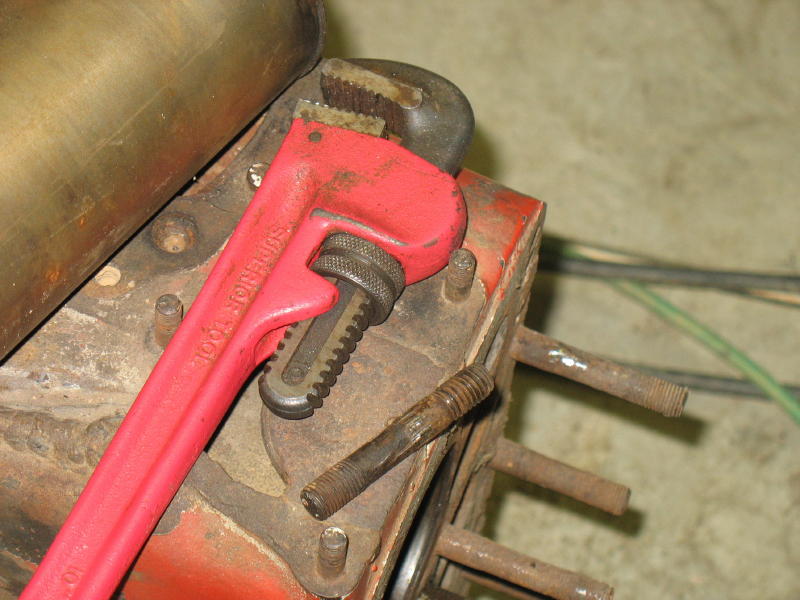
Vice-grips. They can be a bugger to get out sometimes. Unscrew it a bit until it begins to bind. Then tighten a bit to clear the threads and resume unscrewing. Repeat as needed. If you try to brute force it when it binds you'll likely wring it off.

TOH
 
Hi Pete,

If you have a 9N the threads in the block are 7/16" Dia Coarse thread. The original studs were 7/16 DIa with fine threads (7/16-20) one one end and coarse threads (7/16-14) on the other. If you've used a 1/2-13 tap to chase out the threads in the block then what you could do is finish tapping the 1/2"-13 hole and then enlarge the corresponding hole in the head for bolt clearance and use a 1/2"-13 Grade 8 bolt for that hole. the heli-coil drill size for a 7/16-14 thread is 29/64 and the tap that you used is at least 1/2" which is too big for the tap for the helicoil. If I understand the situation
 
use a pair of vise grips to remove the stud. or if u happen to have it a stud remover tool the fits on a 1/2" breaker bar. and take it to ur auto supply. they will most likely hav the size u need. i had to replace one this past summer. 1 stud only cost me $1.50 from napa. beware if u go to the new holland dealer i think they were hirer on the price.
 
(quoted from post at 19:26:39 12/27/09) You need a 7/16 coarse die,It will cut deeper into a 7/16 stud.Loose the 1/2 inch die.A 7/16 coarse nut will work.

[b:fe03d3fe99][color=red:fe03d3fe99]You need a 7/16 coarse die, It will cut deeper into a 7/16 stud[/color:fe03d3fe99][/b:fe03d3fe99]

Yes and it will cut with a different pitch producing a totally screwed up crossed helix thread that I wouldn't trust to hold my pants up. He would be far better off simply running the correct 7/16-20 die over the threads he's already boogered up with the 1/2-13 die.

All to save replacing the $3 stud with a new one :roll: Buy the stud and do it right - hardly rocket science. :idea:

TOH.
 
Take an old 7/16 stud and try it.The fine threads will be gone.This fellow is not going to be able to handle a broken stud.Trying a 1/2 inch die proves that.
 
Yes thats the part I dont understand,everybody is saying I should have 7/16 studs then why would a 1/2" dye even fit,it should have been so sloppy that it would not have cut anything right.The other big mistake qas it was a coarse instead of a fine thread but none trhe lesws it still shouldn't have fit.my other question is what is the chance of me having 1/2" studs in this motor did they ever make them that way
 
(quoted from post at 08:42:50 12/28/09) Take an old 7/16 stud and try it.The fine threads will be gone.This fellow is not going to be able to handle a broken stud.Trying a 1/2 inch die proves that.

The fine threads will not be gone - they will partially obliterated by the new thread and the crest of the new thread will have missing sections where the old thread crosses it. Just for giggles I chucked up a piece of hex in the lathe and cut a length of 7/16-20 on it and then re-cut a longer section with 7/16-14. The difference is quite noticeable and the fit to a 7/16-14 nut is sloppy on the portion with crossed threads. May be fine to you but the thread is is damaged and weakened and would never pass QA in a factory or machine shop. Certainly not something I would want to use for a head bolt. I took a picture but the closeup is too blurry to see the detail. If you require pictoral evidence I'll be happy to provide a digitial blowup of a clearer longer distance image when I get back to my office after New Year. I don't have a decent image editor on my home PC.

I also took the time to remove an original stud from an old 1941 block - here it is along with the high tech stud remover I used - took me all of 2-3 minutes. Slight turn out till it started to bind then back in, repeat about three or four times and the thing unscrewed freely the rest of the way. So simple a caveman could do it.

TOH

Stud.jpg
 
I put a new clutch in my 600.A new battery box was on hand so the solenoid had to come off.the insulation on the battery side was in bad shape.A search of my parts turned up a solenoid that had some poor looking fine threads on the battery side.Tried a new fine thread.it wouldnt tighten.Ran a coarse thread 5/16 die on to the stud.New coarse thread nut tightened up fine.I ve done this to many Ford starter bolts that were stripped.If the head nut would torque up to the proper level I would call it good.You can use a galanized nut and get a tighter fit.If that fellow breaks off a stud he wont be able to handl it
 
A 1/2 inch die has to cut deep to thread 1/2 round stock.Go out and buy a 6in dial caliper ,20 bucks and learn to use it,You can measure the grooves on a 1/2 inch bolt and you will get some answers.You need to do some bookwork before pulling an engine apart.
 
(quoted from post at 20:04:40 01/02/10) A 1/2 inch die has to cut deep to thread 1/2 round stock.Go out and buy a 6in dial caliper ,20 bucks and learn to use it,You can measure the grooves on a 1/2 inch bolt and you will get some answers.You need to do some bookwork before pulling an engine apart.

I was going to refrain from commenting any further on this subject but this last post is just too much. Perhaps you should try a little bookwork as well before disparaging others.

The depth of cut for standard 60* (Unified System) threads used in the US has absolutely nothing to do with the diameter of the stock. It is strictly a function of the thread pitch and I don't need a caliper to find out what it is. A 13 TPI thread on 1/2" stock is the same depth as a 13 TPI thread on 3/8" stock or a 13 TPI thread on 3" stock. It's simple plane geometry based on the 60* unified thread form and the pitch (distance between crests) that determines the depth:

d = p x cos 30 = p x .866 = .866 / TPI = .866 / 13 = .0666

That is approximate as the standard (ANSI B1.7) specifies tolerances suitable for the normal variations in accuracy found in typical thread forming operations and also specifies different limits for three different classes (precision) of fit (1A, 2A, 3A). All designed to ensure that threaded parts interoperate properly.

It's also worth noting that whan a threaded part is to be coated (as in galvanized) the thread is typically over-cut to allow for the deposition of the coating which will bring the thread back into tolerance per the specification and avoid any under or oversize condition.

The tolerances on threads are tightly held to ensure that parts from different manufacturers will mate with the proper clearances and fit. Quality fasteners are QC'd to ensure they stay within the limits prescribed by the standard and engineers rely on threads having proper fit when the do their load calculations. Double cut threads do not have the proper fit, will not pass any reputable QC, and have reduced load capacity. They may be fine for repairing a boogered stud on a starter solenoid in your shop. They are not acceptable for use on head bolts in my shop.

TOH
 
Yesterday's Tractor Forums

We sell tractor parts! We have the parts you need to repair your tractor - the right parts. Our low prices and years of research make us your best choice when you need parts. Shop Online Today.

Back
Top