Installing water temp gauge

Big jake8604

New User
I would like to install a mechanical water temp gauge on my ford diesel tractor how would be the best way to do this also how do I tell what year my tractor is I looked for numbers on and I caint find it anywhere thanks for any help
 
I think I just answered my own question. Since it is a diesel you probably want to run it with the ignition key off to preserve battery power. So a passive capillary tube gauge would be in order. The only remaining question is do you want a limited sweep gauge or a 270 degree sweep gauge.
 
(quoted from post at 23:36:22 05/13/18) Since it is a diesel you probably want to run it with the ignition key off to preserve battery power.

Say what? One should never run a machine with the key off, diesel or no. Although the injection pump and actual running of the engine may or may not depend on it, things like the charging system and some monitoring devices likely do!
 
Sounds like you know close to nothing about your tractor.

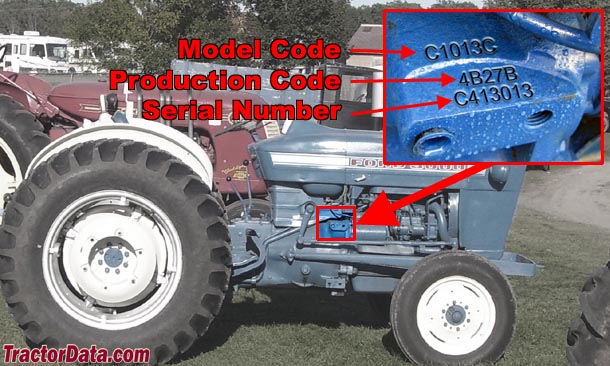
Since it is a diesel, the identifying numbers should be stamped into a flat spot a few inches above and a few inches toward the rear of the tractor from the starter. On the earlier models (pre-a965) the starter is on the left side and on the later models (1965+) it is on the right side.

Early number location:

1666-td3serial.jpg


Later number location:

259-td3serial.jpg


If it is a later one, then the numbers might also be on a foil sticker on the under side of the right side hood panel, above the battery.


It's a ford 4110 and it is a later model tractor because the starter is on the right hand side but there's nothing on the hood, and also someone told me to hook up the water temp gauge to the manifold, is that correct?
 
The 3 cylinder 4110 LCG model was part of the 3 cylinder 4000 series and was made from 1965-1975. If it has a wraparound lower grill and louvers on the sides of the hood then it was made from 1965 through 3/31/1968, and if it has the inset grill and smooth hood sides then it was made from 4/1/68 onward. Look at the second picture that I posted to see where the stamped numbers should be to identify the exact date of final assembly.

The original location for the electrical temperature sender is in the front of the head near the water pump. If you can find a mechanical gauge that will fit the same threads you could mount it there. If you want to keep the electrical sender and add an additional mechanical gauge, my recommendation would be to get an in-line adapter that goes in between the thermostat and the radiator in line with the upper radiator hose. Just google "in line temperature gauge adapter".
 
The only problem with the adapter that you suggest is that it would not read anything before the t-stat opens up. That, and I would question
the accuracy of any gauge plumbed in that location.
 
The factory temp sending unit is 1/8" NPT thread. The smallest adapter you can get for a mechanical gauge is 1/4" NPT thread. If it was mine,
I would drill and tap the side of the intake manifold for 3/8" NPT thread if there's not already one in the rear. Later tractors did have one
there for a cab heater valve port.
 
Yes, sometimes people run their diesels with the switch off when their alternator/ generators is not working right. Normally I run mine with the aux on, but some think that a capillary temp gauge working without power is better than a tractor with no gauges in a situation where there is no time to fix the gen/alternator. The same applies to an electric oil pressure gauge versus a copper/plastic pressure gauge with a bourdon tube.

I am talking about older tractors here not the newer ones that have to have the ignition switch on whenever the tractor is run.
 
Both my coolant temp, fuel, and oil pressure are electric, but there have been times where the battery was failing or the alternator was gone and I switched to off. I would turn it on every 5-10 minutes for a few seconds to check the gauges. Just an expediency for me. My uncle's 800 series? would not keep alternators so he would charge it up overnight and run it during the day just on the battery. Not a good way to do things long term.
 
I think my tractor does have a spot in the manifold I can't see it but I can feel it on the back side of it but I don't think any of my sensors work or at least I know the fuel sensor don't work when I ran it out of fuel last year
 
The coolant temperature sensor on a 3 cylinder 201 engine is located on the front part of the head. Looking from the right of the engine you should be able to see it about an inch down from the top of the head.
 
I found where the serial number and everything is but it's cover with paint the only thing I could make out is the letter D I guess I'll have to get a wire brush or something thanks for the help on that I'll let you know how the water temp gauge goes
 
As Sean said the 4110 is part of the 4000 series. It normally comes with an instrument cluster. If the cluster is intact (doubtful unless it was garage kept and only driven around the block by a little old lady on Sundays) it came with an electric temperature gauge and is not adaptable to a capillary gauge. You have to remotely mount the temperature gauge if you intend on keeping the factory instrument type cluster/dash. I don't know if any 4000 series clusters came with mechanical sensors/gauges with the exception of the tachometer which is mechanical. Oil pressure was/is an idiot light. I think the highway tractor had a speedometer instead of a tachometer. There may be exceptions.

Do you intend on keeping or replacing the instrument cluster or replacing it with an empty dash/panel with cutouts for individual gauges?
The individual panel with separate gauges is the way to go if you intend on using mechanical sensors. No matter what fuse it with a fuse block or inline blade fuses for any electricals. I have see too many burned tractors/salvage tractors at auctions or on Craig's list. Well, at least percentage wise compared to cars.
 
Yes I do plan on keeping it I'm just wanting a water temp gauge so I know if it's over heating when I'm using it this summer and one other question I went out there yesterday to check all the fluids since I haven't started it in a month when I popped the radiator cap there was pressure built up in there I think the cap ain't letting it release pressure through the small hose underneath the cap would that be it or something else
 
If the temp gauge is intact all that is necessary is to connect the sensor to the gauge. A word of caution. The original ford gauges on these clusters operate with a bitmetallic thermal heater wire. The more current flowing into the gauge the warmer the wire wrapped around one arm of the gauge gets. There is a little match box size voltage stabilizer that often has rusted or burned up. This little box is a vibrating contact set that keeps the voltage correct for the gauges. Ford used this approach for gauges a long time and on a lot of vehicles. My old 1973 Toyota Corolla had a similar set up.

Your instrument cluster might be a replacement considering its age. The aftermarket replacement instrument does not operate the same way as the original Ford units. These units use D'arsonval gauges which are voltage operated and do not require the voltage stabilizer. There may even be a little box on the back of the instrument cluster that looks identical to the voltage stabilizer on the OEM.

There is nothing inside the little box except a pair of contact posts with a bridge of soldered wire between the two.
It keeps the appearance of the original. If well made these after market units may outlast the originals. They might be more accurate if properly calibrated.

If the cluster gauges on the tractor do not work you may have to go to an auto parts or tractor parts store and get a remote mount 2 or 2-1/4 round gauge and sensor.
Before you install the gauge and sensor you need to externally run a wire and ground to the gauge and sensor. Power it with 12 volts and jumper clips and immerse the sensor in a cup of boiling water.This will tell you if you have the correct meter sender combination or if the sender is operating properly.

The senders vary. The one in the tractor may work or not. That is why you need to check the calibration. There are all kinds of ways of forcing a sender/ meter match, but it is not the kind of work you want to do now unless you understand solid state electronics. It can also be time consuming unless you enjoy doing this kind of kludging like me. Better to just go out and buy a meter/ sender rather than spending 25-100 time/money equivalent reinventing the wheel. Besides you don't need that kind of accuracy.

You may actually find an aftermarket gauge that is made to match the original sender on the tractor. Still needs to be checked regardless.

YT sells the sensor/ senders here and probably a matching gauge.

DL
 
I just checked. Most of the Ford individual temperature gauges YT sells are mechanical and require a little care running the capillary wire. If you kink it during installation you are screwed and have to buy a new one. They are simpler than the electric gauges, but usually not adjustable.

DL
 
Ok thanks and could you help me I still caint make out the top number but the middle number is 5c11b and the bottom number is c448947
 
That is an area I am not as good at. There are others here on the forum who are far more experienced in finding this particular information.
 
This is my crude attempt to decipher the AN description

Production code: 5C11b:

Made on March 11, 1965 Day shift

This tractor was made on a Thursday. You really don't want it. Send it to me as salvage. lol

We can derive some of the first line.

It is diesel right?

This has the standard 8 speed transmission correct?
It is the lcg model right

C111(pto type?) C. The pto type will either be 2,3,4,5, or 6 and The last C assumes you have the eight speed transmission.
So the first line could be C1113C?

Your 3rd line is the serial number
 
(quoted from post at 16:18:32 05/15/18) This is my crude attempt to decipher the AN description

Production code: 5C11b:

Made on March 11, 1965 Day shift

This tractor was made on a Thursday. You really don't want it. Send it to me as salvage. lol

We can derive some of the first line.

It is diesel right?

This has the standard 8 speed transmission correct?
It is the lcg model right

C111(pto type?) C. The pto type will either be 2,3,4,5, or 6 and The last C assumes you have the eight speed transmission.
So the first line could be C1113C?

Your 3rd line is the serial number
yes it is a diesel and yes it has a 8 speed transmission it has 6 forward gears and 2 reverse thanks
 
If your 4110 has the standard 8 speed transmission then that last letter should be a C. If you find 6 forward speeds then you are missing a forward gear. There should be three forward gears with the stick in the forward direction and one forward and one reverse in the rear direction. 8 forward 2 reverse.


I am not clear on this, but the industrial 4110 had the option for an independent pto, but was listed as available on the powershift which had 10 forward speeds and 2 reverse. Shuttle and powershift are not in my knowledge base.

If it does have an independent pto it should be a 4 or higher.
There is listed a K transmission that had 6 forward and 4 manual reverse.
 
I'll be damn I just checked your right it is a 8 speed iv owned this thing for 2 or 3 years I just thought it was a 6 speed I guess where the reverse is I thought the reverse is as far over as it goes like my jeep is but now I feel stupid lol thanks
 
And like I said I know the top number says d111 but I think it says 4c but I'm not certain on that cause there's so much paint I caint hardly make it out
 
"In the land of the blind the one-eyed man is king." That's what the forum is for. Of course there are members who have probably had good laughs at some of my blind spots.

I am happy to have increased your knowledge and your range of gears. I was not sure myself as I am ignorant of 4110 transmissions.
 

Should be D1113C for your 4110
D = 4000 series with the 201 ci engine
11 = Low Center of Gravity
1 = diesel engine
3 = live 540 pto
C = 8x2 trans

Even though the 4110 is listed as a 4000 series because of it's 201 engine it has the same rear axle with drum brakes like a 3000, thus the reason for the live pto instead of ind pto.
Just to make sure does you tractor have the hydraulic pump mounted on the left side of the tractor near the rear of the engine.
 
This is my crude attempt to decipher the AN description

Production code: 5C11b:

Made on March 11, 1965 Day shift

Not quite. It was made on March 11 of a year ending in a 5, but the serial number C448947 is a much later serial number. Most internet sources would tell you that is a late 1974 serial number, but the internet isn't always perfect, so my guess would be that it is actually an early 1975 serial number so it was made on March 11, 1975.

I am not clear on this, but the industrial 4110 had the option for an independent pto, but was listed as available on the powershift which had 10 forward speeds and 2 reverse. Shuttle and powershift are not in my knowledge base.

The 4110 had the rear axle with the outboard dry brakes and single reduction gears like the 2000/3000 series, and so the only independent PTO available was if it had the Select-O-Speed(10 speed powershift) transmission. The only non-S-O-S tractors available with independent PTO during that time period were the ones with the rear axles that had the inboard wet brakes and double reduction gears like the standard 4000 and 5000 ag chassis models.

D1114C would be a 4110 with diesel engine, independent PTO and an 8 speed transmission, but if it's truly a 4110 with an 8 speed then it couldn't have independent PTO. Can you post a picture of the rear axle?

 
(quoted from post at 06:28:45 05/16/18)
This is my crude attempt to decipher the AN description

Production code: 5C11b:

Made on March 11, 1965 Day shift

Not quite. It was made on March 11 of a year ending in a 5, but the serial number C448947 is a much later serial number. Most internet sources would tell you that is a late 1974 serial number, but the internet isn't always perfect, so my guess would be that it is actually an early 1975 serial number so it was made on March 11, 1975.

I am not clear on this, but the industrial 4110 had the option for an independent pto, but was listed as available on the powershift which had 10 forward speeds and 2 reverse. Shuttle and powershift are not in my knowledge base.

The 4110 had the rear axle with the outboard dry brakes and single reduction gears like the 2000/3000 series, and so the only independent PTO available was if it had the Select-O-Speed(10 speed powershift) transmission. The only non-S-O-S tractors available with independent PTO during that time period were the ones with the rear axles that had the inboard wet brakes and double reduction gears like the standard 4000 and 5000 ag chassis models.

D1114C would be a 4110 with diesel engine, independent PTO and an 8 speed transmission, but if it's truly a 4110 with an 8 speed then it couldn't have independent PTO. Can you post a picture of the rear axle?

yes when I get home this evening I sure will
 
Yesterday's Tractor Forums

We sell tractor parts! We have the parts you need to repair your tractor - the right parts. Our low prices and years of research make us your best choice when you need parts. Shop Online Today.

Back
Top