

You should upgrade or use an alternative browser.


TheOldHokie
Well-known Member
- Location
- Myersville, MD 21773
(quoted from post at 08:29:12 05/05/12)
I have a 1951 8n and I finished rebuilding it. My oil pressure gauge goes up to 50 and that is where it is pinned even at idol. The farmer down the road said that might be concerning. What should the pressure be at idol and when under load?
Hot oil pressure on a good tight rebult engine would be 30+ PSI at idle and 40+ PSI at 1500 RPM. Sounds like you have a defective gauge. If the gauge is good then check the pressure relief valve in the front of the timing cover.
TOH
TheOldHokie
Well-known Member
- Location
- Myersville, MD 21773
(quoted from post at 16:47:29 05/05/12) Thanks for the info. I will keep an eye on the pressure gauge as the engine warms up. So if they are supposed to be limited to 35psi what could be wrong with my setup? Does that mean my pressure relief spring inside the BIG nut is bad?
The limit is not 35 PSI - probably closer to 50 and it doesn't matter hot or cold - no pressure greater than the limit anytime. And yes the spring and plunger would be the culprit if it is not working. My 8N makes about 45+ when cold (no idea if that is the limit setting or just the max it can make) and settles in to a good solid 35+ when hot and working.
TOH
Anonymous-0
Well-known Member
With car motors, my experience has shown that at idle, one only needs a couple of psi oil pressure, if that. I once took a Type IV VW motor apart, 1500 mi. after I rebuilt it, because the oil pressure light would flicker when it got hot. It dropped from ~20+ psi cold to ~1-2 psi hot, by the vdo gauge. It also dropped from ~50 psi cold to 20 hot at 3000+ rpm. Contrary to what I expected to find, all the bearings were still in perfect (new) shape!! It turned out the case main bores were distorted, which I knew beforehand, but I was trying to slide by. A different case corrected the problem.
As the rpm's come up, I believe as little as 10-20 psi may work. Too high a pressure uses extra energy, and (depending on bearing clearances, cylinder wall finish, and ring tension) will blow excessive oil onto the cylinder walls and lead to oil consumption from "ring float" on the thick oil film.
For a historical reference, splash lubrication worked ok for years, until the rpm's and internal forces got high enough to throw/force enough oil from the journals that they would lose their lubricating film (2000+ rpm).
BTW, I also found that thinner 10-40 oil worked better than the recommended 20-50 oils in the VW Van. (Even when it was "hotter n' hell", ~240 degrees.)
I wish you good luck. It's just my 2 cents....
TheOldHokie
Well-known Member
- Location
- Myersville, MD 21773
(quoted from post at 00:44:53 05/06/12) I don't know that much about tractor motors. I just got back from a Tractor Show in Oregon House, Ca.. I had a great time, and hence my interest.
With car motors, my experience has shown that at idle, one only needs a couple of psi oil pressure, if that. I once took a Type IV VW motor apart, 1500 mi. after I rebuilt it, because the oil pressure light would flicker when it got hot. It dropped from ~20+ psi cold to ~1-2 psi hot, by the vdo gauge. It also dropped from ~50 psi cold to 20 hot at 3000+ rpm. Contrary to what I expected to find, all the bearings were still in perfect (new) shape!! It turned out the case main bores were distorted, which I knew beforehand, but I was trying to slide by. A different case corrected the problem.
As the rpm's come up, I believe as little as 10-20 psi may work. Too high a pressure uses extra energy, and (depending on bearing clearances, cylinder wall finish, and ring tension) will blow excessive oil onto the cylinder walls and lead to oil consumption from "ring float" on the thick oil film.
For a historical reference, splash lubrication worked ok for years, until the rpm's and internal forces got high enough to throw/force enough oil from the journals that they would lose their lubricating film (2000+ rpm).
BTW, I also found that thinner 10-40 oil worked better than the recommended 20-50 oils in the VW Van. (Even when it was "hotter n' hell", ~240 degrees.)
I wish you good luck. It's just my 2 cents....
Here's my $.02 worth. As a physicist wannabe I always wondered how 30 PSI oil pressure could keep the crank centered in the bearing shell if it is the same all the way around. The anwer is it can't and system oil pressure as measured by the gauge is NOT what maintains that oil film - splash lubed engines are a perfect example of that. System oil pressure could be 1000 PSI and it wouldn't keep the crank clear of the bearing shells - it would stay on the the bottom just as it would if you placed it in a pressure vessel filled with 1000 PSI oil. It would sink to the bottom because the pressure is the same on all sides and it doesn't "float" in oil.
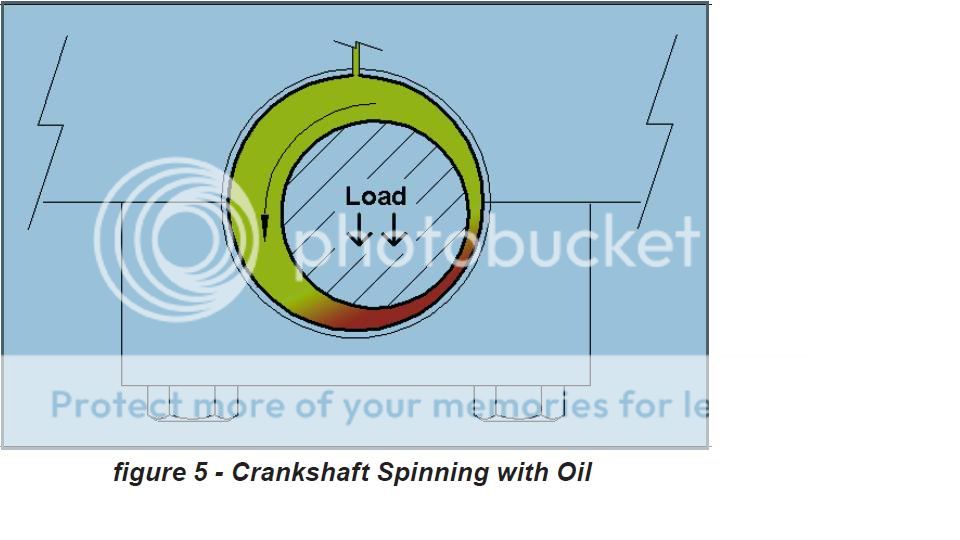
You need a pressure [b:5f7975fa3e]differential[/b:5f7975fa3e] INSIDE the bearing shell to push the crank up off the bearing. An IC engine relies on a phenomenon called hydrodynamic lubrication which is produced by the spinning of the crankshaft inside the bearing shell and is a function of oil viscosity, adhesion, engine RPM, and bearing clearance. As shown in the picture below the adhesion of the oil to the spinning crank pulls the oil inside the bearing shell down into the contact area with the bearing. This creates a localized region of high pressure oil inside the bearing shell (the area shown in red) which acts to force the crankshaft up and to the right in the picture. This hydrodynamic wedge of oil [b:5f7975fa3e]flows[/b:5f7975fa3e] between the crank and the bearing and is the oil film that protects the bearings. The magnitude of the hydrodynamic effect can be on the order of several thousand PSI inside a running engine and is a function of:
- [*:5f7975fa3e]Oil viscosity - the higher the viscosity the more force generated[*:5f7975fa3e]Bearing clearnce - the smaller the clearance the more force generated [*:5f7975fa3e]Adhesion characteristics of the oil - the more adhesive it is the greater the force generated[*:5f7975fa3e]Engine RPM - the greater the speed of rotation the more force generated.[/list
 :5f7975fa3e]System oil pressure as measured by the gauge is simply an indirect indicator of those conditions inside the engine. We "know" that historically 30 PSI is a good indication that the clearances are "normal" and things are working as they should. When the pressure drops to 5 PSI it's an indication the clearances have widened and the engine is loosing it's abilty to form that hydraulic ram. And without that hydrodynamic assist we start getting metal to metal contact especially at low RPMs on a hot heavily loaded engine.
TOH
Jerry Kirkpatrick
Member
(quoted from post at 09:33:28 05/06/12)(quoted from post at 00:44:53 05/06/12) I don't know that much about tractor motors. I just got back from a Tractor Show in Oregon House, Ca.. I had a great time, and hence my interest.
With car motors, my experience has shown that at idle, one only needs a couple of psi oil pressure, if that. I once took a Type IV VW motor apart, 1500 mi. after I rebuilt it, because the oil pressure light would flicker when it got hot. It dropped from ~20+ psi cold to ~1-2 psi hot, by the vdo gauge. It also dropped from ~50 psi cold to 20 hot at 3000+ rpm. Contrary to what I expected to find, all the bearings were still in perfect (new) shape!! It turned out the case main bores were distorted, which I knew beforehand, but I was trying to slide by. A different case corrected the problem.
As the rpm's come up, I believe as little as 10-20 psi may work. Too high a pressure uses extra energy, and (depending on bearing clearances, cylinder wall finish, and ring tension) will blow excessive oil onto the cylinder walls and lead to oil consumption from "ring float" on the thick oil film.
For a historical reference, splash lubrication worked ok for years, until the rpm's and internal forces got high enough to throw/force enough oil from the journals that they would lose their lubricating film (2000+ rpm).
BTW, I also found that thinner 10-40 oil worked better than the recommended 20-50 oils in the VW Van. (Even when it was "hotter n' hell", ~240 degrees.)
I wish you good luck. It's just my 2 cents....
Here's my $.02 worth. As a physicist wannabe I always wondered how 30 PSI oil pressure could keep the crank centered in the bearing shell if it is the same all the way around. The anwer is it can't and system oil pressure as measured by the gauge is NOT what maintains that oil film - splash lubed engines are a perfect example of that. System oil pressure could be 1000 PSI and it wouldn't keep the crank clear of the bearing shells - it would stay on the the bottom just as it would if you placed it in a pressure vessel filled with 1000 PSI oil. It would sink to the bottom because the pressure is the same on all sides and it doesn't "float" in oil.
You need a pressure [b:2ef338e3dc]differential[/b:2ef338e3dc] INSIDE the bearing shell to push the crank up off the bearing. An IC engine relies on a phenomenon called hydrodynamic lubrication which is produced by the spinning of the crankshaft inside the bearing shell and is a function of oil viscosity, adhesion, engine RPM, and bearing clearance. As shown in the picture below the adhesion of the oil to the spinning crank pulls the oil inside the bearing shell down into the contact area with the bearing. This creates a localized region of high pressure oil inside the bearing shell (the area shown in red) which acts to force the crankshaft up and to the right in the picture. This hydrodynamic wedge of oil [b:2ef338e3dc]flows[/b:2ef338e3dc] between the crank and the bearing and is the oil film that protects the bearings. The magnitude of the hydrodynamic effect can be on the order of several thousand PSI inside a running engine and is a function of:
- [*:2ef338e3dc]Oil viscosity - the higher the viscosity the more force generated[*:2ef338e3dc]Bearing clearnce - the smaller the clearance the more force generated [*:2ef338e3dc]Adhesion characteristics of the oil - the more adhesive it is the greater the force generated[*:2ef338e3dc]Engine RPM - the greater the speed of rotation the more force generated.[/list
TOH
Well thought out and well-stated. Thanks from one who can't play the piano but appreciates good music when he hears it.
JK
Similar threads

We sell tractor parts! We have the parts you need to repair your tractor - the right parts. Our low prices and years of research make us your best choice when you need parts. Shop Online Today.
Copyright © 1997-2025 Yesterday's Tractor Co.
All Rights Reserved. Reproduction of any part of this website, including design and content, without written permission is strictly prohibited. Trade Marks and Trade Names contained and used in this Website are those of others, and are used in this Website in a descriptive sense to refer to the products of others. Use of this Web site constitutes acceptance of our User Agreement and Privacy Policy TRADEMARK DISCLAIMER: Tradenames and Trademarks referred to within Yesterday's Tractor Co. products and within the Yesterday's Tractor Co. websites are the property of their respective trademark holders. None of these trademark holders are affiliated with Yesterday's Tractor Co., our products, or our website nor are we sponsored by them. John Deere and its logos are the registered trademarks of the John Deere Corporation. Agco, Agco Allis, White, Massey Ferguson and their logos are the registered trademarks of AGCO Corporation. Case, Case-IH, Farmall, International Harvester, New Holland and their logos are registered trademarks of CNH Global N.V.
Yesterday's Tractors - Antique Tractor Headquarters
Website Accessibility Policy