Hate to beat a dead horse, but there is some terrible misinformation here.
If you try to make the plow pull straight by adjusting the hitch, you will make the tractor impossible to steer, as BushogPapa mentioned. You have worn landsides or the tail wheel needs adjusting, or both. If your landsides are steel, just weld some junk on them to build them up. Its a good chance you made the problem worse by putting on new shares, as the new share cuts wider than the landside. Waiting for the moldboards to scour won't magically fix this problem.
Once the plow pulls straight, the front furrow slice will fill in better and you can set coulters and get other things tuned in.
I don't see anything wrong with your wheel spacing, it can be made to work as is.
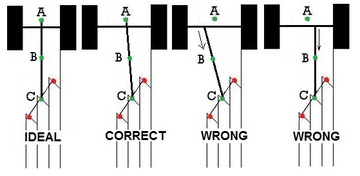
See the attached image. "Line of Draft" is set by the point of pull on the plow, point C, and the plow hitch, Point B. Point A is the point of pull, as the operator's manuals say. Point A is really the dynamic center of gravity of the tractor. You want to equalize the moment, or torque, around the Dyn. COG so the tractor can move forward without something trying to rotate it. You want Points B and C to line with A, which does not create torque around the Dyn COG. When you don't do this, you create a torque and the front of the tractor pulls to one side or the other.
My suggestion- don't get caught up running strings and putting things on blocks. Get in the field, and adjust the plow hitch and tractor hitch side to side to make the tractor steer neutral and make the front bottom cut the correct width-at the same time. Easy! :lol:
What else....Depth is set by the hydraulic cylinder. Tail wheel vertical adjustment rolls the plow forward or back. Lowering the tail wheel turns the points down and creates suck but it also raises the tails of the moldboards. Raising the tail wheel has the opposite effect.
It is my policy, which is echoed by every plow manual, is to run the plow vertical hitch adjustment as low as possible, and then adjust the tractor hitch to create the correct line of draft. When you run your tractor hitch in the down position as BushogPapa suggests, you should be good. If you feel the need to plow a foot deep and the plow hitch drags on the ground, that is the only reason to ever raise the hitch.
In a nutshell, the angle of the hitch (when viewed from the side) determines the balance of the reaction forces between the front wheels and the tail wheel. A plow hitch too flat, shifts the reaction force away from the tail wheel and onto the front wheels, making the rear of the plow bob up and down(unstable). A plow hitch too steep shifts the reaction force from the front wheels onto the tail wheel. I err to this side because the plow will run stable until there is zero force on the front wheels. At which time, the plow will still be stable, but it will begin to shallow up evenly (stable is better than unstable). If you want more details and diagrams, I [i:b2a6b797cf]can[/i:b2a6b797cf] defend this info.
And back to the tail wheel: if your vertical hitch adjustment is off, the tail wheel will flop around and adjusting it will accomplish nothing.
I encourage cleaning rust off before going to the field. And, I like to go further and get the black layer off also. Soil sticks to the black layer for me, and it just takes that much longer to wear off the black layer until you can start polishing the good steel underneath it.
I think that's it.
John