


Root Rake in Action (with pictures)

charles todd

Well-known Member
For those that have seen the pictures of my "Root Rake", these are the pictures of it in action. For those whom have not seen it there are pictures a few pages back. 50 HP (42 HP drawbar) is adequate for 7' rake. I feel the hydraulic top link makes the rake just that much more useful. When trash hangs up in the rake the added pitch from the HTL will usually dislodge it.

[b:44039570dd]Loaded Rake[/b:44039570dd]

CIMG3090.jpg


[b:44039570dd]Loaded Rake[/b:44039570dd]
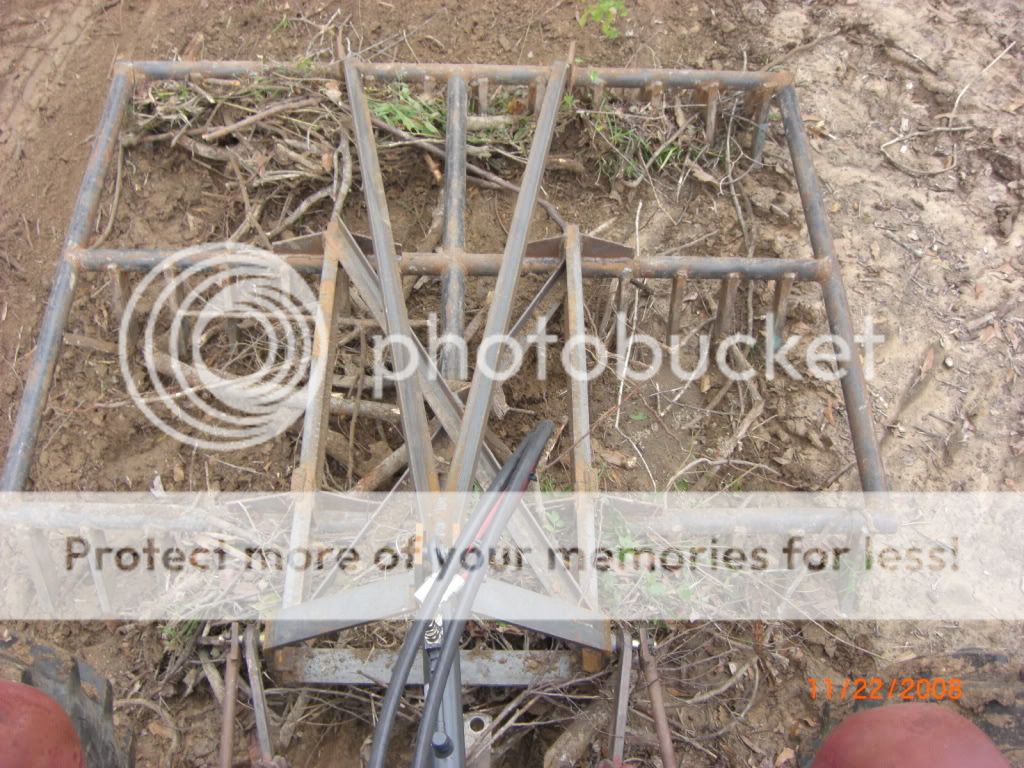
CIMG3092.jpg


[b:44039570dd]Two passes[/b:44039570dd]

CIMG3091.jpg


[b:44039570dd]Small Tree in Rake[/b:44039570dd]
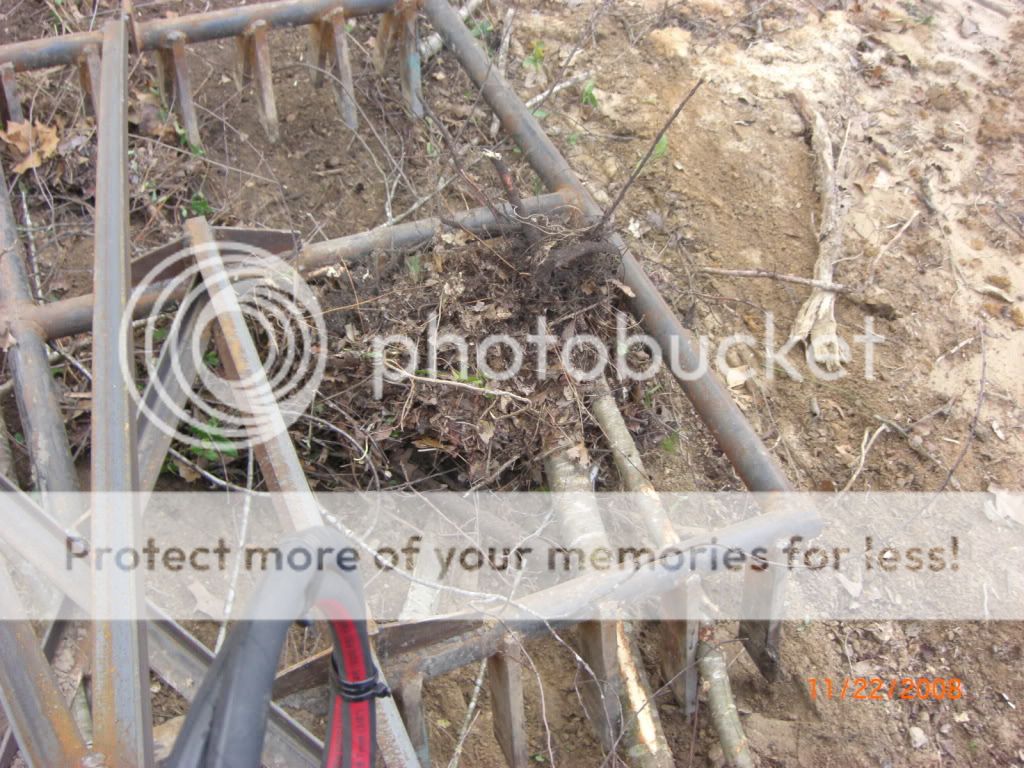
CIMG3087.jpg


[b:44039570dd]Tree that was in rake, I pulled it up by the roots[/b:44039570dd]

CIMG3088.jpg


[b:44039570dd]WindRows[/b:44039570dd]

CIMG3093.jpg


[b:44039570dd]More WindRows[/b:44039570dd]

CIMG3094.jpg


[b:44039570dd]King of the Pile![/b:44039570dd]
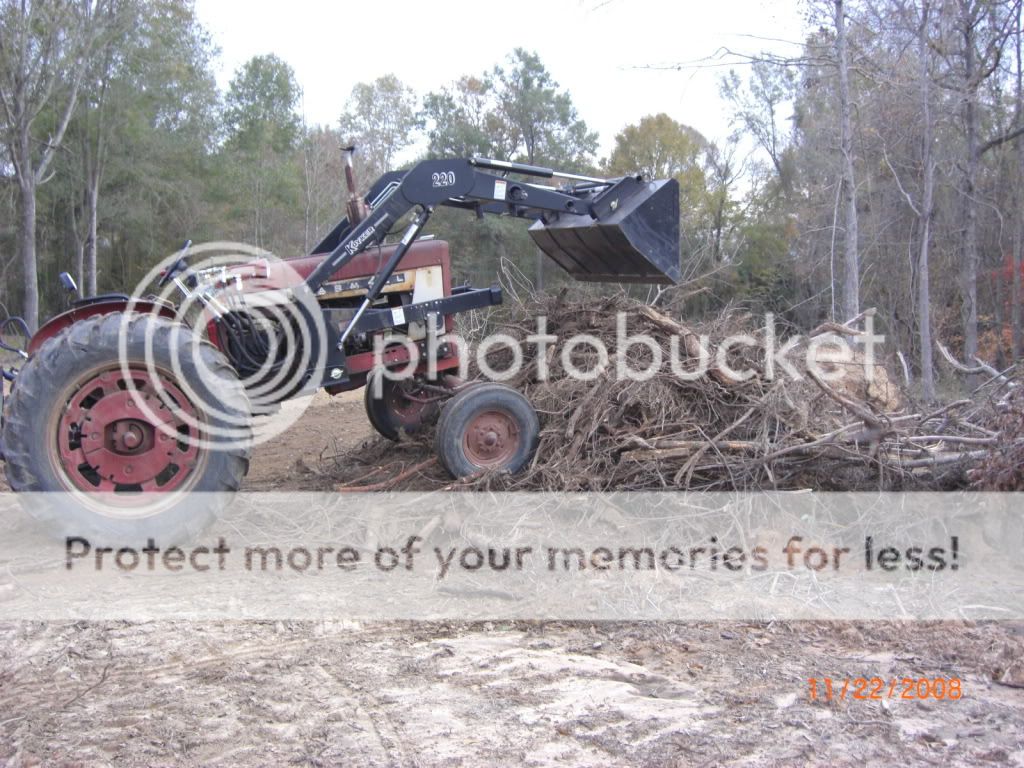
CIMG3095.jpg


[b:44039570dd]Cleaned Area: I love this Rake![/b:44039570dd]

CIMG3096.jpg


Sorry for posting so many pictures, I am just excited about the land clearing, building the rake, CMM hydraulic top link, and cleaning up 50 acres of land!

Enjoy,

Charles
 
Nice looking rake, and well done job. Do you live near Elmer LA or have relatives from there? If so, please contact me. I have my email open.
 
Charles: I take it you are planning to put this land into a grass sod? Your also in an area where frost is not an issue.

Any land I have cleared was for grain, forage, corn or potatoes, in an area where frost each winter keeps heaving up left behind roots up to the surface. Our goal is to remove every root 12" deep in the soil. Everyone who has had the misfortune of getting a 4' long root, 1" in diameter tangled up in a combine, stalk rolls of a corn head or potato harvesting equipment will understand what I'm saying. Not only can these roots cost one a lot of lost time, but the damage they can do to harvesting equipment is prohibitive.

Having said this, I judged your rake as I would use it, rather than just cleaning off the 20% of roots within 3" of the surface. If you don't plow it again for 20 years, and given the fact you don't have frost in LA, the rake will be a success. I still say if one of those teeth snag a stump 2" below the surface, the 504, has the ability to rip a section of pipe wall around tooth, right out. Believe me, I know the ability of that size tractor.
 
Looks like it's going to work dandy for your conditions. Didn't see any rocks in the pictures of course. It would last about 10 minutes here.
 
Looks like a neat fabrication job, and for those conditions it did a nice job. Must not have engaged the ground too aggressively, all stumps must have been out first too, as I can see where hooking onto a substantial root or small stump would stop the tractor, as I've had that happen working areas I've cleared, tractor stops and you lose traction. Interesting to see how things like this, something you've fabricated yourself, actually perform, a lot of these implements/attachments started out that way, then trial and error, until the design holds up to the conditions, and even then, site conditions and methods used can still cause problems.

What Hugh mentioned is interesting too, when putting land that has been cleared, back into crops, never thought to be aware of roots coming up like that once broken up with a rake. I suppose one would have to clear and work the ground a bit, a season or 2, see what comes up.


We used to use Fleco root rakes on D8K Caterpillars, after a feller buncher/tub grinder was on site, and the stumps removed, prior to scrapers removing top soil, we would run these heavy root rakes on the site, and pile up all the roots, and as heavy as these were, you could take some small stumps, and rip through some heavy roots, but an abusive operator could "bugger" one up just the same. Nice to have down pressure too, but you have to remember that when using these, no doubt

3af3_121.jpg
 
glad its working for you...nice job btw

your earlier description on intended use as a root plow is what i was concerned about...keep using it as you are and it'll be ok.
 
yall must have some loose soil up there to push that rake with a wheel loader...has to be tracked in my neck of tha woods or the clay will stop ya about 6" deep.
 
Thanks again for the replies. It was built for the soil conditions and matched to the tractor. I'm not sure what Hugh ment by "20% of the roots 3" deep"? After I make two passes at right angles to each other it pulls almost ALL the roots and trash out.What little roots are left poking up will get bush hogged down by next year.

I respect Hugh, he has been farming for about 80 years and has a lot of good experience. If I am not mistaken he has owned a 504 gas before. I have my 504D loaded about 90% pure water (No freeze threat...) in 14.9"x38's. The rake can stop it cold in its tracks when it connects. I am running 1st and 2nd gear DD. I can set the draft control to heavy and bury the rake or set it a little lighter to scratch a few inches deep. The HTL is AWSOME! I feel this implement would have been a near disaster without the HTL.

To CRUSADER, yes I am from Elmer, LA. You do not have an email because you are logged in as a "guest". You can send me an email though.
 
Bill: Those root rakes on big dozers leave a lot behind. I used to do cleanup work behind buldozers. We used chisel plows to loosen soil and roots, then we followed that with a Dika root windrower. This windrower was built much like a rock rake, except the drum was 4' in diameter and 20' long with 14" teeth made from 1x4 plate with a brace behind the tooth. the drum was driven by a Staffa 5 cylinder hydraulic motor driven from a pump on 1,000 PTO of 125 hp tractor. Yes, I've seen this machine kill the engine on a 1066 cranking 150 hp. We did a fuel comsumption test one day, Cat D7G rooting stumps, articulated Deere on chisel plow and 1066 on this root windrower. I forget the exact figures but 1066 was about 20% higher than either of other two. I've seen this root windrower toss a rock, (at least 4 cubic feet is size) 15'. It cost $21. per hour to keep the teeth maintained on this rake, back in 1978. Sandy loams with no rock were the worst.

We used to run this machine behind 1066, 24 hour days. Mobile fuel tank in the field. One of the quickest things I ever saw kill the 1066, operator was running at night, picked up 100' of wire sheep fencing. The rake had bar along top of drum, with stripper plates. Happened at 2 AM and when replacement operator showed up at 7 AM the night guy was still cutting wire with cole chisel. I told him he should have gone home and we'd get a torch in the morning.
 
I haven't said anything, 'here' in my clay soil with hardwood trees your implement wouldn't do much. I'd need something like Hugh talks about, or the payloader pictured by someone. Tree roots do not pull out easily here, and implements do not pentitrate the ground well.

I think you did a good job with your rake, and it looks like it worked well for your conditions. well done.

Don't rent it to me. ;) It would bend up, it wouldn't get many roots, etc. ;) ;) Like you say, for the conditions.

You did good. Looks real nice.

--->Paul
 
Nope, not attached to this loader. I saw this one listed on e-bay, not too far, but the price and distance was a factor, as well as confirming it would fit my D7 caterpillar, the tractor it came off was the same gauge, center of track to center of track (width) but a D6, and much newer, I do like to save photos of things, and this ended up in the picture file.

A loader would probably not handle a root rake, or not sure how the trans. and drivetrain would hold up with constant push/pull, though I have seen similar attachments on them, I think you would have to skim the surface, don't think you could go too deep using a loader in harsh conditions, though sandy or cleaner soils, might do ok. I am of the opinion most of this work is done with track type tractors, you remove the dozer blade and install the root rake, some have push arms and mounts as a unit on the trunions, attached to the track frames, just like the dozer blade. The place I worked at then had one for the D8's and I used it on 2 sites while I worked there, did a pretty good job in areas that were woods prior to clearing. Rome plow probably made these as well as other mfr's of attachments for track type tractors.

This particular model appears to mount to the C-frame of my 7A dozer, the braces look the same, so you just change out the front, C-frame stays on the tractor, you just remove the blade and replace with the rake, the one we had for the D8's had push arms and the rake in one fixed unit, so you dropped the blade and installed the complete unit.


3e2d_121.jpg
 
Charles: I hear you, but my customers wanted 95% of all roots gone down plow depth. With the frost factor, that meant chisel plow had to run 12" deep to get all.

Believe me I know what it's like to get a 1.5" root in stalk rolls of a corn head.
 
Looks like it worked to perfection! Of course it ISN"T a chisel plow OR a rome plow, OR a clearing rake, or a dozen other tools. From your description, it wasn"t intended to be any of those tools. It"s a purpose built item that works. Simple enough.

Out of curiousity, have you totalled up the material cost on that rake?

I"ve started using hydraulic top links on several tractors. They add another dimention to the 3-point hitch. Just about every mounted implement can benefit to a greater or lesser degree by using them. I"ve found them extremely useful on mounted plows. Makes for fast and easy adjustment to plow out dead furrows among other things. Those HTL"s can"t be beat for use with a box blade!
 
Cost... That is always a tricky subject when you build something.

Running cost:

2 - 21' joints of 2" sch 80 pipe = $200
2 - 20' joints of 2"x2"x1/4" angle = $140
1 - 20' joint of 3"x1/2" flat = $60
50 - pounds of 7018 welding rods = $60
1 - HTL and shipping = $200
2 - hoses and fittings for above = FREE...
51 - shanks = FREE, cut from scrap metal

I would say less than $500 actual cash... Including the HTL, about $700.

Charles
 
There is a lot more to it, like what you described to reclaim a piece of land or clear it for crops than most would think, including me, no expert on that, but from my limited experience of just raking sites that were cleared for developement, these heavy rakes would break it up and you would pile up what comes out, but you are absolutely right, there is a lot left behind and when the topsoil was stockpiled for re-sale, or for re-use on the site, it often had to be screened with a Royer or Read Screen All, some of which we screened 2x, used to have that job on saturdays, running the screen plant doing the 2x/double screened topsoil for sale, think in '94 it was selling for $25= per yard in southern NJ where I was working.


I've seen farmers reclaim fields that were left to become overgrown, seems that most of that is brush and vegetation, very little was formerly woods, they just use heavy tillage equipment after, in the soils we have here, it seems to work. We do have glacial till, a bit of sand, some clay and loam, with some gravel, it percolates well, also have lots of round rock and some areas have a nice layer of topsoil. My neighbor bought a $30,000 JD disc, heaviest built ag type I have ever seen, before you get into those crawler drawn Atlas or Rome plow types, these JD discs really look like extreme service, he pulls it with the JD 4440/w duals, he planted the field behind our ridge of woods, about 20 acres, with corn. I was helping him load hay this summer and asked him if he ran the 6 bottom through there first, it had not been planted in 7-8 years. He just used the disc. That disc did a number on that ground, and it was overgrown with golden rod, and some small saplings, did not mow it first either. I took photos of it after he tilled it, and checked it out after the first pass on the field, looked like he used a bottom plow, let it dry a bit, then made another pass, then planted it, his sprayer contractor did his thing and the stand of corn was excellent, though the critters have gotten into it, he'll do ok with it and seems to be able to keep that 6 row head on the 7000 series JD combine up high enough to avoid any problems, at his age, that is the last thing he needs a root or rock getting caught in there.


That wire is serious, can't imagine cleaning that mess, and I think that D7G which was a great model by Caterpillar, could get that wrapped behind the sprocket and somehow tear up the final seals, not exactly sure, if those had the bellows type or some later type, but I do know anything that can wrap up in there, can cause damage, leaks and letting contaminants in, the landfill machines were probably most at risk from this, with all the garbage they work in.

Sounds like you guys have a process and methods to get this work done up your way, most around here would clear with a dozer and use tillage equipment, always starts with corn, then back to a rotation in a few years or so. Nice to see how well the corn does, usually that idle ground recovers nicely and if done right, the yield is good.
 
That's reasonable, meant for the purpose and your conditions, even with your labor and welding supplies to build it, had to be close or less than if hired out, and you still have it for future use. Even if the shanks are mild steel, probably last longer then you'll ever need it. Just shows what you can do to get a job done, heavy enough for the conditions and in the right hands, does a good job without trashing the implemement or the tractor.
 
The Fleco rake is not bad for leaving stuff behind. The biggest problem with them is getting the ground dry enough to actually rake with them and not plug the rake.
We've got one similar to that on out 4H.
A Beals rake has about twice the tooth spacing and will leave a lot more behind.

Rod
 
COOL PICTURES nice job! all you need is some dust caps,LOL.THEY ARE ON THE WAY, LET ME KNOW WHEN YOU GET EM!P.S. YOU CAN NEVER POST TOO MANY PICTURES
 
Rod: I realize the difference between Fleco and Beals root rakes. As I recall in Nova Scotia, back in the 70s, Beals out numbered Fleco 20 to 1 and the reason was too much soil in the burn pile from the Fleco. Another big mistake they were making back then, was trying to root standing trees. Had they been removing trees and all brush, the soil would have dried out much better with nothing but stumps remainng.

That whole program back then was so flawed, 75% paid for by the government and you had to use heavy equipment to qualify. I always argued it should have been so much per acre on 6 top classes of soil, under Canada Land inventory. It shouldn't have mattered whether one used a bulldozer or an OX. Anyhow the folks that administered the program are all retired and watching their stock market pension fund shrink.
 
I agree that the program was quite flawed. They've eased up on a lot of the nonsense in that regard since then but only pay about 30% now. They're still touchy about doing your own work though. It's all based on paperwork now (billing) and cancelled cheques instead of vibratory clocks...
One thing I'd like to see covered is rock crushing. I mentioned that to one official type about a year ago and he was almost horrified with the idea. Seemed to think it would destroy the soil structure.... I'd tend to think it would give us some soil to work with.
There's not much about those programs today that one could say is 'with' modern practices, much to the detriment of agriculture here.
You'll be pleased to know that some of the individuals that were sucking on the public teat 20 years ago in that branch are still around sucking on the public teat in another branch... basically hiding as they always did.

Rod
 
I agree with you about the Balderson rake. It takes a lot of effort on my part to make a clean pile with the damn thing.
We had wanted a Beals rake when we got the machine but for whatever reason it arrived with the balderson. I don't know if it had to do with Cat's relationship with Balderson, a preference on the part of NS Tractors or an inability to easily adapt a Beals rake to the 6 way setup on this machine. Regardless it's done a lot of work since without too much complaint.

Rod
 
The Cat 1 lower link pins are a weak point. I am going to have to build a clevis style box that will pin thru two holes... Also I welded a weight box onto the rake that originaly was on the 504. The weights are 1.5" x 12" x 18"... I figure they are about 92 lbs ea, I used two. Tried four at first but the top link cylinder could not retract under the load (weight is towards the rear of the rake).

Charles
 
Yesterday's Tractor Forums

We sell tractor parts! We have the parts you need to repair your tractor - the right parts. Our low prices and years of research make us your best choice when you need parts. Shop Online Today.

Back
Top
