Welding a vise advise needed

I have a very old ,abused and neglected 60+ lb vise. Just guessing the jaws are at least 6" and the draw is 10". The replaceable plate on the moving jaw is history and the holding bolts are sheared off. That jaw is rather mangled and I'm not sure what rod to use to dress this up and forget the holding plate (jaw),would nickle rod do the trick or is it forged steel?
 
That is one of those thing that may or may not work but what do you have to loose if you don't at least try. I would probably try to heat it up real good in the area you plan to weld and then heat it back up after welding then let it cool. Then if it works let me know I have a vise that has the same problem and have been thinking about welding the part back on but haven't gotten around to it
 
I would guess this vice is cast steel, by the weight. I’ve seen smaller vices that were cast iron. We need to know for sure!
Would you do a grind test to make sure?
Cast iron will have a red shower of sparks kind of dull red starburst type.
Cast steel will have bright yellow sparks.
 
As magnetic as it is and now that you mention it the slide does appear to be welded to that moving jaw. I'm sure at one time this was a really nice piece , the back part has like a flat anvil about 4x6" . I'll grind on tomorrow to see the sparks ,learn new things everyday! Thanks
 
Yep, need to know what it's made out of. Cast steel is fairly easy to repair. If it's cast iron, a lot of vices are a nodular cast iron and can't be repaired successfully. Dave


Richard,

Most vises are cast iron, but do the test as
others have said. If it is cast iron, don't
waste your time on it with arc weld, do it with
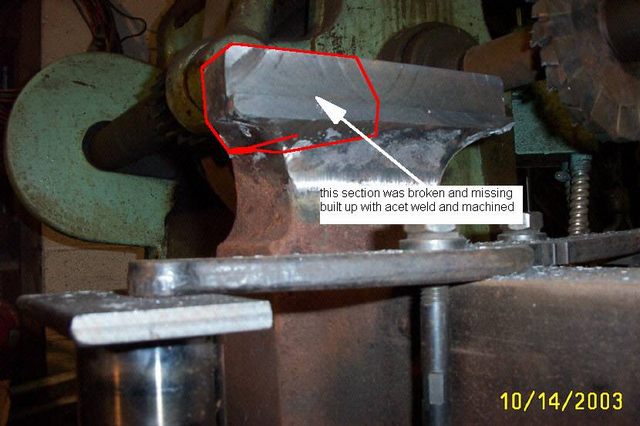
oxy/acet cast iron and it will hold.I have built
up the casting and remachined it for replacable
jaw. It's not really difficult , but does take
some equipment and much heat.
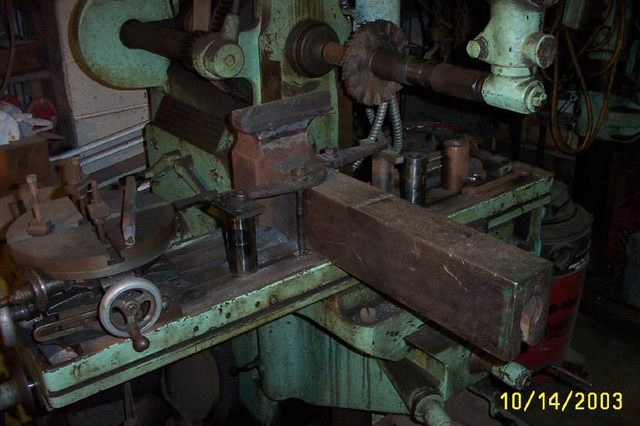
pictures below of a large vice that I repaired
several years ago. If you have questions ,send
me an email.

george

<p align="center">
vice02.jpg
</p>

<p align="center">
vice01.jpg
</p>
 
Well George the one you show is a clone it appears and Puddles it is apparently cast by the sparks. For interest I ground on some steel ,forged and known cast to see the difference.. pretty interesting to know.
All I want to do is dress up that jaw ,especially the top groove and then if I want I can use 2" angle iron on both sides for a wrap. Kinda like the brass wrap jaws. My biggest machine is a 6" angle grinder. I can braze but to be honest I have no idea what filler to use on cast ,never done it.
 

Richard if you decide to weld it here is the procedure I use. I have this saved so I don’t have to retype it all the time! :lol: When you price any of these rods make sure you’re setting down! :shock:


Most of this was taken right out of Lincoln’s book “Metals and How to Weld Them.”

First off there are six different types of cast iron so you need to know the type of cast iron you are dealing with. Manifolds and cylinder heads are Gray cast iron. If preheating can be used, the preheat temperature for shielded arc welding (stick) should be held between 500° and 1200°. When oxyacetylene welding you should preheat between 900° and 1200°. You should never let the object being repaired get over 1450°. Make your repairs, then place the object in your kitchen oven, (if it will fit) at 500° for 24-hours. I would purchase the proper temp sticks from your local welding supply.

Nickel 99 can be cut, drilled, milled, and ground. Ni-55 can be ground. The low nickel rod can't be even ground.


Other suggestions:

Ni-44 for Tig rod

Certanium 889, (stick)

Crown Alloys 255 (stick)

Lincoln Softweld 55 (stick)

Harris / Welco 65 (stick)

Ni-55 (stick)
 
O/A welding of cast iron is more of a specialty and there aren't many people doing it. It's not something you could just pick up the first time you try. Arc welding can work on cast iron but you have follow the proper procedures to a T for what you want to do. Dave
 
Alright cast what?Steel? Its alright to weld cast steel with 7018,if its cast iron you need one of the nickel rods.
There are other rods besides 7018 that will work for cast steel.Cast iron is kind of limited to nickel and some others that are real expensive.
I wouldnt think brazing would hold up,and unless you know what you are doing you could break it by getting it too hot.There are grease pencils that melt at a certain temperature that you need to heat something precisely. 6011 in an AC welder might work on cast steel to build up that jaw.7018 would probably work better for that though.MIG might also work.
If its made in the USA and like that picture I would guess it to be cast steel.If its made in China theres a good chance its like cast iron.
 
I had a vice that had broken jaw plate screws ect, and just shut the vice,( may have used a spacer between the jaws or not) and brazed the original plates in place.

It took a considerable amount of heat to get everything hot enough.

And worked just fine.
 
Just to clarify. I think he's determined it's cast iron. Cast iron like that,requires a lot of preheat no matter how it's repaired. O/A welding uses more heat than brazing because it is hot enough to melt the cast iron rather than just heating it real hot. Brazing could fail because it isn't strong enough or if the vice was used for heating things but not because it got too hot while it was brazed. Temperature markers are called Tempilstiks. 6011 or MIG wouldn't be the best choice. Some vices are steel, most are cast iron though. Where it's made doesn't determine what it's made of. Stating that cast iron is limited to nickel and specialty rods is generally correct but is completely contradictory to your previous post's stating that 7018 is better for cast iron than nickel rods. Maybe you are learning something after all. Now you have even more knowledge. Dave
 
Sodel 35 is the rod I'd use on that. It's a machinable nickle rod.
It's also about ~60 bucks per pound so you need to think about how valuable that vise is first...
You can also use a i/r temperature gun for checking the temp on your preheat if you have one rather than buying the temp sticks if that's handy for you.

Rod
 
Richard, that sounds close to the size of the old large beat up RR vise we used at work 40 years ago. It had gotten damaged, and had one of the ears broken where a hold-down bolt went through. We got some 7018 rod and welded the crack up, and it lasted at least 25 years until it was scrapped.
When the railroads started becoming more alert to safety, they started throwing away any tools that had deep scratches, cuts, welds, etc.
So out went that old vise with the welded ear.

But we really abused that old vise. Without using any heat, we even used it to bend 3 ton chain hoist hooks back into shape that had been used in derailments. We used it like a press a lot of times, using an 8lb sledge hammer on the handle or pipe to put more squeeze on it. A lot of times the handle would have to be straightened back out, too.

I'm really surprised that your vise is cast iron, especially since you said it had been abused. The one we used would never have stood the abuse if it had been cast iron.

If I were you, I would try using 7018 rod on it just to be sure it's not cast steel.
If you wanted, you could try it in an inconspicuous spot by turning it over and see if you can run a bead on the bottom of the base.

BTW, that "anvil" on it is actually just a cover over the screw. You can get away by lightly hammering on it, but I would be careful in doing that.
If yours has been hammered on, I doubt that it's cast iron.
Someone mentioned on a blacksmith forum a couple years ago, that he had seen a lot of vises that had that part broken off by people using them as anvils.

Ronnie
 
Yesterday's Tractor Forums

We sell tractor parts! We have the parts you need to repair your tractor - the right parts. Our low prices and years of research make us your best choice when you need parts. Shop Online Today.

Back
Top