

You should upgrade or use an alternative browser.

Bruce (VA)
Well-known Member
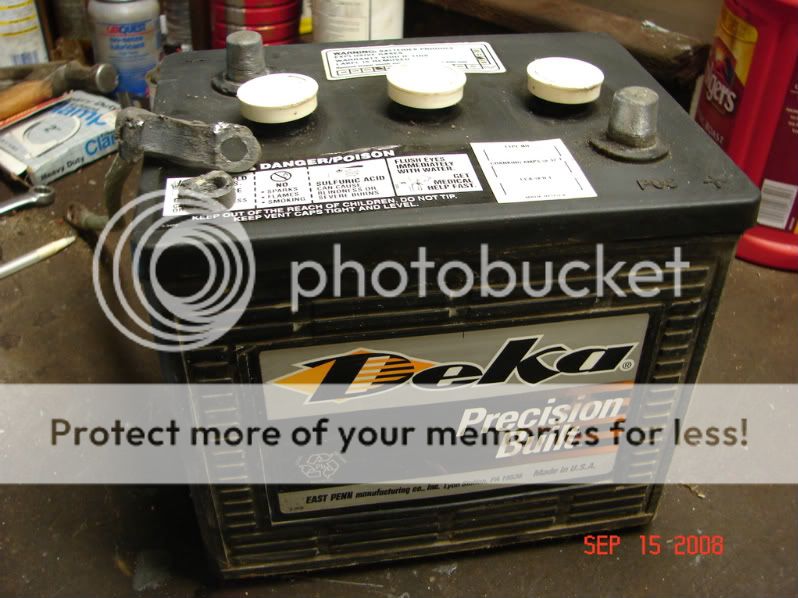
I'm not sure how the PO maintained the battery the first two years of it's life, but given the overall condition of the tractor when I purchased it, my bet is it sat unused most of the time.
I always run the N's to operating temp every 3 or 4 weeks if they haven't been used. To make sure the battery doesn't discharge, all 4 N's now have float chargers.
I also keep everything "clean, bright & tight", use the braided strap & 00 gauge positive cables.
So, in addition to it being a well made battery, doing everything else right probably helped this battery to make it 8 years & 6 months!
It finally refused to turn the 1951 over last September, so I replaced it w/ a new one. Another Deka, model 901MF; cost w/ exchange was $69.
50 Tips

Anonymous-0
Well-known Member
Just noticed you said 9n, no voltage regulator on that but I am sure you catch my drift
(quoted from post at 21:04:26 07/10/09) Will a 6 volt generator charge an 8 volt battery properly?It doesn't seen like that would work.
Not without "tweekin", and try finding an 8v charger.
Either keep the 6v, or go for the gusto, and 12v.
8v is a poor bandaid at the best.
Bruce (VA)
Well-known Member
Bruce (VA)
Well-known Member
J.F. Regan
New User
9N/2N Voltage Regulator Web Page
Anonymous-0
Well-known Member
Thank you very much for consideration of this question.
J.F. Regan
New User
Anonymous-0
Well-known Member

We sell tractor parts! We have the parts you need to repair your tractor - the right parts. Our low prices and years of research make us your best choice when you need parts. Shop Online Today.
Copyright © 1997-2025 Yesterday's Tractor Co.
All Rights Reserved. Reproduction of any part of this website, including design and content, without written permission is strictly prohibited. Trade Marks and Trade Names contained and used in this Website are those of others, and are used in this Website in a descriptive sense to refer to the products of others. Use of this Web site constitutes acceptance of our User Agreement and Privacy Policy TRADEMARK DISCLAIMER: Tradenames and Trademarks referred to within Yesterday's Tractor Co. products and within the Yesterday's Tractor Co. websites are the property of their respective trademark holders. None of these trademark holders are affiliated with Yesterday's Tractor Co., our products, or our website nor are we sponsored by them. John Deere and its logos are the registered trademarks of the John Deere Corporation. Agco, Agco Allis, White, Massey Ferguson and their logos are the registered trademarks of AGCO Corporation. Case, Case-IH, Farmall, International Harvester, New Holland and their logos are registered trademarks of CNH Global N.V.
Yesterday's Tractors - Antique Tractor Headquarters
Website Accessibility Policy