

Electrical help

grandpa Love

Well-known Member
Can I use this meter to check voltage from the coil to distributor on my Fords and cubs? Most are 12 volt. Some coils ain't marked if the have internal resistor or not. If I can use it what do I set it on?
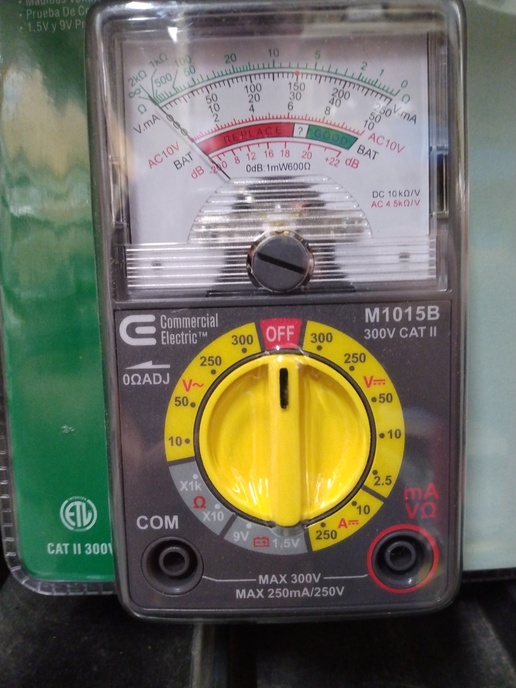
cvphoto94743.jpg
 
Yes you can but if you have a generator on it it will be eradic while tractor is running, better would be an anolog meter. Use the numbers on the right that has the straight line with the dashes below it, on 12V use the 50 setting, on 6V use the 10 setting.
 
Yes you can if you know how to read the scale on the sweep hand. Set it to the lower left gray scale 1K the red simbel there stands for OHMS. A 6 volt coil will have around 1.5 ohms and a 12 volt 3-4 ohms if I remember right. In this case a digital VOM is better since reading the sweep hand with only a 1K ohm scale can be hard to do with such low ohm values
 
Do you want to check voltage or ohm values of a coil?? @ different things. A 12 volt coil will have around 3 ohm resistance and a 6 volt around 1.5 ohms but that is not voltage it is ohm as in resistance and the 2 are totally 2 different things
 
Looks like this in new in the package so I am guessing you are thinking about purchasing it. I would not. It has a 300 volt setting but the meter does not have a 300 volt scale so not sure where it would read if I am seeing it correct. It is an analog meter which I prefer over a digital any day of the week and twice on Saturday. It will read 6 and 12 volt correct using the dc voltage setting of 10 and 50. Always select a higher setting than potential voltage. If I understand you want to check voltage from coil to distributor that is going to be much higher than this meter will read resulting in the meter only working one time. If you intend to read the voltage to the coil from battery it should work fine. For ohm reading you need a meter with a X1 setting for low ohms. The X10 setting basically means the 1 on the ohm range is 10 ohms the X1K means the 1 is 1000 ohms. Just my opinion.
 
It does it is just in the reflection. Find the 150, and go right to the end. Less expensive meters like this work as well as needed. They are sure not a Fluke certified meter, but they do the job. Jim
 
Just some additional info on taking the reading. You would use the lowest Ohms scale, which on this meter is X 10 (a meter with x1 would be better for this application), then you would zero the meter by touching the leads together and adjusting the meter to read zero on the ohms scale with the 0 Ohms adjust, then put the leads across the coil terminals and take the reading. Also you would want to isolate the coil electrically by disconnecting one of the coil wires before taking the measurement. Around 1.5 Ohms is a six Volt coil, around 3 Ohms is a 12 Volt coil. With this particular meter set to x10 1 will represent 10 Ohms so you have to look very closely when reading low resistance.
 
Let me clarify......wire comes in to the coil from the switch. Big wire goes out the top to the distributor cap......I ain't worried about that one. Small wire comes off coil and goes to the side of distributor, condenser and points attach to that stud inside distributor. I want to know how many volts (?) That wire is. I would assume that it's around 12 going in and if coil has an internal resistor it should be 6 or so going to side of distributor. Don't want to cook the points. I had a digital meter, it had a nice little booklet that explains how it works. I loaned to to someone and now they own it.......This one has no instructions with it. Geeze I can build anything out of wood, but struggle with electrical. Just want to know if I need a ceramic resistor in line on my dad's cub. Just put an alternator on it and wanted to check the new coil. Really need a simple answer. This is not my strong suit......
 
Well, it will work. But you get what you pay for. That's a 13 dollar Chinese multimeter from HD. My Fluke 77 cost nearly 200 bucks back in '92. It would cost over $300 to replace it today.

HD sells some quite respectable Klein-branded digital multimeters. The <a href=https://www.homedepot.com/p/Klein-Tools-Manual-Ranging-Digital-Multimeter-MM300/206517192>cheapest is 30 dollars</a> and for a hundred bucks you can get a very nice <a href=https://www.homedepot.com/p/Klein-Tools-True-RMS-Auto-Ranging-Digital-Multimeter-MM700/206517339>True RMS multimeter with frequency and capacitance ranges</a> that will allow you to set up your generator or test motor capacitors.

I really don't understand why anyone would use an analog meter in the twenty-first century. Even a ten dollar HF multimeter is a better test instrument than the beloved Simpson 260. And a ten dollar Chinese analog meter is not a Simpson 260.
 
Mark, I spare no expenses on tools for our real job, building decks and installing fencing. But for a little hobby,where I might use this meter a couple times a year, I hope it gets the job done. I'm cheap sometimes......... Tractors ain't my lively hood.......
 

Instructions found on Home depot website. Use and Care Guide M1015B

You may have better luck just disconnecting the two primary wires and measuring the coil's impedance (ohms) to see if it a 6 or 12 volt coil. The voltage you see will likely change depending on whether or not the points are open or closed.
 
It will work just fine. When measuring resistance, ohms, dont have voltage on the system. Disconnect the two coil wires. Youtube videos are better than trying to describe it. At least for me.
 
Grandpa, great question 'Can I use this meter to check voltage from the coil to distributor on my Fords and cubs?'

NOTE my answer and analysis is actually for measuring 'volts FROM coil TO frame/ground' as I think that's your intention, if NOT let me know. The actual voltage 'FROM coil output TO distributor' would be near zero but subject to current and resistance of the wire... Its voltage from coil to frame/ground thats more important then the resistance and resultant voltage drop in the small wire from coil to distributor terminal for your purposes I believe ?????????


SURE you can use it provide it 'works' and is at least somewhat accurate, even if its NOT as accurate or as perfect as an expensive quality meter, it can still provide at least a useable indication for what you asked about IE ' Can I use this meter to check voltage from the coil to distributor' ???????????????

Set it on the 50 VDC scale (one on right side) so you can read the needle at 12 + or - on the 50 V.ma scale or whatever the battery is and meters accuracy (use 10 for a 6 volt tractor)

NOTE 1) If your points are working and fully closing and NOT badly burned or pitted or carboned over, the voltage FROM THE COIL TO DISTRIBUTOR terminal (Thats what you asked about or intend I think??) with respect to frame ground

1) Should be near zero when the points are closed

2) Battery voltage when the points are open

If you had ignition on AND ENGINE TURNED OVER SLOWLY a meter (or test light) on coils output to distributor with other lead on frame/ground, should flash ON near battery volts when points are OPEN, but OFF zero volts when closed !!!!!!!!!!!!!!!!

NOTE 2 If there were any external series voltage dropping ballast resistor and the switch was on and POINTS CLOSED only then would the voltage on the coils INPUT (from switch NOT to distributor side) with respect to ground be reduced from 12 to 6. If points are open (no current flow no V = I x R drop) voltage on coil with respect to ground would still be battery voltage.


REGARDING YOUR METER


Just because its cheap even if NOT perfect, hey it can still help just as good as if it were an expensive one. It DOES NOT have to be perfect accurate to read volts on coils output to distributor with respect to ground!!!!!!!!!! Cheap or expensive to read volts on coils output to distributor (your question) it should still be near zero points closed and near battery voltage points open

Being an electrical engineer and electrical hobbyist for over 60 years Ive owned a ton of meters and despite having more accurate digital units I STILL LOVE MY OLD SIMPSON 260 ANALOG for its damping characteristics when looking into noisy pulsing arcing brushes etc old tractor generator systems. Actually I like it BETTER them an expensive digital when it comes to 'certain' old tractor generator use yayyyyyyy Simpson for several old tractor applications but YAYYYYYYYY for my expensive Digital for other uses. EACH has its place in my toolbox, I love having options and having BOTH........But thats just me others are entitled to their opinions and what meter to use.....

BOTTOM LINE Yessssssssss you can use that meter if it works and don't need an expensive digital for crude approximate old tractor DC application where perfect isnt required....

Hope this helps and answers your question

Best wishes and God Bless Grandpa, take care now be happy be kind

John T
 
To determine what coil you have and if it needs a resistor, disconnect one or both primary coil terminals (the + and - studs on top).

Set the knob on the meter to X10 ohms. You will be reading the top scale. Touching the leads together should swing the needle to the 0 on the right. If not the battery may be low or there may be an adjustment.

Touch the leads to the coil terminals. Wiggle them around to get a good steady reading.

A true 12v coil, one that does not need a resistor, will show about 3 ohms resistance.

A 6v coil OR a 12v that is designed to operate with a resistor will show about 1.5 ohms.

End result, for a 12v system, you want either a 3 ohm coil and no resistor, or a 1.5 ohm coil used with a 1.5 ohm resistor in series ahead of the coil on the incoming voltage from the switch.

Simply testing voltage before and after the coil will not give you an answer.
 
GP,
There's only one problem with that old school analog meter.
They are not fool proof.
You get the polarity wrong, the meter will go backwards and bend the pointer.
You connect the meter to voltage when on the resistance scale, the smoke will leave the meter. Ask me how I know?

Your meter is better than some digital meters when measuring charging voltage.
Some digital meters will dance all over because the charging voltage isn't steady.

When your points are open, you should get full battery voltage on the + of coil.
When your points are closed, you will get less than full battery voltage because some is used by ballast. My rule of thumb, 6v on coil and 6v on ballast will usually mean 4 amps in coil. Your meter can't measure 4 amps. 250 ma, quarter of an amp.
If you have negative ground, the voltage at coil will be positive.
BE CAREFUL, you get the polarity right, Use the largest voltage scale to prevent banging the pointer is you get the polarity wrong.

Another negative about they meter, It doesn't respond well to gravity, dropping it.
Keep it in a clean place too. Metal particles will find their way to the magnet in meter movement.

Good chance you make one mistake and the meter won't forgive you.
 
(quoted from post at 09:13:25 07/16/21) GP,
There's only one problem with that old school analog meter.
They are not fool proof.
You get the polarity wrong, the meter will go backwards and bend the pointer.
You connect the meter to voltage when on the resistance scale, the smoke will leave the meter. Ask me how I know?

Your meter is better than some digital meters when measuring charging voltage.
Some digital meters will dance all over because the charging voltage isn't steady.

When your points are open, you should get full battery voltage on the + of coil.
When your points are closed, you will get less than full battery voltage because some is used by ballast. My rule of thumb, 6v on coil and 6v on ballast will usually mean 4 amps in coil. Your meter can't measure 4 amps. 250 ma, quarter of an amp.
If you have negative ground, the voltage at coil will be positive.
BE CAREFUL, you get the polarity right, Use the largest voltage scale to prevent banging the pointer is you get the polarity wrong.

Another negative about they meter, It doesn't respond well to gravity, dropping it.
Keep it in a clean place too. Metal particles will find their way to the magnet in meter movement.

Good chance you make one mistake and the meter won't forgive you.

ell, grandpa, my heart goes out to you, because if you came here confused, you will go away either more confused or feeling insane, as there is a lot of bogus/conflicting stuff/opinions expressed here. I need to write a book to address each one &amp; do not intend to. I will try to help a little.
1) that meter is useless to use in measurinf 1.5 or 3 ohms. Reason: loweat scale is X10....that means that the 1 on right side of Ohms scale is 10 Ohms, thus each little hash mark between 0 and 1 represents 2 Ohms. So, you might guess that a needle pointing somewhere between 0 and the first little hash mark is somewhere around 1 Ohm. Now it is highly likely that the meter and leads, connections, etc. will render even that guess less that close. Document says +/-5% accuracy. IF that is 5% of full scale, that means +/- 0.05 X 20,000= +/- 1000 Ohms. If it means 5% of any reading, then 5% of 1 Ohm is real precision (don't expect that. It may mean 'as a percent of the swing of the arc'? If all the stars align correctly, you might determine a 1.5 vs 3 Ohm coil in a side by side comparison in that the larger will move the pointer twice as much as the smaller one. That is probably the best you can hope for.
You idea of the voltage on connection between coil and distributor is wrong. You will not see 6v there (on 12v system) ever. You will see 12v when points open and Zero volts when pints closed. Hope a little bit helpful.
 
> You idea of the voltage on connection between coil and distributor is wrong. You will not see 6v there (on 12v system) ever. You will see 12v when points open and Zero volts when pints closed.

I assume he meant the voltage from the positive primary coil terminal to ground, and that there's a ballast resistor in the circuit.

The voltage from the negative coil terminal (coil/distributor connection) to ground is the very useful voltage drop across the points. Although you won't get a particularly good measurement with a meter whose smallest DCV scale is 2.5 volts.
 

Use the 0-100 scale times 3 . As low end as it is . That meter is vastly superior to donking around with a test
Light .
 
Yesterday's Tractor Forums

We sell tractor parts! We have the parts you need to repair your tractor - the right parts. Our low prices and years of research make us your best choice when you need parts. Shop Online Today.

Back
Top