

Bench top mill comparison

Dave41A

Member
Good evening. I'm looking at getting into some light machining. From work years ago I had some experience with JET benchtop mills. There's a bunch (Enco, Grizzly, etc) that are all clones of an older Rong-Fu model. They worked well for us. I cannot justify the space or cost of a Bridgeport mill. I will be buying used.

These mills seem to have two different cast iron bases. On some the cast iron base come up on the mill column shaped like an octagon. On others it is boxy, almost square. Does anyone know if there is a difference? I posted some pictures to show the difference. Both of these are marketed as the JMD-15. I have also heard there is a difference in the diameter of the column, but cannot find this info. Thanks in advance. Dave

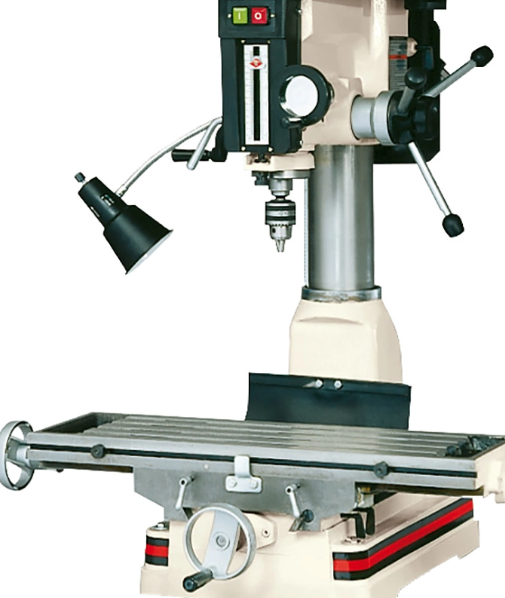
octagon.png
square.png
 
I can't imagine either one of those would be very rigid, which is important when milling. More so than a lathe.

If you can find a knee mill, you'd be happier.

cover29.jpg

pivot roller780.jpg

This is the modern day clone of the old Clausing 8520. They're available from a number of vendors. https://www.grizzly.com/products/grizzly-8-x-30-1-1-2-hp-vertical-mill-with-power-feed/g0731

I did NOT pay 7K for mine. I bought it back around 2007 for around $1100 new. I don't know how guys afford these things nowadays.

It's a reasonably rigid machine. Not as much as I'd like, but I can usually work around its shortcomings. Smaller cutters, smaller DOC, etc.......... I wish it had a bigger table, more clearance beneath the spindle, and a dovetail head that extends towards the front of the table. But, it's reasonably easy to move, and has a very small footprint.

It took me around 20yrs to finally put a set of decent way covers on it. That's been the only upgrade, besides the coolant tray, that I've done in all the years I've owned it. It's been a trouble free machine.

Despite its diminutive size, it is a "real" milling machine in most respects.

exhaust flange742.JPG

It'll do about everything a big boy will do...........just on a smaller scale. These aren't toys.

winterizing6.jpg

I work in exceptionally tight quarters. So.........although I'd like a full size Bridgeport..........this small machine has worked out well in the confined space available. You do the best you can do with what you have. Budgets, available space, and other things, all force us to make choices.

The one thing that you'll find.......................... YOUR TOOLING WILL COST MANY X THE COST OF THE MACHINE
itsok.gif


Machine tools are the one thing where size really matters. Size means weight, which means rigidity. Buy the heaviest damn thing you can afford, or have room for.

IMHO
 
The biggest issue that the mills you have shown is the spindle design. You know the saying, "A chain is only as strong as the weakest link" If does not matter how rigid the rest of the machine is if the spindle is not rigid. Compare a real mill spindle to the spindles on the ones in your pictures. Depending on what you want to do, they might work for you, BUT be aware the spindles shown in your pictures will not do any real milling.

Spindle comparison.jpg
 
Good evening. I'm looking at getting into some light machining. From work years ago I had some experience with JET benchtop mills. There's a bunch (Enco, Grizzly, etc) that are all clones of an older Rong-Fu model. They worked well for us. I cannot justify the space or cost of a Bridgeport mill. I will be buying used.

These mills seem to have two different cast iron bases. On some the cast iron base come up on the mill column shaped like an octagon. On others it is boxy, almost square. Does anyone know if there is a difference? I posted some pictures to show the difference. Both of these are marketed as the JMD-15. I have also heard there is a difference in the diameter of the column, but cannot find this info. Thanks in advance. Dave

View attachment 169770View attachment 169771
A drill spindle is designed to take axial thrust loads, without much side load. Those drill press mills might be OK for occasional wide tolerance woodworking or maybe for machining light plastics, but I would not use them for metalworking.
 
Thanks for all the responses. Two questions remain:

1) What's the difference between the castings in the original photo?
2) What's the difference between a "bridgeport" and a "knee mill" other than the manufacturer? Aren't they the same thing?
 
I can't imagine either one of those would be very rigid, which is important when milling. More so than a lathe.

If you can find a knee mill, you'd be happier.

View attachment 169782
View attachment 169783
This is the modern day clone of the old Clausing 8520. They're available from a number of vendors. https://www.grizzly.com/products/grizzly-8-x-30-1-1-2-hp-vertical-mill-with-power-feed/g0731

I did NOT pay 7K for mine. I bought it back around 2007 for around $1100 new. I don't know how guys afford these things nowadays.

It's a reasonably rigid machine. Not as much as I'd like, but I can usually work around its shortcomings. Smaller cutters, smaller DOC, etc.......... I wish it had a bigger table, more clearance beneath the spindle, and a dovetail head that extends towards the front of the table. But, it's reasonably easy to move, and has a very small footprint.

It took me around 20yrs to finally put a set of decent way covers on it. That's been the only upgrade, besides the coolant tray, that I've done in all the years I've owned it. It's been a trouble free machine.

Despite its diminutive size, it is a "real" milling machine in most respects.

View attachment 169784
It'll do about everything a big boy will do...........just on a smaller scale. These aren't toys.

View attachment 169786
I work in exceptionally tight quarters. So.........although I'd like a full size Bridgeport..........this small machine has worked out well in the confined space available. You do the best you can do with what you have. Budgets, available space, and other things, all force us to make choices.

The one thing that you'll find.......................... YOUR TOOLING WILL COST MANY X THE COST OF THE MACHINEView attachment 169788

Machine tools are the one thing where size really matters. Size means weight, which means rigidity. Buy the heaviest damn thing you can afford, or have room for.

IMHO
There's a Gorton, 2 Bridgeports, Ex-cell-O, Mill-rite, and Rambuadi available locally for under $1500. The BP are the only two over 1000. But moving them is the challenge. Which is why I was looking at the bench mill. Dave
 
I have a “foreign” knockoff of the same size. It will do any thing I need it to. So I’m assuming either one of those would work well.
Thank you. An "AI" search says the octagon casting is for a 3.5 inch column, while the square means a 4.5 inch column. The 4.5 is the Jet-18, while the 3.5 is the Jet-15. But that's AI.
Do you have the octagon on the square base?
 
There's a Gorton, 2 Bridgeports, Ex-cell-O, Mill-rite, and Rambuadi available locally for under $1500. The BP are the only two over 1000. But moving them is the challenge. Which is why I was looking at the bench mill. Dave
So, it looks like we're pretty much leaning towards a small round column machine. That's cool
tkqe4fh-smiley-two-thumbs-up175028_285604.gif


Get the largest diameter column you can find. Larger diameter means more resistance to deflection...............more rigid.

As a general rule....................a machine with tapered roller bearings supporting the spindle will handle radial loads better. Look for that feature. Look for parts diagrams online, etc. Hopefully you can find a diagram close to what you're considering buying. Keep in mind that the only difference between most of these machines is the badge......................most are virtually identical machines, just sold under different names.

Now, a quick tutorial on dealing with less than desirable rigidity.

Use smaller diameter mills. Maybe max out at around 1/2" diameter.

Take small cuts. You can do good work, it just takes longer.

Instead of buying an indexable face mill with individual carbide cutters.................invest in a cheap fly cutter, some HSS blank stock, and a bench grinder. You can grind your own tooling. Fly cutters are stable, and use less power.

End Mills...................................

When dealing with less power, and less rigidity, you need something that cuts easily.

Roughing End Mills

A regular end mill
pivot roller304.jpg

This type of mill requires a very rigid setup, and more power to cut. ESPECIALLY IF YOU'RE SIDE MILLING. And, if you need to run a larger diameter............this one is a 3/4" end mill.

pivot roller305.jpg

Excessive stickout, lack of rigidity..................... The tool will chatter, and rapidly dull. You could do smaller pocket cuts all the way to the bottom of the workpiece........but it's still too much stickout for the cutting forces required.

Let's grab one of my favorite go-to tools.................

pivot roller307.jpg

This is a "rougher" You can see how each tooth takes a small bite of the apple. Less power, extremely fast compared to a finish mill.

pivot roller311.jpg

FULL DEPTH FULL WIDTH CUT


pivot roller312.jpg

Does what I need it to do.........without drama, and CHATTER.

pivot roller153.jpg

pivot roller152.jpg

This style end mill will make it possible for you to work with a small mill/drill. There's always a work around.

EDIT: Substituted "radial" for "axial"
 
Last edited:
Also..............a word about used machine tools...............

The internet is full of guys that claim that they scored a pristine used machine. I mostly call BS on that. If it's "affordable", it's probably clapped out. You get what you pay for.

Unless you've been at this for quite a while, it's very hard to check a machine for wear. You have to show up with a dial indicator, and the knowledge to know where to use it. It's tough for someone who hasn't dealt with old stuff.

The idea is to MAKE PARTS. You can't make good parts on a loose, or worn machine. Ways that are worn can kill your accuracy.

Then, you're facing reconditioning the machine. That gets expensive fast.............unless you know how to scrape ways, and have the tools to check your work. It's very complicated.........or more accurately..........it takes very expensive tools to accomplish. If you need outside labor, it gets expensive. DYI, or outsourcing,,,,,,,,,,,,,,,,,,,,,,,,,,,,,,,,,,,you can triple, or quadruple (Hell, even more than that), the price of that bargain you dragged home.
 
There was a thread in Tractor Tales that lamented the lack of younger folks coming on the forum.

I have, for years, commented on this. I simply don't know how young people..........who generally don't have much money.......get into welding, and machining.

My welding equipment is is in the 5 figures. Same with the machine tools. I collected the stuff over 30yrs. AT SUBSTANTIALLY LOWER PRICES THAN TODAY. I don't know how people afford a small shop.

I see guys buying the cheap crappy welders. They're doing the best they can do. But......in the long run, they'll be disappointed when those machines let that magic blue smoke out. This stuff simply doesn't hold up.

I bought a new lathe.................an offshore offering. I had to do extensive work to make it useable. I dunno if most folks are capable of that........AND EVEN HAVE THE MACHINE TOOLS TO DO IT. The vendor paid for all my parts (mostly bearings), but if I wasn't a guy that knew what he's doing.......I'd have an expensive paper weight, or a protracted fight for a refund. Fortunately I bought cheap Chinese made stuff WHEN IT WAS STILL CHEAP. That lathe is over 2X more expensive at today's price.

lathe setup36.JPG

lathe setup25-1.JPG

The spindle bearings were either defective, or preloaded improperly. The vendor paid for brand new, quality, P5 bearings. I did the work. Everybody was made whole..................and I'm damn sure he didn't want to do a refund.
 
lathe setup131.JPG

The tooling I had to build in order to rebuild the spindle to my standards.

If you're not bucks up, you're fishing from the bottom of the barrel. You better be sure that you have the skills to make a silk purse out of a sow's ear.
 
Thanks for all the responses. Two questions remain:


2) What's the difference between a "bridgeport" and a "knee mill" other than the manufacturer? Aren't they the same thing?
Knee mill is a type of lighter duty milling machine that is great for hobbyists.

“Bridgeport” is probably the most popular brand, and one of the original manufacturers of knee mills. While there were a few other old line names that built a mill competitive with Bridgeport, the majority of import clones are based on the Bridgeport design.

As to moving a Bridgeport, mine sits up on a few inches of blocking that lets me slide a pallet jack under it.
 
Last edited:
Yesterday's Tractor Forums

We sell tractor parts! We have the parts you need to repair your tractor - the right parts. Our low prices and years of research make us your best choice when you need parts. Shop Online Today.

Back
Top
